Page 20 of 34

Charles F. Wooley

Charles F. Wooley

Charles F. Wooley

Charles F. Wooley (1929-2008) was one of the earliest full time academicians in the Division of Cardiovascular Medicine and was Director of the Cardiology Catheterization Laboratory (1963-1971). After establishing the Overstreet Cardiovascular Teaching and Research Laboratory, Wooley served as its Director from 1982 to 1991. Notable contributions from this lab were the studies of left bundle branch block which became the basis for biventricular pacing, aortic physiology and pathology, connective tissue disorders, and his family study.

Early on, prior to most contemporary cardiologists, Wooley became interested in pacemakers and electrophysiologic studies. These early EP studies defined mechanisms of atrial arrhythmias and atrial conduction disorders (he was one of the first to do such studies). He was an expert in angiography of valvular and congenital heart disease, including some innovative studies with upright posture. He also pioneered intracardiac sound and hifidelity pressure recordings.

Wooley’s major areas of interest were mitral and tricuspid disease, mitral valve prolapse and MVP syndrome (for which he developed the definitive classification and disease mechanisms), function and disorders of the aorta, cardiovascular manifestations of connective tissue disorders, and his family with familial cardiomyopathy – the studies of which evolved over 35 years (1st publication in 1972) and eventually defined the natural history, genetic basis, pathology, and therapy. This study identified the appearance of hereditary disease in middle life and its progression from arrhythmia to muscle disease.

After retirement in 1992, he remained active in the Division of Cardiovascular Medicine. As his interest in medical history grew in the 1990’s, he along with others developed the Medical Heritage Center at The Ohio State University Health Sciences Library in 1997.

In the last half of his academic career, Wooley became a world renowned historian. Wooley’s interest in the historical aspects of mitral valve prolapse began with realization that MVP was not a new disease. DaCosta’s original work during the Civil War in which he described midsystolic clicks in “disabled” soldiers led Wooley to uncover the MVP story. Wooley wrote nearly twenty papers on this story and compiled them in his book, “The Irritable Heart of Soldiers and the Origins of Angelo-American Cardiology” published in 2002. He was also the author of “Academic Heritage: The Transmission of Excellence” (1992), “The Second Blessing: Columbus Medicine and Health The Early Years” (2006) and countless articles and papers.

The MHC also sells copies of some of his publications: https://hsl.osu.edu/dept/medical-heritage-center/publications-and-scholarship-0
James V. Warren

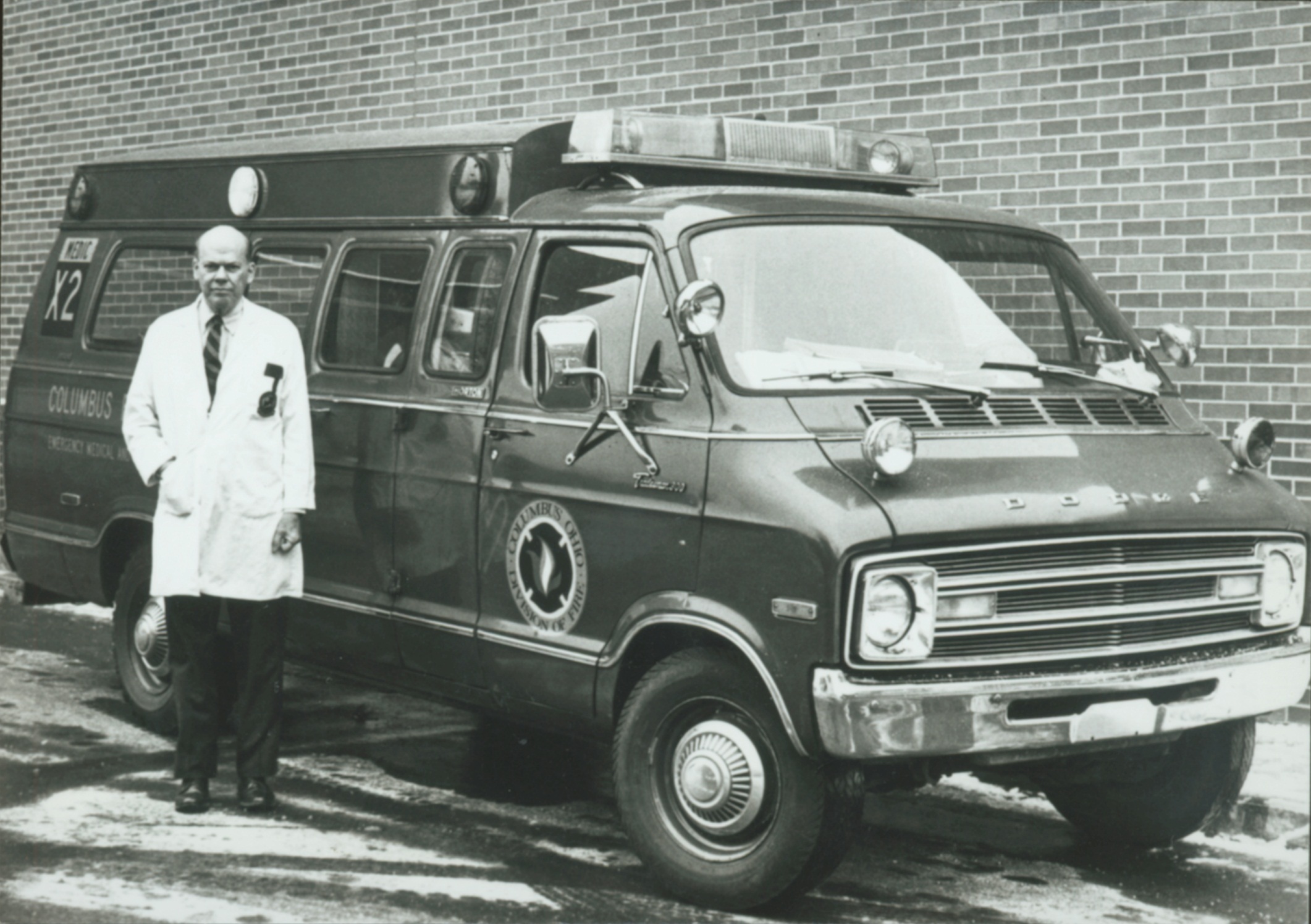
James Warren with the Heartmobile

James Warren with the Heartmobile

James Vaughn Warren (1915-1990) was an internationally renowned cardiologist and the former Chair of Medicine at The Ohio State University from 1961-1979.

Warren graduated from The Ohio State University in 1935 with a B.A. in chemistry and from Harvard Medical School in 1939 with his medical degree. He served in residency at Peter Bent Brigham Hospital in Boston and later taught medicine at Emory University Medical School, Duke University Medical School, University of Texas Medical School and The Ohio State University.

Warren gained worldwide recognition for 50 years of work in cardiovascular research and for his important contributions to the understanding and prevention of sudden cardiac death. He authored many scientific and educational publications dealing mostly with congestive heart failure and blood flow. He was one of the first physicians to use cardiac catheterization for diagnosing heart problems and helped to define the mechanisms of congestive heart failure. In 1988 he was honored by the Columbus USA Association in his native city of Columbus for his creation of the Heartmobile, a coronary emergency unit that is credited with saving thousands of lives in the city.

The Medical Heritage Center has an archival collection about Dr. Warren and the finding aid for it can be viewed at https://hsl.osu.edu/mhc/pdf/dr-james-v-and-gloria-k-warren-collection.

Richard L. Meiling

Richard Meiling

Richard Meiling

Richard Lewis Meiling (1908-1984) received his BA from Wittenberg College in 1930, and his MD from the University of Munich in 1937. He maintained a long career in the military and pioneered air evacuation for the allied armies in World War II. Upon returning to the States, Meiling was a professor at OSU (1947-1960) and served as Dean of the College of Medicine (1961-1970). Among other things during his tenure as Dean, Meiling obtained art glass panels for the College documenting its history (featured on the 1st floor of Meiling Hall); a mosaic for Prior Hall; and, an official seal for the College of Medicine.

The Medical Heritage Center has an archival collection about Dr. Meiling and the finding aid for it can be viewed at https://hsl.osu.edu/mhc/pdf/richard-l-meiling-md-collection.

Lighting Standards

In the 1950’s, the OSU Institute for Research in Vision, led by H. Richard Blackwell, played a leading role in developing specifications and international standards for lighting. Read this article by Blackwell to learn more:  http://www.iesna.org/PDF/100Papers/074.pdf

Nursing Curriculum Changes

In 1958 fifteen top students to the class were invited to participate in an accelerated program that was considered an experiment for an honors program. The outcome was the students achieved at a high level and that clinical time could be markedly reduced without jeopardizing learning. Based on the findings a new curriculum was developed for all BSN students. The new curriculum was implemented in 1962.

Robert M. Zollinger

Robert Zollinger

Robert Zollinger

With a career that spanned much of the 20th century, Robert Milton Zollinger (1903-1992) was respected by his peers, feared by his students and loved by his patients.  In 1955, working with Dr. Edwin Ellison, he discovered the Zollinger-Ellison Syndrome, which dealt with the relationship between non-beta islet cell tumors of the pancreas and diseases of the gastrointestinal tract.

Zollinger also co-authored the Atlas of Surgical Operations, a textbook currently in its ninth edition.

The Medical Heritage Center has an archival collection about Dr. Zollinger and the finding aid for it can be viewed at https://hsl.osu.edu/mhc/pdf/robert-m-zollinger-md-collection.

Lionel Topaz Memorial Library of Visual Science

The Lionel Topaz Memorial Library of Visual Science was dedicated October 31, 1955 and was located in Fry Hall. In 1987, due to cost increases and difficulty in maintaining a current optometry collection, the Topaz Library merged with the Health Sciences Library. At the time of its closing, the Topaz Library with its approximately 4,000 volumes was the largest, most complete optometry library in the world and was the oldest departmental library at Ohio State.

Lionel Topaz was born in Russia May 15, 1875. He moved to England in 1897 and came to America 1903. He married in Boston in 1904 and had three children, Mae, Oscar, and Martin. Topaz established “The Optometric Weekly” in 1910 and founded The Professional Press, Inc. in 1919. He was the publisher of numerous books in the field of visual optics and a close friend of Charles Sheard, first director of the OSU Applied Optics program and for whom Ohio State’s Sheard Foundation for Research in Vision is named. Topaz died in Chicago, Illinois on July 23, 1942.

The oldest book from this library collection is a 1704 edition of Opticks by Sir Issac Newton that is part of the Medical Heritage Center rare book collection and can viewed during their open hours or by appointment.

The Medical Heritage Center also has an archival collection from the Topaz Library and the finding aid for it can be viewed at: https://hsl.osu.edu/mhc/pdf/lionel-topaz-memorial-library-visual-science-collection

William H. Havener

William H. Havener, MD (1923-1991) was the first full-time ophthalmologist at The Ohio State University College of Medicine (1959-1961) and chairman of the Department of Ophthalmology. After being appointed chairman in 1959 at age 35, Dr. Havener established an innovative teaching program for residents. Dr. Havener became interested in repairing retinal detachments, and developed a technique using a donor fascia lata for scleral buckling. He was dedicated to residents and student teaching and set up a number of formal instruction programs for both the medical school and residency. A distinguished teacher and internationally known author, Dr. Havener was an innovative and skillful surgeon, thoughtful citizen, an avid gardener, and most of all, a considerate and caring physician.

The Medical Heritage Center has an archival collection about Dr. Havener and the finding aid for it can be viewed at https://hsl.osu.edu/mhc/pdf/william-h-havener-md-collection.

Gillette Hayden

Gillette Hayden

Gillette Hayden

Gillette Hayden (1880-1929) was the great-granddaughter of Horace Hayden, one of the founders of the first dental college in Baltimore, and she gained fame for her achievements in periodontics.

Dr. Hayden was valedictorian from East High School in Columbus, Ohio.  She went on to become the third woman to graduate from the dental department of Ohio Medical University in 1902.  After taking some post-graduate work at Northwestern Dental School, she began a general practice of dentistry in Columbus in 1903.  In 1905 she traveled to Europe to introduce methods and treatment of periodontal diseases developed by the late Dr. D.D. Smith of Philadelphia.  In 1908 she returned to Columbus, devoting her practice exclusively to periodontia.

In co-operation with Dr. Grace Rogers Spalding of Detroit, Michigan, Dr. Hayden helped form the American Academy of Periodontology in 1914.  Dr. Hayden was president of the group in 1916, was later elected fellow, and served almost continuously on the executive council until her passing.  She also served as president of the Federation of American Women Dentists in 1923 and was elected secretary of the periodontia section of the International Dental Congress in 1925.  In addition to being a member of the National Dental Association, she was also a member of the Ohio State and Columbus Dental Societies, the Northern Ohio Dental Association and the Central Ohio Dental Association.

Dr. Hayden also worked in the equal rights movement and helped found the Columbus branch of the National Altrusa Club.  In 1925 she was elected president of the National Association.  She was a vibrant member of the community and was actively involved in many more groups and organizations.

The Medical Heritage Center has an archival collection of Dr. Hayden’s and the finding aid for it can be viewed at https://hsl.osu.edu/mhc/pdf/gillette-hayden-collection.

Master of Science in Nursing

In 1954, a master of science program in nursing was developed with a focus in Medical Surgical Nursing, Psychiatric Nursing and Pediatric Nursing and prepared nursing students for an education or leadership position.

This program was the first master’s program offered by a public university in Ohio.  The master’s program in nursing received its initial accreditation from the National League of Nursing in 1955.

« Older posts Newer posts »