Year: 2012 (page 1 of 5)

Holiday Hours

The Medical Heritage Center reading room hours are affected due to the upcoming holidays. Please see below:

December 24 – 25: closed for Holiday
December 26-31: please contact Carol Powell for assistance
January 1: closed for Holiday
January 2 – 4: by appointment

MHC Quick Info Session Wednesday

Location: First floor collaborative space, Prior Hall

Join us for the Quick Information Session on Wednesday, December 12 from noon-1:00pm in the first floor collaborative space behind the Desk:

“Treasures from the Medical Heritage Center”

Curators will be showcasing hidden treasures from the MHC collections. If you are curious about the services and artifacts that the Medical Heritage Center houses on the fifth floor of Prior Hall, this is a great opportunity to learn more!

Featured treasures will include

–          Swamp root cure

–          Dental cabinet (shown through images, not in person)

–          Jimmy Buffet eyewear

–          Bound human skull

–          Wax moulage and book

–          Suppository pill press

–          Newton’s Opticks (1704)

–          Nightingale’s Notes on Nursing (1860)

–          OSUWMC Service Board poster

–          Dr. Pavey Collection booklet

St. Francis Hospital and Starling Medical College

St. Francis Hospital and Starling Medical College

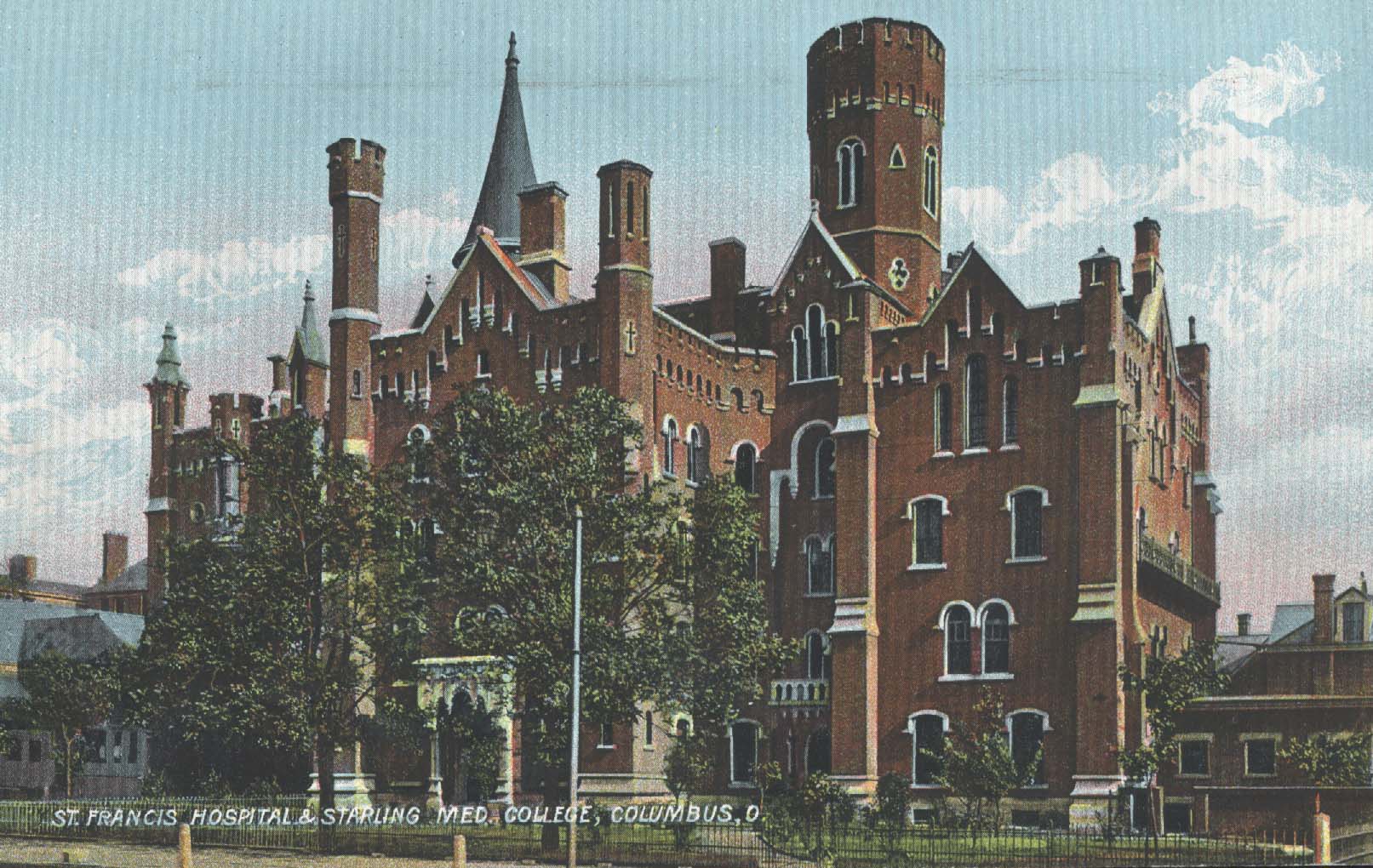
Built in 1847 at 311 East State Street (present site of Grant Medical Center), this Norman Gothic structure was the first to combine patient care and clinical teaching in the same facility in the United States. St. Francis Hospital comprised two-thirds of the building with Starling Medical College housed in the remainder.

Starling Medical College (one of six predecessor schools to the OSU College of Medicine) was in operation from 1847 to 1907 and named in honor of Mr. Lyne Starling, who donated the land and $35,000 for the new building. During its tenure, the College had 2,600 graduates.

Initially lacking funding to complete the hospital part of the building, Dr. Richard L. Howard, a Starling Medical College trustee, provided money to open the “Howard Infirmary.” Managing this facility proved to be overwhelming and the Infirmary closed in the 1850s. Because of the lack of medical facilities in Columbus at this time, local physicians organized a move to bring a group of nuns to the Columbus community to serve as health care workers in 1861. In 1865, a 99-year lease was granted to the Sisters of the Poor of St. Francis to operate the hospital. In 1929, the Sisters organized a School of Nursing which moved to St. Anthony’s Hospital in 1955 when St. Francis Hospital closed. St. Francis Hospital was razed in 1957.

*Part seven of a seven part series highlighting the history of Columbus medical centers.

MHC Closed Thursday and Friday

In observance of the University holidays, the Medical Heritage Center is closed November 22 and 23.

Starling-Loving University Hospital

Starling-Loving University Hospital

In 1917, The Ohio State University Board of Trustees announced that the abandoned homeopathy building would be incorporated into a new hospital for the medical school. A modified English Tudor addition to the homeopathic building made the hospital operational in 1924. The building was renamed Starling-Loving University Hospital in honor of Mr. Lyne Starling, a community leader and benefactor of Starling Medical College, and Dr. Starling Loving, dean of Starling Medical College (1880-1905).

By 1926, with the addition of three wings, the hospital housed 296 beds, an operating amphitheater, laboratories, a maternity department and an outpatient clinic. The main purpose was clinical teaching.

When The Ohio State University Hospital was built in the 1950′s, all hospital practices moved there. Starling-Loving University Hospital was renamed Starling-Loving Hall in 1961. It no longer serves as a hospital facility but houses offices and classrooms.

*Part six of a seven part series highlighting the history of Columbus medical centers.

Mount Carmel Medical Center

Mount Carmel Medical Center

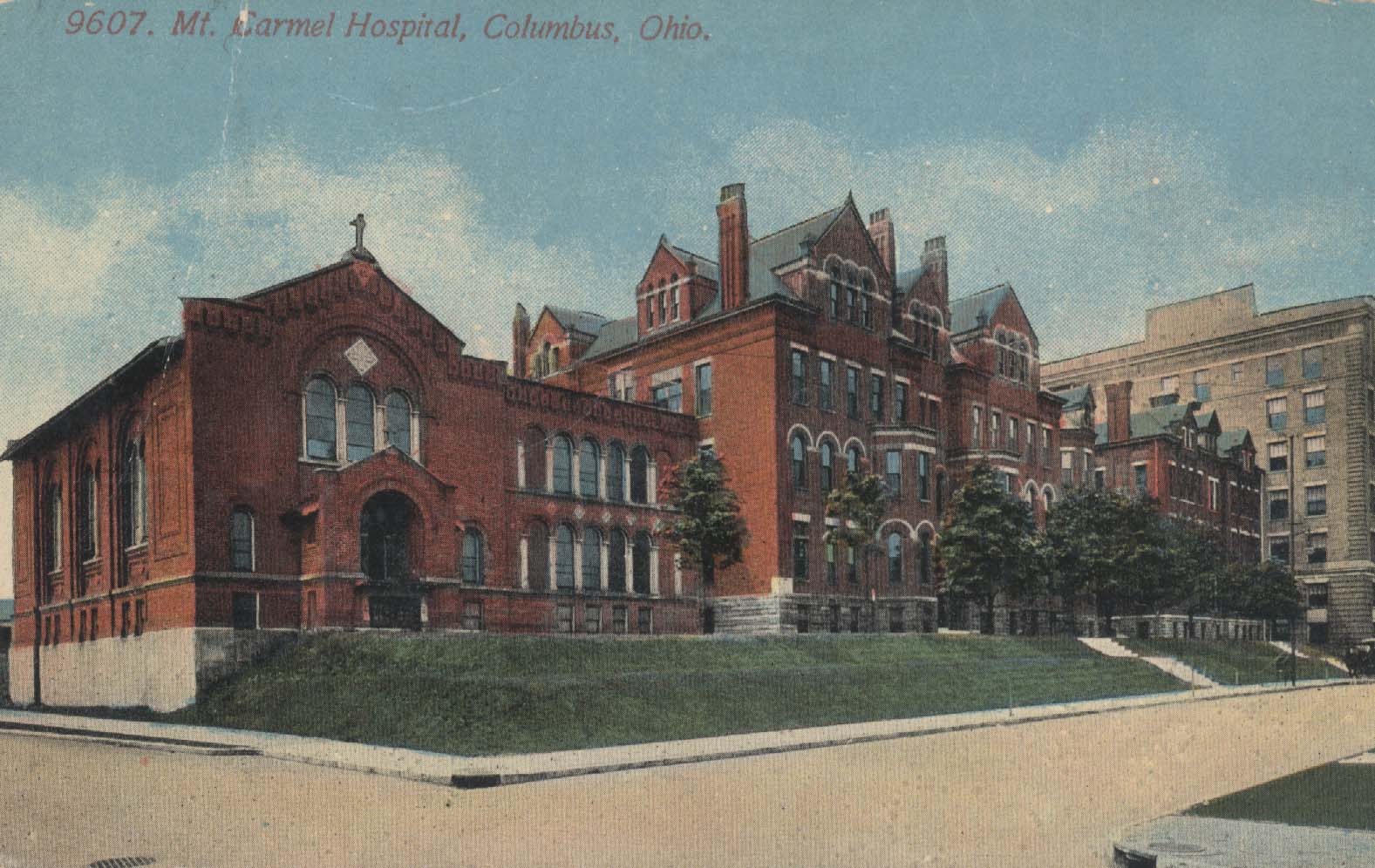
Hawkes Hospital of Mt. Carmel was founded by Dr. W. B. Hawkes (1812-1883). He donated land and gave $10,000 in United States Government bonds. Before the building was completed, Dr. Hawkes died and Dr. John W. Hamilton (1823-1898) completed the work. Dr. Hamilton secured the services of the Sisters of the Holy Cross, and formally opened the hospital in 1886. The hospital was located on West Street and Davis Avenue.

The first addition to the hospital was made in 1891. In 1906 a second building adjoining the old one was started. It contained a chapel and 120 additional private rooms for patients. Another building, consisting of 120 rooms with recreation halls, library, and three classrooms was erected and opened in 1921. This was the home for the student nurses. In 1934, on a lot to the west of the hospital, and connected with the hospital, a building for convenience of the Sisters was erected. It was a gift of Mrs. Neill Darrow.

From 1876 to1892, the hospital was operated in connection with the Columbus Medical College.

The Training School for Nurses was opened in 1903. The first graduates received their diplomas in 1906. Eight Sisters were included in the class. The school still exists today and is now the Mount Carmel College of Nursing.

Today this location is known as Mount Carmel West and is one of the four facilities that comprise the Mount Carmel Health System.

*Part five of a seven part series highlighting the history of Columbus medical centers.

Children’s Hospital

Children’s Hospital

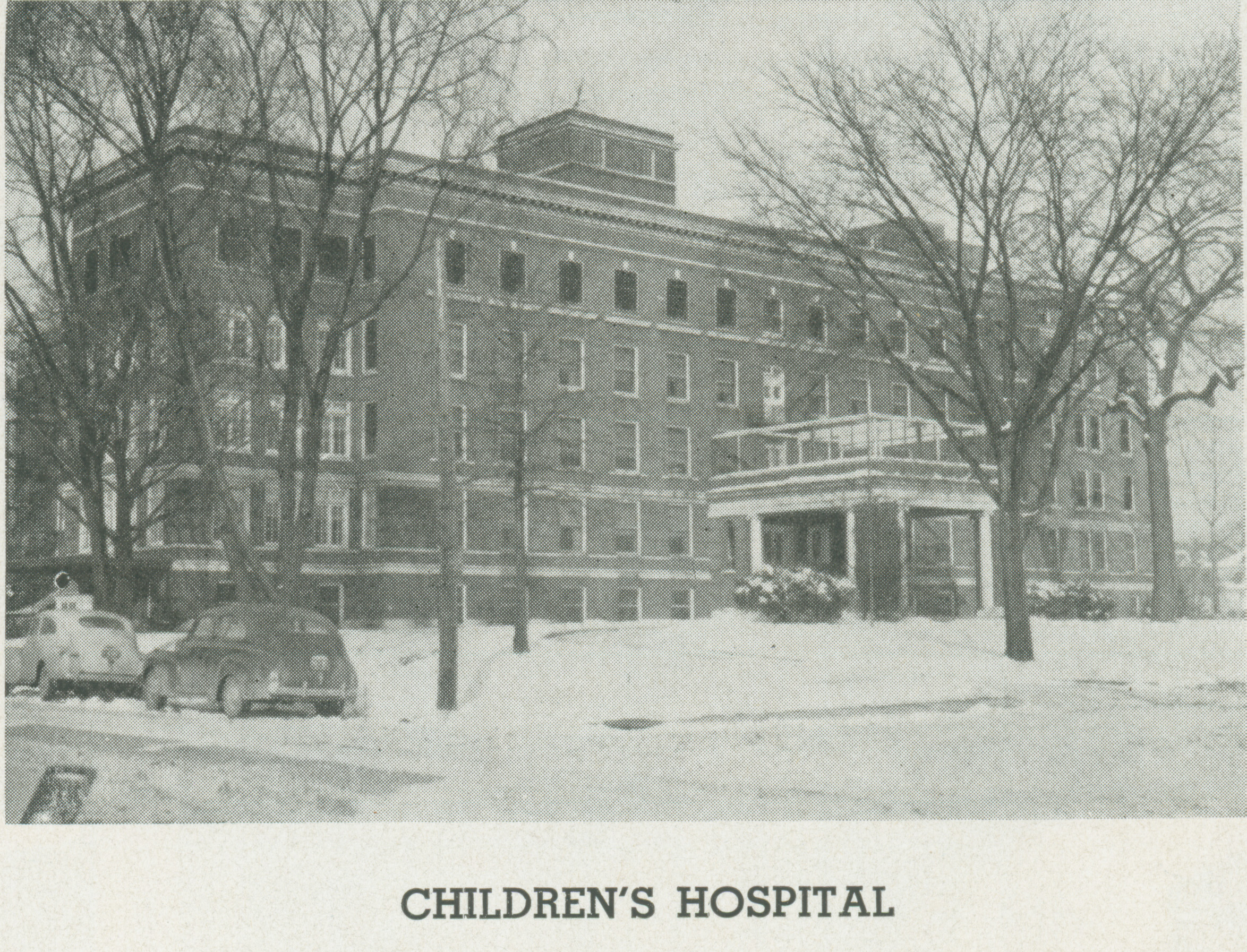
Hospitals for children began to appear in the United States in the late 1800s. Members of the King’s Daughters of St. Paul Episcopal Church initiated the movement to secure a children’s hospital in Columbus in 1891.

The first Children’s Hospital building opened in 1891. The prevailing color scheme was blue and white, carried out in staff uniforms, chinaware, linens and bedding. Originally Children’s Hospital had four beds. Six more were added almost immediately. The hospital was open to patients between the ages of one and sixteen; no patient could stay longer than three months; and, no cases of infectious disease were accepted.

Eventually, the hospital outgrew its original building and moved to new facilities in 1924 at 17th and Stone Streets, fronting Livingston Park. The hospital is now known as Nationwide Children’s Hospital. It is home to the Department of Pediatrics of The Ohio State University College of Medicine.

*Part four of a seven part series highlighting the history of Columbus medical centers.

10th Annual John C. Burnham Lecture in the History of Medicine

The Ohio State University Department of History
and The Medical Heritage Center
Present
10th Annual John C. Burnham Lecture in the History of Medicine
Featuring
Dr. George Weisz
Cotton-Hannah Chair in the History of Medicine, McGill University

“The Reinvention of Chronic Disease in the 20th Century”

The term “chronic” has existed for many centuries to describe illnesses that unfold slowly, in contrast to acute diseases that either kill or disappear quickly. But in the early 20th century, “chronic disease” took on an entirely new meaning; it was reframed as a social problem that demanded significant reform of health care institutions. It has been argued that this development was a natural response to what has been called the “demographic transition”—that the decline in infectious diseases, allowed diseases like cancer, diabetes and cardiovascular disease to assume new significance. While this view has some validity, it ignores the fact that the process occurred almost exclusively in the United States until around the 1950s, when chronic disease appeared on a limited scale in Britain as part of an effort to deal with the institutionalized elderly. The term did not assume policy significance in France until the 21st century. In the first part of this talk I shall try to explain why the term emerged as a useful category of thought and action in the American health arena between 1920 and 1960 and how “objective” data was produced that confirmed the existence of a “chronic disease plague”. The second section of the talk will focus on France, where institutional conditions made the notion of chronic disease virtually invisible for much of the 20th century.

George Weisz is Cotton-Hannah Chair for the History of Medicine at McGill University. His recent books include Divide and Conquer: A Comparative History of Medical Specialization, 1830-1950 (2006) and, as co-editor, Body Counts: Medical Quantification in Historical and Sociological Perspectives // La Quantification médicale, perspectives historiques et sociologiques (2005) and Healing the World’s Children: Interdisciplinary Perspectives on Child Health in the Twentieth Century (2008).  He is currently completing a book on Chronic Disease in the Twentieth Century for the Johns Hopkins University Press.

Thursday, October 25, 2012
Reception at 4:00 pm; Lecture at 4:30 pm
OSU Health Sciences Library Medical Heritage Center (5th Floor)

Prior Hall | 376 West 10th Avenue, Columbus, OH
Wexner Medical Center at The Ohio State University
FREE and open to the public
Parking: We suggest parking in the SAFEAUTO Hospitals Garage. Please visithttp://medicalcenter.osu.edu/pdfs/maps/finding_prkng_pad.pdf for maps and parking information. Visit go.osu.edu/mhc or call (614) 292-9966 for event information.

St. Anthony’s Hospital

St. Anthony’s Hospital

St. Anthony’s Hospital opened in 1890 under the direction of the Sisters of the Poor of St. Francis. The Hospital was located at Hawthorne Street and Taylor Avenue (site of present day University Hospital East). There were accommodations for over 200 long-term critically-ill patients, with no inside rooms. In 1904 an additional floor was added, and in 1939 a 3-story wing increased bed capacity to 270. The Sisters also operated St. Francis – St. Anthony Hospital School of Nursing from 1955 to 1970.

*Part three of a seven part series highlighting the history of Columbus medical centers.

Conestoga Club Lecture

The Medical Heritage Center and the Ohio Historical Society’s Conestoga Club present:

Dr. Steve Gabbe

A Story of Two Miracles, the Impact of Insulin on Pregnant Women with Diabetes Mellitus

October 11, 2012

Reception at 4:00pm; Lecture begins at 4:30pm

Room 550 of Prior Hall
376 W. 10th Ave.
Columbus, OH 43210

The event is free and open to the public.

Parking: We suggest parking in the SAFEAUTO Hospitals Garage. Please visit http://medicalcenter.osu.edu/pdfs/maps/finding_prkng_pad.pdf for maps and parking information.
Visit go.osu.edu/mhc or call (614) 292-9966 for event information.
Older posts