

Controversy
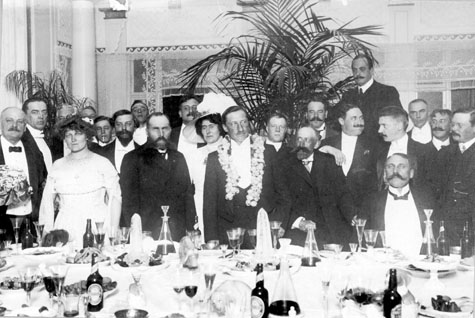
Image 1
Only five days after Dr. Cook returned from the Arctic, Peary announced that he had reached the North Pole. Dr. Cook responded that he was glad to hear the news that a fellow American had also reached the North Pole. Peary, on the other hand, was not nearly as gracious, and immediately responded that Cook had not been to the Pole and in time, he would prove it.
There were staunch supporters on both sides of the argument, and Dr. Cook remained the public favorite for a short while, particularly in Copenhagen, but it would not last. It didn’t take long before his claim to the North Pole would to start to unravel. Backed by the Peary Arctic Club and the National Geographic Society, Peary was successful in discrediting Cook’s claim to the North Pole, reporting to the New York Times that Cook had “sold the public a gold brick.” Though Cook maintained a loyal following, Peary’s reputation and drive, along with the support of some of the most important politicians of the time quickly thrust Peary into the position of the claimant of the North Pole. Complicating the matter for Dr. Cook was the fact that his Mt. McKinley achievement was now beginning to be publicly questioned.
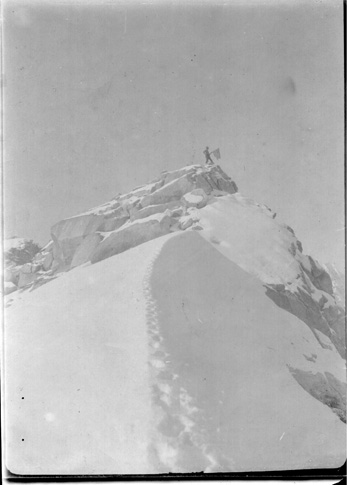
Image 2
Harper’s Monthly Magazine published the account of Dr. Cook’s McKinley climb in the May 1907 issue, including illustrations. This was when the infamous image of Dr. Cook’s summit photo, depicting Ed Barrill holding the American flag, first debuted. Belmore Browne and Herschel Parker, members of the 1906 expedition that had been left back during Cook’s ascent to the summit, were suspicious. The captions under the images published in the Harper’s article did not resemble the conditions they experienced on Mt. McKinley. However, by the time they were ready to confront Cook, he had already left for the Arctic. Similarly, his book about the climb, To the Top of the Continent, was released after he had departed for the Arctic. Included in the book were some of the same images that appeared in the article but some of the captions had been changed. Additionally, the summit image of Barrill holding the flag was different – it showed a distant peak in the lower right hand corner. This image had apparently been cropped for the Harper’s article.
By early October 1909, only a month after Dr. Cook announced that he had reached the North Pole, newspapers had begun to print rumors that Barrill had a diary that would disprove Cook’s claim to have climbed Mount McKinley. In time, Barrill would claim in an affidavit, published in the New York Globe and Commercial Advertiser on October 14, 1909, that Dr. Cook did not reach the summit of Mt. McKinley, and had falsely captioned many of the photographs. Supporters of Dr. Cook would quickly point out that Barrill was compensated $5000 for this testimony.19 In the midst of all of this controversy, Dr. Cook remained calm and continued his lecture circuit, appearing enthusiastic about his accomplishments. His apparent sincerity and charisma convinced his audiences that he spoke the truth, and his claims were taken on faith for a great many people.20
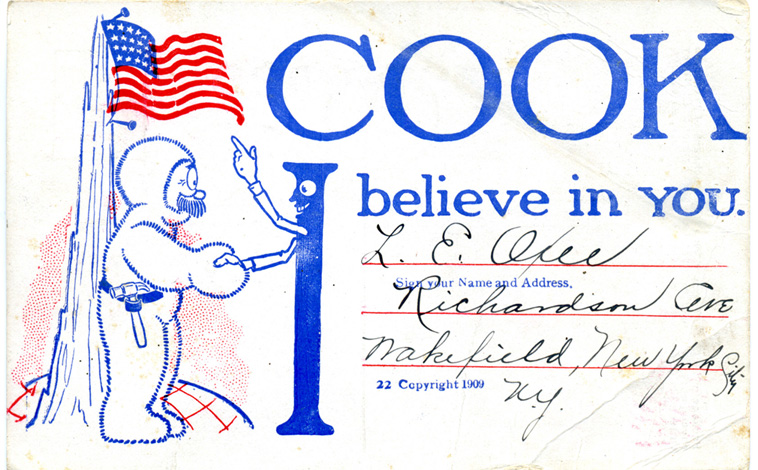
Image 3
Meanwhile, Belmore Browne and Herschel Parker were at last confident enough to speak out about their suspicions that Cook had not achieved the summit of Mt. McKinley. They presented their argument to a committee at the Explorers Club on October 17, 1909. Dr. Cook faced the committee of with his attorney to address the charges.

Image 4
The committee requested that Cook provide his original diary, any unpublished images of the climb, and the negatives of those images that had appeared in To the Top of the Continent. They also agreed that he could provide these items at the conclusion of lecture tour to several western states. While on this tour, Cook first encountered an audience that no longer took him at his word. While lecturing in Hamilton, Montana, Ed Barrill was in the audience and stood and repeated the statements in his affidavit. Dr. Cook was booed by the crowd and left the lecture hall. He then disappeared from the public eye, sequestering himself for nearly a year. He never did provide the proofs as requested by the Explorers Club. While he was in hiding, the Explorers Club as well as the American Alpine Club removed him from their membership rosters.21
Image 1: Dinner of the Royal Geographic Society at the Hotel Phoenix, Copenhagen, 1909. Dr. Cook is at center, wreathed in flowers.
Image 2: The uncropped version of Dr. Cook’s Mt. McKinley summit image, commonly called “fake peak.”
Image 3: Frederick A. Cook Society Collection: Box 21 Folder 13
Image 4: Frederick A. Cook Society Collection: Box 21 Folder 13
19The Dishonorable Dr. Cook, pp. 64-65.
20Ibid, page 68.
21Ibid pp. 70-73.
