Thomas Gregory Song Family Exhibit

Based on papers held with the Rare Books & Manuscripts Library at The Ohio State University

A Remarkable Family Calligraphy Book

Guest Post by Max Li

In early March (2025), we opened the exhibit “Mobility, Collecting, and Diaspora: Preserving and Teaching East Asian History” in the Special Collections Atrium of the main campus library. Drawing on rare and distinctive works from multiple campus collections—including the Thompson Libraries’ Special Collections and the Bliss M. and Mildred A. Wiant Collection of Chinese Art—the exhibit celebrates the depth and diversity of East Asian materials at OSU. 

Among the featured items, one artifact stands out: a well-preserved calligraphy book that contains Chinese poems and inscriptions from Korean monuments.

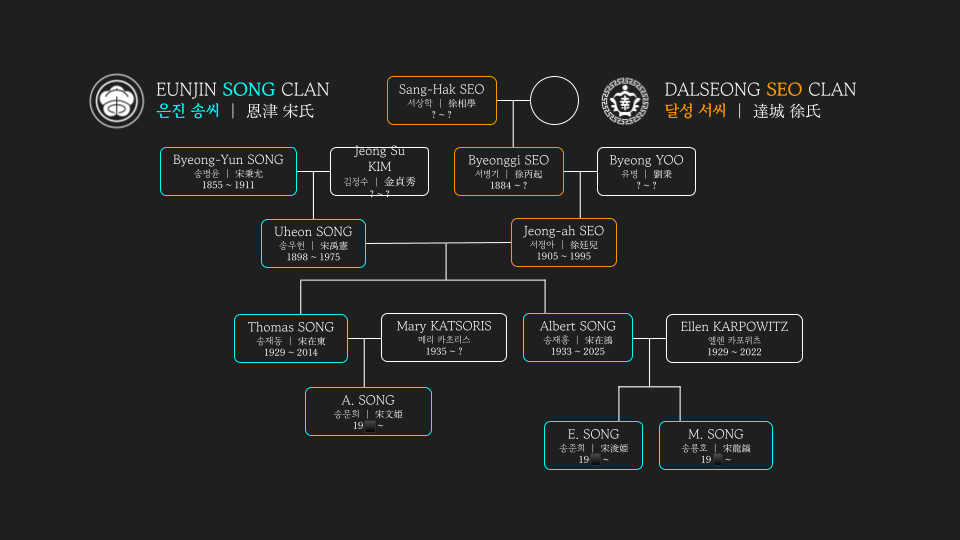
A treasured family heirloom, the book has journeyed across borders and generations—traveling from Korea to Japan, northeast China, back to Korea, and ultimately to the United States. Preserved for centuries by the ancestors of Thomas Gregory Song’s mother,  So Jong-Ah (1905–1995), the volume now resides in the Rare Books & Manuscripts Library at University Libraries. Its remarkable journey truly captures the exhibit’s central themes of mobility, collecting, and diaspora.

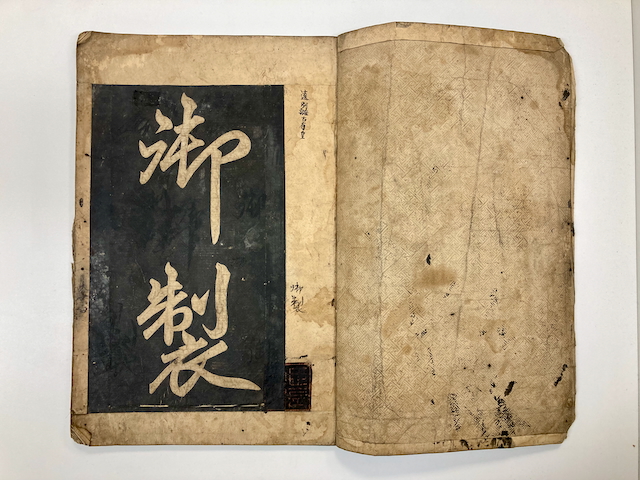
A open calligraphy book with two large handwritten Chinese characters

The first page of ink rubbings in the remarkable calligraphy book.

Created in 1740, the book contains ink rubbings of calligraphic inscriptions originally carved on one of two stone stele that are part of the Historic Monuments and Sites of Kaesong, a UNESCO World Heritage Site in present-day North Korea. The calligraphy was drawn by the reigning monarch at the time, King Yeongjo (r. 1724–1776), the 21st ruler of the Joseon dynasty. Scholars believe that the rubbings are roughly contemporary with the original stele: their precision and clarity suggest they were made immediately, before the stone inscriptions were weathered by time. 

Produced by royal hand, such calligraphy rubbings served as exemplary models for students learning to write—a vital skill in the East Asian scholarly tradition, where penmanship was linked to reputation and status. Creating these rubbings required meticulous craftsmanship. After pasting a traced copy of the original calligraphy onto the stone, engravers would carefully carve through the outline, striving for exact replication. 

“Stowaway Poems” and Recycled Paper

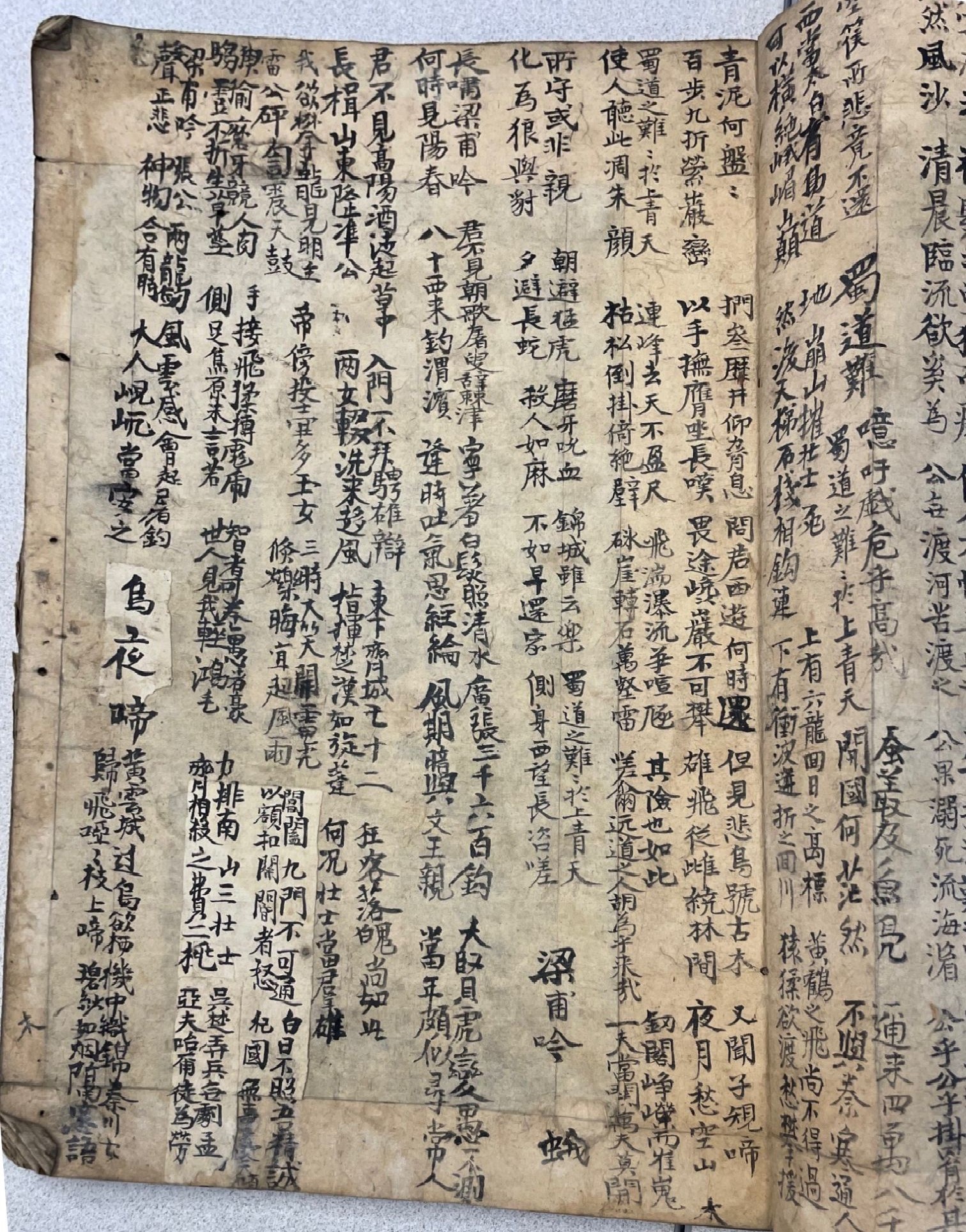
Interestingly, the rubbings in this book were printed on the reverse sides of reused paper—sheets that had been inscribed previously with poetry, likely at a much earlier date. In traditional China, it was not uncommon for new texts to be printed on the backs of both public and private discarded papers. Following a consult with Chinese Studies Librarian, Professor Guoqing Li, we know that the hidden texts on the back of these pages include poems by the renowned Tang dynasty poet Li Bai (李白, 701–762), also known as Li Bo, courtesy name Taibai (太白). Widely celebrated as one of China’s greatest poets, Li Bai’s “stowaway” verses add another layer of significance to this already remarkable manuscript. 

One page of an open book showing handwritten Chinese poems

Poems by Li Bai discovered in the calligraphy book.

Beyond the Page

The donation of the Song Family “calligraphy book” builds on the important historic materials already held in that collection. This is an exceedingly rare artifact that presents great potential for research in Chinese literature and book technologies, as well as Korean history and calligraphy. It not only contains important stone monument rubbings from a world heritage site in North Korea, but also provides a rare example of ancient “paper recycling.” The inverse sides of the pages in this calligraphy book contain Tang-period “stowaway” poems that were written on the paper at an earlier (unknown) date, prior to 1740. The calligraphy book is a precious and unique resource that bridges history, literacy, and transnational heritage, underscoring the Song family’s deep respect for both tradition and knowledge.

Library Resources

About Li Bai


The Frog Outside the Well

The Jokbo Challenge

One of the most important items in the Song Family Collection is the Eunjin Song Clan jokbo. For the uninitiated, jokbo1 are traditional Korean genealogies detailing family lines going back to their first common ancestor. There are many types of jokbo, and they have certainly evolved over time, but the Eunjin Song Clan jokbo is a patrilineal record typical of the Confucian-based Joseon period society.

For our purposes, in tracing the history of the Song family diaspora in the modern era, the Song Family jokbo has been an indispensable resource. Above all, we have used it to confirm birthdates and Chinese characters in the names of the various members of the latest generation of the Song family. However, making sense of the family jokbo has been no easy matter. To better utilize Korean jokbo as a tool for such genealogical research, I searched Google for any credible English-language information on the topic. Luckily for me, I found a gold mine.

Enter Professor Mark Peterson

While hunting for resources, I discovered a master of the craft: Professor Emeritus of Korean, Asian, and Near Eastern Languages at Brigham Young University, Dr. Mark Peterson, an expert on Korean language and history and an impassioned translator of jokbo. On his YouTube channel, “우물 밖의 개구리The Frog Outside the Well,” Dr. Peterson has curated a playlist of seven instructional videos in which he covers the key elements for understanding a jokbo. After viewing these videos, I was able to get a solid start on reading the Song family jokbo.

Peterson’s videos can be divided into roughly two sections. The first is with a woman named Jiwon “Rebecca” Moon, who brings her genealogy to discuss with Dr. Peterson in the video. They explain, over three videos, the five important Chinese characters needed to read jokbo, the changes in jokbo over time, and a “special” kind of jokbo known as a palgojodo (팔조조도) or “eight great great grandfather chart.”

The second section is another series of three videos with a 3rd generation Korean-American named Braden Oh, who contacted Dr. Peterson for help investigating some of his own family jokbo. Notably, Oh was seeking Peterson’s support due to his inability to read Korean. Together these videos cover basic information on immediate family and relationships, basic biography and burial information, and how to trace ancestry up from the present generation to the more recent generations.

A seventh and final video stands on its own: a lecture in Korean by Dr. Peterson talking about the relationships of Koreans with jokbo, and how to solve the “jokbo problem” (i.e. some people love them and some hate them). This video goes into great detail about the palgojodo, which traces both female and male ancestral lines (rather than focusing solely on paternal lines).

Everyone Can Read Jokbo!

Before engaging with Dr. Peterson’s videos, I had no understanding of how to navigate a jokbo. Though I was able to use my knowledge of Chinese characters to crudely navigate through its pages, the “flow” of the system and the quirks in its character choices eluded me. For example, I had no way of knowing that “卒”, which (in Japanese, at least) means “graduation,” actually denotes a person’s death date. Thanks to Dr. Peterson’s content, I am much more confident navigating a variety of old and new jokbo.

If you have any interest in learning about jokbo, no matter your language or ancestry, I encourage you to take a look at his content and explore some jokbo on your own. It is a fascinating type of archival record with a rich history, and one certainly worth your time.

  1. Links to Wikipedia are provided for a quick summary of topics, with the understanding that they may contain inaccuracies. For a more complete picture, seek out the cited sources at the end of Wikipedia pages. ↩︎

Further Reading

Musical Memories

Introduction

For several weeks I have been combing through Thomas Song’s diary-blog on Hatena, working to translate and highlight passages of note for researchers and family members. So far, I am working through the blogs of 2014, the year with both the most entries and, unfortunately, Thomas’ last year of life. Many memories of Manchuria and elsewhere appear to have swirled in his mind, more so than in his previous years’ writings; therefore it seemed important to capture this year first.

This post be the first of a series in which I will introduce some of the significant discoveries from Thomas’ blog writing, in no particular order. This time I would like to introduce two songs that Thomas Song mentions on two separate occasions. Music provides a window into emotions; emotions weave the fabric of memory. I hope that translating Thomas’ words and the songs that permeated his mind in his final year may help illuminate his experiences and emotions to those who wish to better understand his original diary (nikki).

Diary. 2014.Feb.14.Friday. 宵待ち草

On February 14th, 2014, Thomas recalled the lyrics to a song entitled Evening Primrose1. He wrote,

宵待草

待てど暮らせど来ぬ人を 宵待草のやるせなさ 今宵は月も出ぬそうな

7,5,5,7,7,5と、36をみごとに整理した、往事の日本流行歌。

これだから、日本語はやめられない。

T. G. Song

Translation:

Evening Primrose

Waiting for one who will not come The wretched evening primrose Even the moon shall not rise tonight

7, 5, 5, 7, 7, 5―36 morae beautifully arranged one-by-one; a popular song from a Japan long past.

I cannot give up Japanese for just this reason.

T. G. Song, trans. E. Seitz

Evening Primrose was written in 1917, with lyrics by Takehisa Yumeji (竹久夢二) and music by Oono Tadasuke (多忠亮). Originally a poem by Takehisa, the song featured slightly different lyrics than in its initial release. A version performed by singer Yotsuya Fumiko (四家文子)was released in Showa 3, or 1928, five years before Thomas was born. According to Thomas, the song was a hit in Japan. Though he does not write when or where he became acquainted with the tune, its presumed popularity makes it likely that it was played often in the Japanese community in Dairen where he was raised. Additionally, the reason the song sticks out in his memory is unclear, except for the fact that the lyrics appear to have captivated him.

Referring to the structure, Thomas made a small typo: counting up the morae/on, it should be 7, 5, 7, 5, 7, 5. This structure is reminiscent of classic Japanese poetry, which in all its forms is grouped into lines of 5 or 7 onEvening Primrose‘s alternating 7-5 pattern is somewhat like a chouka, or “long poem,” except it does not end with two lines of 7 on. Regardless, it seems that the beauty of the lyrics combined with their classical structure served as a constant reminder to Thomas of the positive aspects of Japanese, in spite of his complex relationship with the nation and its language.

Below you can hear the popular version of the song:

Evening Primrose, performed by Yotsuya Fumiko

Diary. 2014.May 1. Thursday.

Later, on May 1st, 2014, Thomas related another musical memory, this time with more context:

妙に満洲について頻繁に感傷的になるが、旅順高校で昔愛唱した寮歌(北帰行)を思 い出す。

‘今は黙して行かん

何をまた語るべき

さらばわがふるさとよ

明日は異郷の旅路’

これを覚えたのが1945年の旅順の近くの土城子”飛行場建設”勤労動員の夏だった。

僕はまだ16歳の少年だった。それからほぼ70年その異郷の旅路をたどったことになる。人生運命って不思議でもある。北朝鮮強制収用所で悲惨な日々にあえぐ人たちがこれを歌っていたと読んだ。同級生がそこに混じっていた可能性もある。

T. G. Song

Translation:

Strangely, I’m feeling sentimental toward Manchuria quite often. For instance, I am recalling an old favorite dormitory song from Port Arthur High School, Hokkikou [Northern Return Trip]

What more should I say?

For I cannot keep quiet

O farewell, my old home

Tomorrow’s journey leads far away.

I learned this song in 1945. I was working on the construction of the Dojoushi [Tuchengzi] airport near Port Arthur, as a part of that summer’s wartime labor mobilization.

I was still a young boy of 16. Nearly 70 years later I have taken that “far away journey.” Fate really is a mysterious thing. I read that the people caught in lands seized by North Korea sang this song every day, wretched and suffering. It’s possible some of them were my classmates.

T. G. Song, trans. E. Seitz

Hokkikou was written by a former student of Port Arthur High School named Uda Hiroshi (宇田博). He wrote it after he was expelled, teaching it to his classmates shortly before he went away. It has since lived on as a favorite dormitory song, not simply about wandering but as an expression of personal liberation. Later, in 1961, singer Kobayashi Akira (小林旭) released a pop version with slightly different lyrics and that attained great popularity nationwide.

Hokkikou clearly resonated with Thomas, though he only alludes to the reasons why. It seems to me that he saw himself in the song, having taken several journeys in his lifetime. I imagine he may have felt like he would never settle anywhere, drifting from place to place, until he had made deep roots in America.

Below you can listen to both versions of Hokkikou:

Original lyrics and tune by Uda Hiroshi
https://www.youtube.com/watch?v=JrekJ2qVK3U
Popular version by Kobayashi Akira

Further Reading


  1. Links to Wikipedia are provided for a quick summary of people and topics, with the understanding that they may contain inaccuracies. For a more complete picture, seek out the cited sources at the end of Wikipedia pages. ↩︎

Jokbo Translation

This week the talented researcher, Evie Seitz, has been translating a couple of pages (pp. 268-69) from the Song family Jokbo held in OSU’s Rare Books & Manuscripts Library. The significance of these specific pages is that they list the names of immediate family members in Thomas Song’s generation (Generation #26), his father’s generation (Generation #25), and his grandfather’s (Generation #24). Evie’s work on this translation is so important that I’m posting it below for future access:


Song Family Jokbo Translation Explanation

by Evelyn Seitz

July 21, 2023

The sister document to this (“Final Jokbo Translation”) is an Excel spreadsheet holding a faithful translation of pages 268 and 269 of the Eunjin Song clan jokbo. In order to better understand the format of both the original and the translation, brief explanatory notes are provided below.

In the Eunjin Song clan jokbo, only the names of sons are recorded. Sons are noted with the character 子 (Hangeul: 자; RR: ja; “child”) followed by their name. Daughters are listed with the character 女 (Hangeul: 여; RR: yeo; “woman”) followed by their husband’s name. The exception to this rule is that starting with the 27th generation, daughters are noted 女 followed by their own names; married daughters are listed in the same manner, with the addition of their husband noted by 夫 (H: 부; RR: bu; “husband”) and the husbands name, written immediately to the left with a small space (smaller than between siblings in a row).

Jokbo are read in a “stair step” method, moving from top-to-bottom, right-to-left. Each row is a generation, with the oldest at the top and the most recent at the bottom. Starting at an upper row, names listed directly below and to the left of any given son are his children, until there is a gap, and one travels back up the page to another upper row to follow a new line down. Below is a photo of the original, untranslated pages, annotated to show the flow of reading:

I have opted to translate only the most relevant relations to Thomas and Albert Song on this page. As such, only the 23rd, 24th, and 25th generation lines on pages 268-269 have been translated. As of July 20th, 2023, several small sections have been left untranslated, as consultation with outside specialists may be necessary to accurately parse them. For now, they have been left in Chinese characters as red or blue colored text to mark them for future inquiry.

The translation spreadsheet is formatted such that it follows the same method of reading as the jokbo, simply reversed to accommodate English reading direction. In other words, it should be read top-to-bottom, left-to-right; an exact mirror of the original.

All dates have been left in their original format as opposed to converted to Gregorian calendar dates. However, all have been checked for accuracy according to the Gregorian dates we have available from other sources in the collection. Many jokbo have mistakes, and these two pages appear to have only one, that being a discrepancy in Song Yo-heon’s date of death. Thomas’ papers indicate he died in 1962; this jokbo records his death as in 1986. An investigation will be conducted to determine which is correct.

Below is the same image of pages 268-269, annotated with brackets that show what portion is in the translation spreadsheet, as well as the locations of family members and their relationship to Thomas and Albert Song:

A picture of the two pages without notes: