Guest post by Sieon Lim1
Recently, one of our student workers, Sieon Lim, conducted research on Thomas Gregory Song’s mother, Seo Jeong-ah, and her family lineage and bongwan (clan). The following is a condensed summary of his findings regarding Seo Jeong-ah and the potential for her (and by extension, her family) to share a bongwan with the prominent Korean/Korean American reformer and activist Philip Jaisohn (born Seo Jae-pil, 1864–1951).
The Dalseong Seo clan holds a particularly significant place among the prominent Seo lineages in Korea; over time, a branch of the clan became more prominent in Korea’s capital and began maintaining its own separate genealogical records. Although members of this branch continued to recognize their shared kinship with the Dalseong lineage, the branch came to identify Daegu as its bongwan.2
Crests of the Daegu and Dalseong Seo Clans
In 1884, two Daegu Seo clansmen, Seo Jae-pil and Seo Gwang-beom, played leading roles in an attempted coup d’état against the Joseon court, known today as the Gapsin Coup (also spelled Kapsin Coup). The coup failed, leading to the punishment and persecution of its organizers and their families. In order to distance themselves from those who had taken part in the revolt, the Daegu Seo clan altered its generation naming conventions (hangnyeolja).
According to traditional Korean naming conventions, names are generally composed of a surname and a given name, which is made up of a generational name and a unique name. Each clan has its own set of generational names, which are assigned based not on when a person was born, but rather on their place in the lineage (meaning two people from different time periods can end up in the same generation and thus have the same generational name).
For the Daegu Seo clan, the 25th generation name was “Gwang” and the 26th was “Jae.” However, following the attempted coup, the clan altered its naming convention, introducing “Byeong” and “Jeong” in place of “Gwang” and “Jae,” respectively.3 This meant that going forward, all members of the 25th generation were named using the generation name “Byeong,” and all members of the 26th generation were named using the generation name “Jeong.”
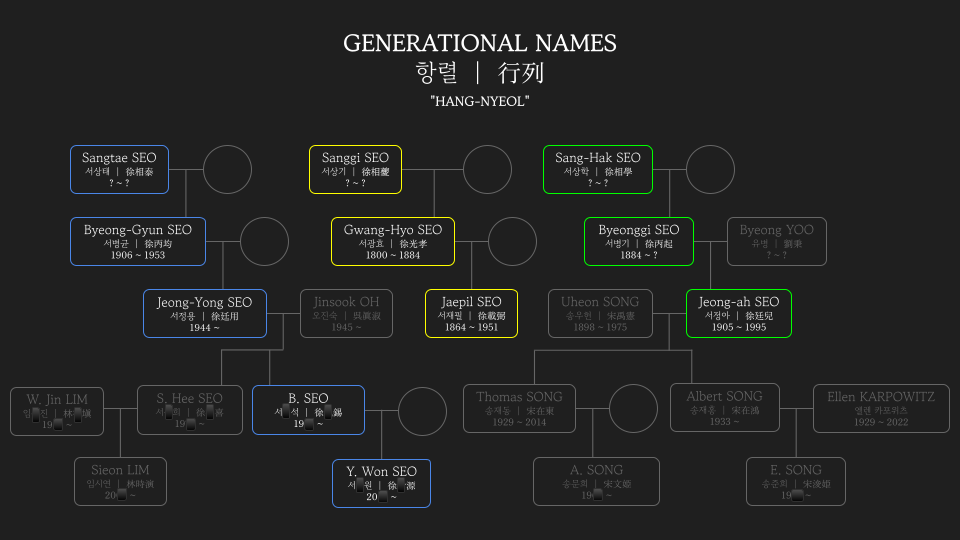
Comparison of 25th- and 26th-generation naming patterns across three Seo family lineages: Lim’s family (blue), Seo Jae-pil’s lineage (yellow), and Seo Jeong-ah’s lineage (green). The diagram highlights the use of the generational names Gwang/Jae and Byeong/Jeong discussed above.
For Thomas Song’s mother, Seo Jeong-ah, her name was constructed using the generation name “Jeong.” Furthermore, her father, Seo Byeong-gi, used the generation name “Byeong,” which also corresponds with the name change found in the Daegu Seo naming convention. While this could be a coincidence, the pattern appears to align closely with the Daegu Seo clan, suggesting the likelihood that Seo Jeong-ah and her family were members of the smaller Daegu Seo clan, as opposed to the Dalseong Seo clan.
Today, the Dalseong Seo clan vastly outnumbers the Daegu Seo clan. For members of the Daegu Seo clan, explaining membership in a lesser-known branch can require far more effort than simply identifying with the better-known lineage, particularly given the historical relationship between the two. Thus, some members of the smaller Daegu Seo clan may identify themselves as belonging to the larger Dalseong Seo clan. Over generations, this practice may also make it more difficult for descendants to recognize their connection to the smaller Daegu Seo clan, particularly in families that migrated away from Korea.
Amidst the fallout of the Gapsin Coup, Seo Jae-pil moved to the United States, where he adopted the name Philip Jaisohn and became the first Korean to gain naturalized American citizenship. He later earned his medical degree, becoming the first Korean to do so in the United States. Given this trajectory, we can find parallels between Jaisohn’s life and that of Seo Jeong-ah, who eventually became one of the first female Korean doctors to earn a medical license in Imperial Japan.
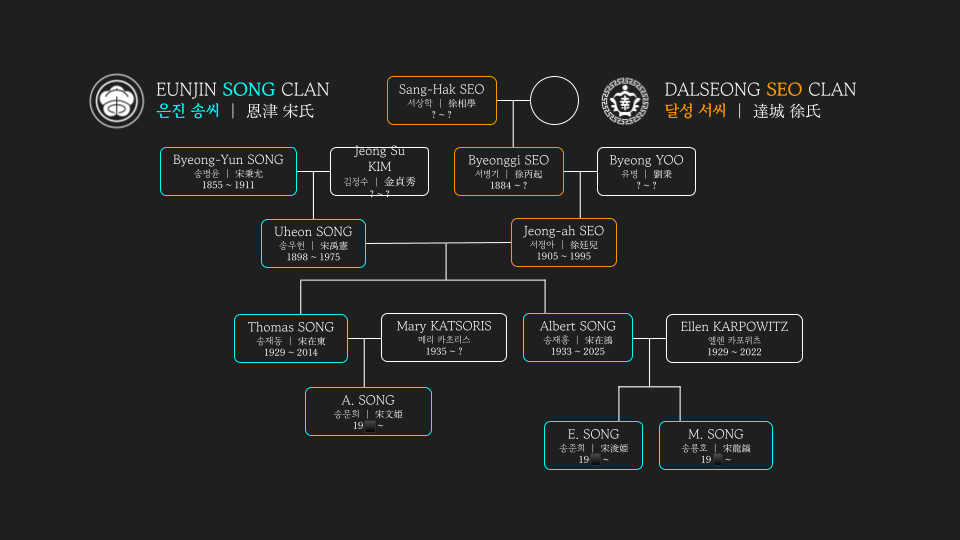
Selected Song family genealogy, showing Thomas and Albert Song in relation to the parents and grandparents discussed in this post. The maternal Seo lineage (orange) provides genealogical context for the research explored here.
In regard to the Song Family Collection, these findings are not about claiming historical prestige, but rather about illustrating the complexity of Korean genealogical research and the care required when seeking to identify and interpret clan affiliations. They also underscore a broader theme that is present throughout the Song Family Papers: how lives, identities, and family records are shaped by imperialism, war, displacement, and historical rupture.
Notes:
1. Student author Lim’s interest in this question was partly personal: his own family traces its lineage to the Daegu Seo clan, and he was intrigued by the possibility of a genealogical connection to Thomas Song’s family. His research was also informed by his family’s longstanding understanding that they belonged to the Dalseong Seo clan. This unexpected intersection between his own family history and the Korean family represented in the Song Family Collection inspired Lim to pursue summer work as a student researcher at The Ohio State University, adding a particularly personal dimension to this research.↩
2. The historical relationship between the Dalseong Seo and Daegu Seo clans is complex. The Daegu Seo were associated with the Gyeongpa (京派, “capital branch”) and the Dalseong Seo with the Hyangpa (鄕派, “local/provincial branch”). Although the two groups recognized one another as kin, Daegu Seo genealogies increasingly distinguished between them. According to Yu Su-ji, the first Daegu Seo genealogy, compiled in 1702, recorded the Dalseong Seo separately in a supplementary genealogy; subsequent genealogies continued to negotiate the relationship between the two groups. See “Composition of the Daegu Seo Clan through Genealogy from the 18th to the 19th Century” [「18~19세기 族譜를 통해 본 大丘徐氏 동족집단의 구성」], Joseon Sidae Sahakbo [Journal of Chosŏn Dynasty History], no. 105 (2023): 451–480.↩
3. For further context, please see Jeon Woo-yong, “항렬자를 지우니 이름의 무게가 가벼워지다” [“Erasing the Generation Character Lightens the Weight of a Name”], JoongAng Ilbo, November 22, 2010.↩