The Story of Justice For My Sister: Combatting Gender-Based Violence Across Borders

By Kimberly Bautista
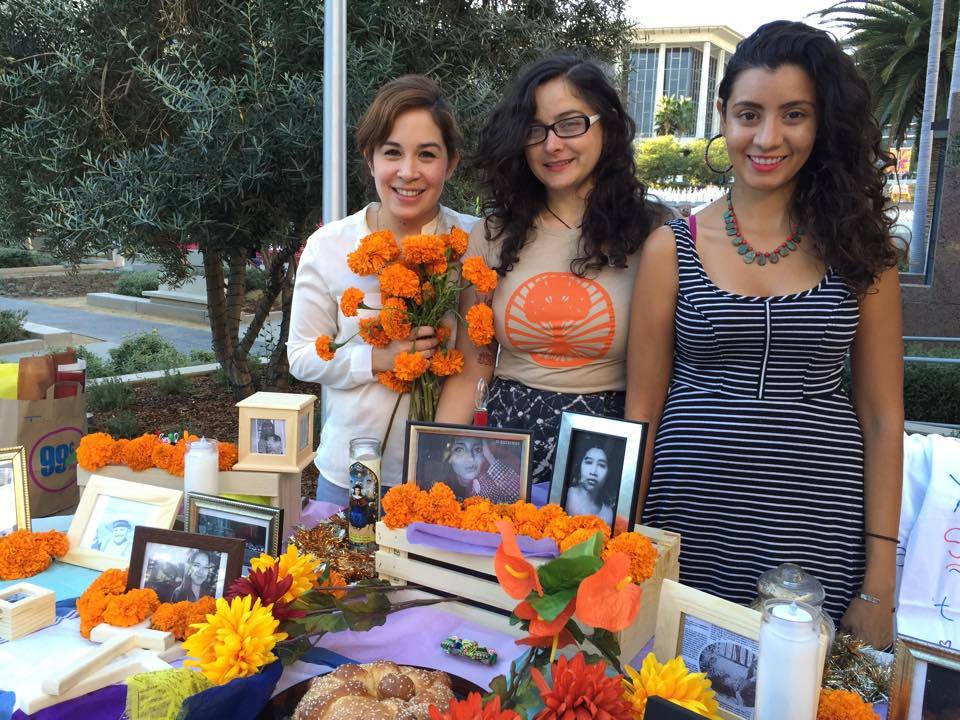
People standing behind altar for Day fo the Dead

Justice for My Sister Collective members adorn Altar for Día de los Muertos at Grand Park in LosAngeles, curated by Self Help Graphics & Art www.selfhelpgraphics.com
Photoed (L to R) Paulina Castro Murillo, Kimberly Bautista, Daniella Padilla-Ortiz. CC BY-NC-ND 2.0

My Testimonio of Coming Full Circle

Coming full circle is when your activism leads to your scholarly work, and that leads to your community work and career. And you continue cycling through this rotation in different ways during your journey. For me, at the center for each of these intersecting worlds and coming full circle is healing through community–recognizing myself and my own struggles in the testimonios of my sisters, brothers, and all my relations who connect and build together to produce critical work and uplift our struggles to heal our mundo. The connections among us are numerous. Recently, I’ve considered a few examples of this “full circle” in my experience. One is when my friend from UC Santa Cruz Edith Gurrola invited me to speak about my documentary Justice for My Sister and its violence prevention campaign at Comisión Femenil in the San Fernando Valley.  After the talk, I spoke with Rosemary Muñiz, College Admissions Adviser at CSUN, and realized that we had met at the Comisión back in 2007 when they hosted my student group Speak Out For Them (SOFT) at their event to denounce the unsolved cases of las muertas de Juárez. Another was hearing

Lourdes Portillo, the filmmaker who created Señorita Extraviada, in an academic context and getting inspired to co-found the club Speak Out For Them (SOFT) with my friend Joanna Kibler. Yet another example of “full circle” in my life was running into my mentor Maria Soldatenko at a march in Guatemala. Many years before that Soldatenko had introduced me to Lucia Muñoz from MIA, Mujeres Iniciando en Las Americas, who holds trainings for Men Against Feminicide in Guatemala. One final example is when MIA advocate Marina Woods introduced me to JFMS Collective members in Guatemala in 2011 and later joined our retreat in Los Angeles to train us on Gender 101 in 2012. Full circle. Every time.
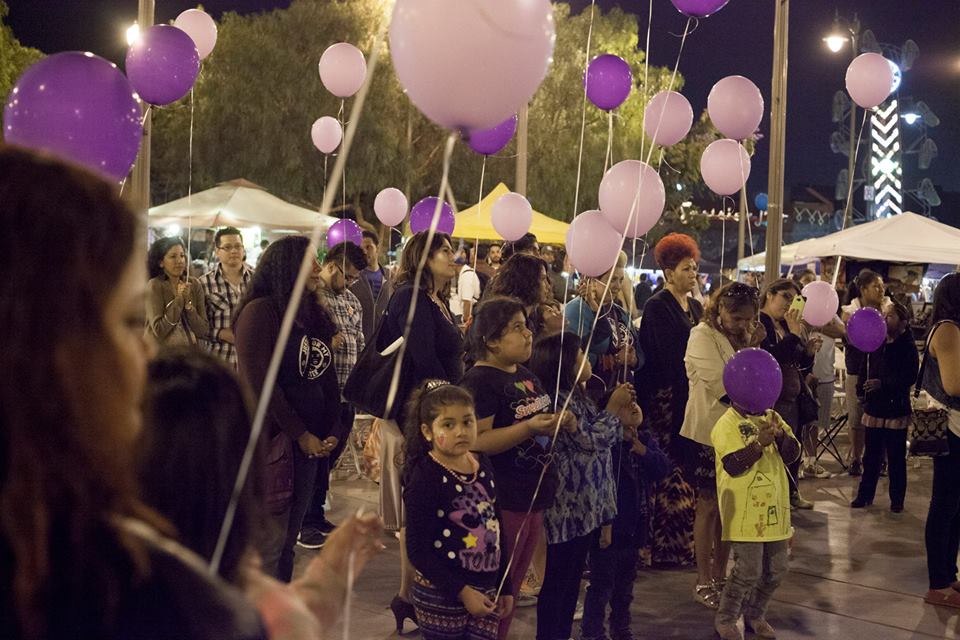
Children and Adults holding purple balloons

Comunidad en Boyle Heights (Los Angeles) commemorate those affected by violence and symbolically release trauma through a balloon release at Retomemos la Noche. Photo by Sonia Hernandez IG: @_bag_lady_ CC BY-NC-ND 2.0

These “full circle” moments are about the importance of creating community. With my film, I commit to continuing that work by screening the film annually with our SiStars from Mujeres de Maiz at the Boyle Heights Farmers Market and hosting a series of Healthy Relationships Panels with the Justice for My Sister Collective and our partners in Los Angeles. These events gave us advocates and activists a chance to have meaningful conversations about our own relationship histories. These talks led to other conversations about community accountability. Community accountability, through transformative justice can lead to healing, and more creative and love-centered approaches to breaking cycles of violence. It provides an alternative to the prison industrial complex, which has historically criminalized men, women, and gender non-conforming individuals of color and torn our communities apart.

Personal Stakes Led to a Bigger Movement

Let me take a step back to explain why healing through community is so important to my journey.  Justice for My Sister is my award-winning documentary about violence against women in Guatemala. It follows the story of Rebeca during her journey to hold her sister’s killer accountable in spite of victim-blaming and impunity.

When I was in the field during production, I was targeted in a home invasion where my equipment was stolen and I was raped at gunpoint. The ringleader of the operation threatened to kill me. I realized then that the film had to be much more than an advocacy piece. It needed to be part of a larger solution to actively prevent gender-based violence through leadership development where participants (both women and men) are trained to become resources to their peers. It’s for this reason that our educational materials are tailored to a variety of audiences: mothers of young children, youth (young women and men), police, judges, lawyers, religious communities, Indigenous communities, survivors of violence, and men who work in male-dominated industries.

At the core, this documentary and the curriculum created inspires entire communities to empower themselves by understanding how to identify the different forms of violence, as well as how to offer solutions. As part of the film screening, we develop local resource guides (many audiences otherwise don’t know where to go for help) and we emphasize the importance of healthy relationships. We emphasize that “healthy relationships” within community extends past intimate partner situations: it encompasses relationships in family, friendships, work, and lucha. It means we listen attentively, ask questions, speak from the heart, give space to others, and stand our ground (read: set and maintain boundaries). Self-care is also fundamental to achieve healthy relationships in community. We must sometimes retreat, sleep, replenish, and reflect in order to be fully present for others and continue in our (beautiful) struggle for equitable exchanges in our everyday interactions and in our overarching narrative in our fight for a more equitable society, free of victim-blaming, where we can individually and collectively reach our full potential.

Accountable Representation and Filmmaking

In the making of the documentary, I was concerned with creating an ethical representation of Rebeca and her family, whose story we follow. It was very important for me to develop a good relationship with them in a humble way, keeping in mind that I was entering a very sensitive moment in their lives where they were recently exposed to live-changing trauma.  The unity that we developed with each other surface in the film, and this is why the story resonates with audiences. Rebeca became a support for me when I was subject to abuse, and she helped me frame the narrative in my mind so that I could see myself as an empowered individual. She helped me keep my vision in mind during my healing process, which continues to this day. That has been an enormous source of strength.

Also, Rebeca is very relatable: many people understand the nature of fighting for someone you love and the struggle for justice in the face of all the odds. Rebeca’s heroic determination is very empowering and the truth is, many people are hungry for these stories to be on screen, because sadly Rebeca’s fight is one of many–we just simply don’t see it often on the screen because the mainstream media places more value on the lives of the affluent.

Three women standing together.

Shero Rebeca Eunice Perez (donning a shirt from our Collective in Los Angeles) meets
representatives from UN Women in Guatemala after an inspiring talk at a university
in Guatemala City. CC BY-NC-ND 2.0

It was important for me to follow Rebeca in particular because she’s a single mother of five from Escuintla, a community rarely represented in popular media. She’s a woman who descends from Indigenous folks, who identifies as costeña, who obtained a sixth grade education. She makes tortillas for a living, and essentially became an advocate and investigator for her sister’s case. She was determined to hold her sister’s killer accountable, an almost unimaginable task in a country where 99% of men who kill women are never punished, and often times, not even investigated. Rebeca’s determination and courage in the face of threats and intimidation on behalf of the suspect, and discrimination and objectification on behalf of the state, is inspiring. Audiences who have had the privilege to meet Rebeca at a screening approach her as a role model, and can’t help but hug her.

Breaking Silences and Building Justice

The feature-length documentary has been on tour in Guatemala with advocates from the Justice for My Sister Collective since we had a rough cut in late 2011. Every time we screen it, audiences come forward to break the silence and share their own stories. In 2013, I decided I wanted to document some of the other stories to highlight the far-reaching impact of gender-based violence and bring more visibility to other cases as well. Many of the stories in our web series are of survivors that had seen Rebeca’s story in the feature documentary and decided they also wanted to share their stories. Again, coming full circle. We want to offer survivors a platform to share their stories, casting aside blame and shame (as the historically typical narrative would have it), and in turn break the silence and disrupting the hegemonic, heteronormative, white supremacist, imperialist, victim-blaming narrative.

We should all feel passionately about eradicating gender-based violence, because gender-based violence affects many communities in distinct ways. And if you’re doing nothing, here’s your gentle cue to get centered so you can work on empathy a bit more. I know mainstream occidental culture has worked hard to program empathy out of us, but we just have to focus on our humanity a few moments a day to reclaim it.

In Ecuador there’s a chant: “Si tocan a una, nos tocan a todas.” “If they touch one woman, they touch us all.” This is true anywhere that men get away with these crimes; impunity gives aggressors a sense of entitlement or a license to abuse or even kill in some cases. Sometimes it feels daunting because there’s a lot of work to be done. That’s when seeing the human impact of the campaign is most heartening. Through the production of Justice for My Sister, the film’s campaign materials, and the support of Community Partners, we have provided a platform for women to lift up their voices and be heard, which is very healing when you’ve been silenced and your story has been challenged or questioned. The feedback we’ve received from survivors of abuse, their children and their families assures us that we’re on the right path.

Kimberly Bautista is a Colombian-Irish-American feminist, filmmaker, and community organizer based in Southern California. Her feature-length documentary film, Justice for My Sister, has screened in over 20 countries as part of a transnational campaign to prevent gender-based violence. The film has won several accolades, including the HBO-NALIP 2012 Documentary Filmmaker Award, and Best Documentary at film festivals in Holland, Bolivia, Guatemala, France, and Los Angeles. She has spoken as an expert on the topics of gender-based violence and representation of women and girls in the media at the United Nations Office at Geneva, and at the INternational PUblic Television Screening Conference (INPUT) in El Salvador. She acted as jury member for the Connect the Docs Transmedia Pitch Competition at the 2013 Hot Docs Conference & Forum in Toronto, Canada. She is the Project Lead for the Justice for My Sister Collective, a project of Community Partners that uses an arts-based approach to create safe spaces within marginalized communities to initiate collective healing and develop local leaders to combat gender-based violence.

To bring the film Justice for My Sister to your campus, organization, or film festival, email justiceformysister@gmail.com. To purchase a copy of the film and study/discussion guide, please see: http://newdayfilms.com/film/justice-my-sister Continue reading

The Marlin Mine and Women’s Resistance

by Nancy Sabas

With the permission of the author, we are republishing a blog essay by Nancy Sabas on Indigenous Mam Mayan women resisting mining operations in their community of San Miguel Ixtahuacán in the highlands of Guatemala. The essay originally appeared on the Latin American Advocacy Blog in June 2015 and is republished here with additional reference notes for readers.

Was it you who sent the miners?
They violate the womb of Mother Earth
They take the gold, destroying the hills.
One gram of blood is worth more than a thousand kilos of gold.
What about my people?
And you, my God, where are you hiding?
Fear paralyzes us
My people are sold and they do not realize it.

-Portion of a song written by the Parish of San Miguel Ixtahuacán.

A few weeks ago, I organized a learning tour for North American participants to discuss the mining industry in Guatemala, On the tour, we visited the department of San Marcos and surrounding communities that deal with this problem.

Mining operations in Guatemala are not a recent issue. In 1998, two years after the signing of the peace agreement following a harsh civil war, the Foreign Investment Law removed the restrictions on trade with Guatemala, which attracted transnational companies to enter the country. Among the various companies, Goldcorp, a Canadian extractive company with high interest in exploiting gold, stands out.

After a license granted by the Guatemalan government, the Marlin mine, operated by Montana Exploradora, a subsidiary of Goldcorp, began its operations in the community of San Miguel in western Guatemala. This was done without prior community consultation, even though it is an obligatory requirement of various international and national laws.¹  In 2009, Goldcorp stopped appearing in the Canadian Jantzi Social Index for ethical investment due to the controversial use of cyanide in their operations.²  Currently the Marlin mine is considered the most lucrative mine that Goldcorp owns worldwide.

During our trip, we visited the community and interviewed community members to hear their side of the story. I met Crisanta Pérez, a Mayan Mam woman with 6 children who lives with determination, loyal to her philosophy of caring for Mother Earth and defending her territory. Crisanta resists and denounces Goldcorp’s environmental and community violations.  Despite facing intimidation, 14 arrest warrants and criminalization for her work in defense of her territory and human rights, Crisanta stands firm. When we asked her how the resistance movement in San Miguel was born, she explained, ”There are many men who work as miners in the company. Our community is divided in opinions, and although some of the men disagree with the mining operations in the community, they do not take a position because they are working there. It is for this reason that the resistance movement in San Miguel against mining started from the women.¨

As an indigenous woman, Crisanta faces various levels of oppression. However, she resists the roles imposed by a patriarchal hegemonic system, and has become a public figure, with a voice, empowered with knowledge about her rights and equipped to assertively demand the vindication of environmentally sustainable traditional practices, in line with the Mayan worldview. In addition, Crisanta tirelessly denounces the massive exploitation of resources.
¨Transnational companies are destroying the most valuable thing we have, Mother Earth,¨ Crisanta explained during our visit.

With her focus from the periphery, Crisanta defies the ruling capitalist logic that sacrifices the sacred elements (Mother Earth) and whose goal is the strict accumulation of wealth. The position of inequality that Crisanta has, along with other Mam women, enables her to integrate a more holistic perspective in line with her worldview and allows her to critique the mining operations from a Maya Mam light. These women, based on their condition of oppression, have the ability to see with clarity from the base. This viewpoint enables them to understand the world from their ancestral worldview, as well as the reality of the mestizo (the Guatemalan State), and the dominant white (Goldcorp). This understanding contrasts the power groups’ viewpoint who understand and legitimize their knowledge as the only valid form of knowing. The women have become privileged epistemic subjects, for not being ¨contaminated¨ with only one way of knowledge that comes from an advantageous social position.

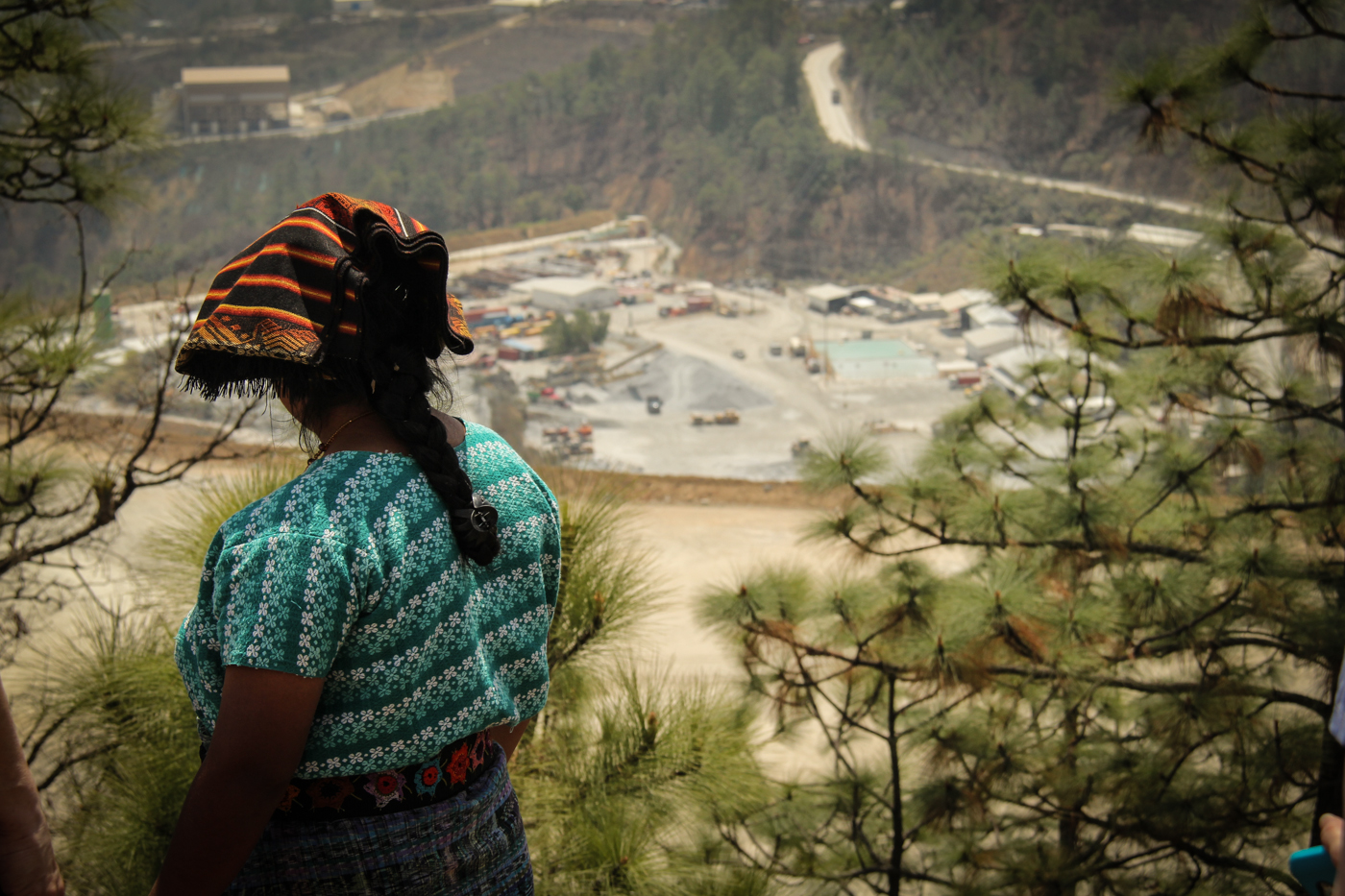
A member of the catholic parish, an indigenous Mam woman facing towards the marlin mine. Photo credit: Matthew Kok.

A member of the Catholic parish, an indigenous Mam woman facing towards the Marlin mine. Photo credit: Matthew Kok. Used with permission of author.

The case of mining in San Miguel Ixtahuacán, its environmental impact and the criminalization of women activists, can be understood from an ecofeminist perspective. As Vandana Shiva, in her book Stolen Harvest states: ¨For more than two centuries, patriarchal, eurocentric, and anthropocentric scientific discourse has treated women, other cultures, and other species as objects. Experts have been treated as the only legitimate knowers. For more than two decades, feminist movements, Third World and indigenous people’s movements, and ecological and animal-rights movements have questioned this objectification and denial of subjecthood.¨ The Guatemalan state and the mining company, driven by their focus on production, consumption and accumulation of wealth fail to respect the sovereignty and spirituality of indigenous peoples. The Mayan worldview is trampled by a mercantilist system that does not recognize the land as sacred, positioning man/production over woman /nature.

Crisanta and the anti-mining resistance group of San Miguel are reluctant to embrace the imposition of a clearly western and patriarchal “development” that despises life in the periphery and legitimizes abuse from its position of power. On the contrary, the women demand ¨the good life which according to their worldview and ancestral knowledge, consists in the search for harmony and balance with Mother Earth and all forms of existence. This philosophy of living naturally disapproves all forms of accumulation and exploitation that would alter the harmonious coexistence and quality of life of other beings.

In 2008, the Pastoral Commission of Peace and Ecology (COPAE) of San Marcos along with other organizations doing independent studies presented their detections of arsenic, aluminum, copper, manganese, and other metals in some water sources near the Marlin mine. The poor management of the mine waste and their presence in natural sources of water is a good explanation for the increase in gastrointestinal and skin diseases among the neighbors of the nearby communities.

During my visit, as we were interviewing members of the Parish of the San Miguel community, we talked about how racism was politically used to justify these atrocities. A parishioner tearfully explained, abuse is legitimized under the premise that ¨the Indians are dirty and unhygienic.¨ The hierarchy of race or gender is illogical and cannot be interpreted if it does not fall within a base structure with political interest. This is a clear example, where the discrediting and discrimination of a population is aligned with neoliberalist interest.

¨On the threshold of the third millennium, liberation strategies must ensure that human freedom is not achieved at the expense of other species, that freedom of one race or gender is not based on the increasing subjugation of other races and genders. In each of these struggles for freedom, the challenge is to include the other.¨ –Vandana Shiva

For me, Crisanta´s resistance is a miracle born from an oppressed community. The same system that abused and excluded Mam women, now is the same that caused the conditions for them to become creators of new knowledge outside of a dominant perspective. The heart and unbreakable spirit of these women defending their territory and returning to their ancestral knowledge, translates their struggles against the violation of the land to their female bodies and vice versa. They are women who cling to their indigenous philosophy of the ¨Good Life,¨ seeking harmony and sustainable living between people and nature peacefully. Under that view, Crisanta and the women of San Miguel Ixtahuacán rethink, deconstruct and reconstruct themselves.

Take action:
Send a letter to your congressmen to ensure that ensure that Canadian oil, mining and gas companies live up to international human rights, labour and environmental standards:
http://www.kairoscanada.org/take-action/open-for-justice/

References:

1.  S. James Anaya, “Preliminary Note on the Application of the Principle of Consultation with Indigenous Peoples in Guatemala and the Case of the Marlin Mine, ” UN Human Rights Council Report A/HRC/15/37/App. 8 (July 8, 2010), http://unsr.jamesanaya.org/special-reports/preliminary-note-on-the-application-of-the-principle-of-consultation-with-indigenous-peoples-in-guatemala-and-the-case-of-the-marlin-mine-2010

2. Jantzi Research Client Alert (2008), https://goldcorpoutofguatemala.files.wordpress.com/2010/07/jantziresearch-alert-080430-goldcorp-final.pdf

3. Vandana Shiva, Stolen Harvest: The Hijacking of the Global Food Supply, (Boston: South End Press, 2000).

Nancy Sabas, originally from Honduras, currently lives in Guatemala as a exchange coordinator for the Mennonite Central Committee. She has a degree in Business Management and is a current student in a feminist studies certification course provided by Ixchel women´s collective in Guatemala City.

Las dos alas de un pájaro: The Cuban Refugee Program and Operation Bootstrap

by Carmen R. Lugo-Lugo and Cheris Brewer Current

Cuba y Puerto Rico son
(Cuba and Puerto Rico are)

De un pájaro las dos alas,
(Two birds of a feather)

Reciben flores y balas
(They receive flowers and bullets)

Sobre el mismo corazón…
(Over the same heart…)

—From Mi libro de Cuba by Lola Rodríguez de Tió


One Bird, Two Wings

Sometimes attributed to Cuban revolutionary José Martí, the verses by Puerto Rican revolutionary Lola Rodríguez de Tió were first published in 1893, while she was exiled in Cuba. Martí and Rodríguez de Tió became good friends and avid advocates for the independence of their own and each other’s country, as Cuba and Puerto Rico remained the last bastions of Spain’s Empire in the Caribbean. The verses were a testimony of the similar histories the two islands developed under four centuries of Spanish rule. They can also be seen as a chilling presage of what was to come after the U.S. won the Spanish American War in 1898 and became a consistent presence in the future of both countries, as U.S. decisions and U.S. policies have affected the way Cubans and Puerto Ricans live their lives on both their respective islands and the US mainland as well.

The islands were forced into different routes during the 20th century with the Platt Amendment (1901) steering Cuba in one direction (i.e., eventual independence), and the Foraker Act (1900) and Jones Act (1917) gearing Puerto Rico in another (i.e., an entrenched colonial status). Later, when Puerto Rico became a Commonwealth of the U.S. in 1952 and Fidel Castro assumed power in 1959, this bifurcation seemed to be irreversible. The effects of U.S. policies toward Puerto Rico and Cuba have been critical in shaping the positions that both islands occupy globally, and in the living conditions of Cubans and Puerto Ricans on the mainland.

This essay presents a brief comparative sketch of two distinctive immigrating and incoming Caribbean groups resulting from two specific structural programs: the Cuban Refugee Program (CRP) targeting Cubans in the U.S.; and Operation Bootstrap (OB) involving Puerto Ricans on the island. Both programs had their genesis in the mid-twentieth century, at a moment when the U.S. was attempting to re-vamp its racial politics in response to both domestic and international pressures. Yet, it is noteworthy that both CRP and OB were operational before the passage of the Immigration and Nationality Act of 1965 which ended explicit race based preferences in entrants.

Thus Puerto Rican incomers and Cuban immigrants of the 1950s and 1960s are a precursor to the increasingly diverse group of immigrants who were to follow. Movement from Latin American and the Caribbean to the US contains a peculiar history shaped by individual relationships between countries of origin and the US. Immigrants from countries with closer political, economic, and social ties to the US were (and are) granted advantages in entrance, settlement, and employment that are unavailable to immigrants from countries who do not share the same intimacy with the US. This is clear when you compare Cubans with other political immigrants of the period—Haitians and Dominicans, for instance—who, because of racial and political reasons were not granted refugee status. This essay focuses on two relatively privileged groups of Latino immigrants: Puerto Ricans who entered with citizenship status, and Cubans who were granted legal status, provided financial assistance, and structural assimilation. Tracing the reception of these two groups illustrates the ways in which the U.S. government eased and aided the process of migration for some, while it outright neglected other newcomers.

Bootstrapping the Island

As an economic policy and as a development initiative, OB was not a U.S. policy per se, but rather, the effort of Puerto Rican leaders, who sought to develop Puerto Rico economically (Maldonado, 1997). The program was funded, almost entirely, by the island’s government. However, U.S. involvement was at the heart of its conception and implementation, for the companies targeted by the program were exclusively U.S. companies. U.S. policy was also at the heart of the program by way of specific tax exemptions that these companies would enjoy, as “Puerto Rico had been exempted from U.S. taxes since 1900” (Maldonado, 1997: 46). Those exemptions were the core of the program, so OB was possible, fundamentally, because of already existing U.S. policy. In addition, the massive movement of Puerto Ricans to the mainland that ensued after OB was also only possible, again, because of U.S. policy (in this case, policies ruling citizenship and territories).

Using an “industrialization by invitation” approach (Dietz, 1986; Whalen, 2005),
Operación Manos a la Obra (as it is known in Spanish) began in the 1940s, and had among its main objectives to eliminate extreme poverty on the island, and to develop the island economically (Morales-Carrión, 1983). Initially, the project included federal tax incentives and exemptions to entice American businesses with cheap and abundant labor. OB turned into an export-oriented form of absentee capitalism that overhauled the economy in Puerto Rico in unprecedented ways. By the 1950s the island had largely left its agricultural past behind, for as James Dietz (1986) tells us, agriculture came to be regarded as an obstacle to progress.

OB prompted a massive exodus of Puerto Ricans to the mainland US that has literally divided the Puerto Rican population in half, and has prompted poet Nicolasa Mohr to thoughtfully proclaim that “Puerto Ricans are no longer an island people” (in Rodríguez, 1991). The movement of Puerto Ricans alleviated the large-scale unemployment produced by the sudden shift from an agricultural to an industrial economy. The mainland Puerto Rican population went from 53,000 in 1930 (before OB), to 1.5 million in1964, roughly 20 years after OB began (Briggs, 2002). Although the set of initiatives, policies, and practices that came to be known as Operation Bootstrap did not institute or formally encourage island to mainland movement, we are suggesting (as have others before us—see, e.g., Briggs 2002; Dietz 1986; Maldonado 1997; and Whalen 2005, etc.) that Operation Bootstrap created a de facto form of movement to the U.S. by “pushing” migrants northward.

When the U.S. is Pulling the Bootstrap

The post-1959 migration of Cubans was part of an immigration continuum that had brought Cubans to Florida whenever political or economic strife hit the island (Mirabal, 2003; Poyo, 1989). Given this history, the U.S. became a natural refuge for former supporters of Batista and other Cubans who quickly became politically and financially disillusioned with the revolution, but discerning why the U.S. chose to accept over 650,000 refugees by 1977 is a more complicated challenge (Whorton, 1997). The acceptance of Cubans, first as immigrants and then as refuges, marks an anomaly in US immigration policy, as they arrived during an era of restrictive immigration (1924-1965).

Accepting Cuban refugees was merely one aspect of the U.S.’s developing policies directed at incoming exiles. Early on, many Cubans leaving the island managed to take money and other forms of capital with them and were able to support themselves –if only temporarily– in their exile. The restrictions Castro imposed on what Cubans could take with them became increasingly stringent over time as concern grew that assets in the forms of cash and jewelry were being sent northward. Eventually luggage was limited to a change or two of clothing.
As Cubans began entering the U.S. early in 1959, private agencies and local church groups offered aid to impoverished refugees. Federal aid increased greatly in 1961 with the creation of the Cuban Refugee Program, providing the needed resources for the programs many aid-based goals. The CRP, administered by the Department of Health, Education and Welfare (HEW), provided funds for resettlement, and “monthly relief checks, health services, job training, adult educational opportunities, and surplus food distribution (canned meat, powdered eggs and milk, cheese, and oatmeal, among other food products)” (García, 1996).

Based on number of dependents, place of residence, and employment status, CRP staff calculated a monthly financial benefit for deserving refugees – primarily the unemployed – and granted refugees a maximum of $60 a month for a single person and $100 for a family (Voorhees, 1961). These payments were substantially more than the welfare payments available to U.S. citizens (including Puerto Ricans). The CRP also provided additional assistance, including medical insurance, assistance with employment readjustment, and college scholarships. This comprehensive program ensured that Cuban refugees were provided with structural assistance that extended beyond the stopgap needs of early exile.

Final Thoughts: Of Cubans, Puerto Ricans, Republicans, and Latinos

The unequal power relations that typify U.S.-Latin American exchanges mark the admittance, treatment and integration of Latin American immigrants, as all migrants from the region have been subject to the whims of the U.S.’s shifting relations with Latin America. Similarly, the complex histories that individual nations share with the U.S. have dictated the response to immigration policy and immigrants (Taft, et al, 1979 ). This in part explains that although Puerto Ricans and Cubans are all categorized as “Hispanic” in the eyes of the U.S. government or Latinos in the U.S. popular imagination, for instance, specific historical, political and perceived racial differences have produced great disparity in U.S. policy and reception of immigrants or incomers from the country and territory respectively.

This discrepancy becomes patently obvious when one compares the reception of Cuban refugees to that of Puerto Ricans workers during the mid-twentieth century. On the one hand, during the Puerto Rican movement to the U.S., the U.S. government benefited from the cheap labor that ended up manning its factories and processing plants. It was assumed that Puerto Ricans, who were U.S. citizens after all, could access welfare if needed—yet the racialized welfare system discouraged if not outright barred people of color from accessing services (DeParle, 2004). Meanwhile, unlike Cuban refugees from the same period, Puerto Ricans did not receive a hero’s welcome, or assistance to find a place to stay, or to learn English. They were given no free vocational training, or medical services. In sum, Puerto Ricans were not presented with an aid package tailored to their needs. As citizens, they were assumed to have access to the U.S. government resources, when the reality seemed that they were here only to fulfill the needs of an economic system that thrived on cheap labor. The massive migration turned out to be a “win-win” for both governments (US’ and Puerto Rico’s), while it became a “lose-lose” for Puerto Ricans, including Puerto Ricans in the U.S., who ended up at the bottom of the economic ladder.

On the other hand, the US government not only allowed Cubans entry, but it also provided direct assistance that exceeded any welfare program available to its own citizens, including Puerto Ricans. Some of the motives behind this benevolence remain unclear; what is clear is that the Cold War and anti-communist rhetoric shaped governmental discussions of Cuban immigration; ensuring the well-being and success of people fleeing communism held important ideological value. The direct assistance that Cubans received was, indeed, helpful in some form, as they still have the highest net worth of any U.S. Latino group. Puerto Ricans, on the other hand, continue to lag behind, and are experienced as a problem group, one immersed in poverty—and racialized as non-White. Regardless of the historical, social, and racial similarities shared by Cuba and Puerto Rico pre-1898 (the two birds of a feather), an act of American exceptionalism elevated (and perhaps continues to elevate) the status of Cubans, while Puerto Ricans and other Latino/as remain(ed) marginalized. This unilateral decision predisposed Puerto Ricans to a different treatment by mainstream U.S. culture, and hence, a different future from that of Cubans.

Over half a century into that future, the 2016 presidential election campaign has produced (thus far) two Republican hopefuls of Cuban descent, while not one Puerto Rican has ever made a bid for the presidency (on either party). Something to note here is that the candidates in question are both the offspring of Cubans who migrated to the U.S. before Castro took office, meaning, they are not CRP babies. This fact brings us to a crucial, final argument: the CRP seems to have “lifted the boats” of Cubans as a group, even those who did not participate in it (and perhaps even those who came after the program was terminated). This point is important, for the net effect of the CRP extends beyond the assistance granted to individuals, as the program collectively elevated the economic and social status of Cubans. The CRP argued that these heralded newcomers were capable of accessing the American Dream and political self-determination (as it was assumed that the future leaders of Cuba were temporary sojourners, who would return to the island eventually and take control). Puerto Ricans were pushed to the margins as they were denied structural assistance and viewed as political and economic dependents, creating a long-lasting, major chasm between both groups.

But now the chasm seems to be closing, and Republican candidates notwithstanding, second and third generation Cuban Americans are shifting politically, presumably joining Puerto Ricans and other Latinos in less conservative spaces (Fisher, (2015). Thus, regardless of their bifurcated histories, and their still dissimilar class status, Puerto Ricans and Cubans in the U.S. seem to be finally converging not only geographically, but in their ideals and aspirations as well. There is also the collective imagination of Americans who sees both groups as part of that collective known as Latinos/as, and whether that is a good thing or not, is a question for another essay.

References:

Briggs, Laura. 2002. Reproducing Empire: Race, Sex, Science, and U.S. Imperialism in Puerto Rico. Berkeley: University of California Press.

Boswell, Thomas and James Curtis. 1984. The Cuban American Experience: Culture,
Images and Perspectives. Totowa, New Jersey: Rowman & Allaheld Publishers.

DeParle, Jason. 2004. American Dream: Three Women, Ten Kids, and a Nation’s Drive
to End Welfare. Penguin Books: New York.

Dietz, James L. 2003. Puerto Rico: Negotiating Development and Change. Boulder:
Lynne Rienner Publishers.

Fisher, Marc. 2015. “Cuban Americans’ Shifting Identity, and Political Views Divides
Key Block.” The Washington Post. June 12. http://www.washingtonpost.com/
politics/as-time-passes-a-cuban-identity-fades-to-an-american-one/2015/04/
12/83d3346a-dfd0-11e4-a1b8-2ed88bc190d2_story.html.

García, M.C. 1996. Havana USA: Cuban Exiles and Cuban Americans in South Florida, 1959-1994. Berkley: University of California Press.

Maldonado, A.W. 1997. Teodoro Moscoso and Puerto Rico’s Operation Bootstrap.
Gainesville: University Press of Florida.

Masud-Piloto, F.R. 1996. From Welcomed Exiles to Illegal Immigrants: Cuban Migration to the US, 1959-1995. Lanham, Maryland: Rowman & Littlefield Publishers, Inc.

Mirabal, N. R. 2003.“‘Ser de Aquí’: Beyond the Cuban Exile Model.” Latino Studies vol. 1: 366-382.

Morales Carrión, Arturo. 1983. Puerto Rico: A Political and Cultural History. New
York: W. W. Norton and Company.

Poyo, G. 1989. With All, and for the Good of All: The Emergence of Popular Nationalism in the Cuban Communities of the United States, 1848-1898. Durham: Duke University Press.

Rodríguez, Clara E. 1991. Puerto Ricans: Born in the U.S. Boulder: Westview Press.

Taft, J.V., North, D.S.& Ford, D.A. 1979. Refugee Resettlement in the US: Time for a New Focus. Washington DC: New TrasCentury Foundation.

Thomas, J.F. 1963. “US Cuban Refugee Program.” (December) Records of Health, Education, and Welfare, RG 363, Carton 12, File CR 18-1, National Archives II.

Whalen, Carmen Teresa. 2005. “Colonialism, Citizenship and the Making of the Puerto
Rican Diaspora.” In The Puerto Rican Diaspora: Historical Perspectives edited by Carmen Teresa Whalen and Víctor Vázquez-Hernández. Philadelphia: Temple University Press.

Whorton, B. 1997. The Transformation of Refugee Policy: Race, Welfare, and American Political Culture, 1959-1997. PhD Dissertation. Sociology, University of Kansas.

Carmen R. Lugo-Lugo is an Associate Professor in the Department of Critical Culture, Gender,  and Race Studies at Washington State University. Her research focuses on Latinos in the US, “the War on Terror,” and the representation of Latinas/os and other minorities in popular culture. Cheris Brewer Current is Associate Professor of Sociology and Social Work
at Walla Walla University’s Wilma Hepker School of Social Work and Sociology. Her research focuses on Cuban Immigration to the U.S., and the intersections of race, class, and gender.

Reports from May 2015 Indigenous Knowledge Gathering in California

group moving and dancing through room

Photo of Indigenous Knowledge Gathering by Agos Bawi. CC BY-NC-ND 2.0

Movements in Motion by Angela “Mictlanxochitl” Anderson Guerrero

On May 2nd, indigenous communities, scholars, and activists were invited to the California Institute of Integral Studies (CIIS) in San Francisco to build understanding around culturally competent integration of indigenous knowledge in the academy. A student-initiated event aimed to raise awareness and attention to the value of culturally competent curriculum and programming at CIIS and other universities. The Indigenous Knowledge Gathering was an experience that inspired dialogue, tough questions, and movement to honor the history and sources of indigenous knowledge. Huge awe for our volunteer team who showed up at 8 a.m. and stepped into action to welcome and invite everyone into CIIS. The day was organized to facilitate dialogue and to build community with all types of knowledge keepers. No papers were presented, but each of the presenters were asked to share their testimonies, which in return help ground our self-reflection as a group and dialogue.

Wicahpiluta Candelaria, Carla Munoz, and Desiree Munoz welcomed all of us into Ohlone territories with songs of mourning and joy to start the day. Monique guided and weaved together the stories shared by Ohlone participants Corrina Gould, Nicholas Alexander Gomez, and Jonathan Cordero of their connections to the land and the transformative possibilities of bringing Native people to the table for equitable say and involvement involving the land, indigenous knowledge, and traditions. Laura Cedillo fired up the dialogue by challenging us all to think about the benefits of indigenous knowledge cultivated in the academy?

To slow down and encourage the dialogue to linger among participants, Corrina Gould blessed the mid-day meal that was prepared by Seven Native American Generations Youth Organization, or SNAG. We were honored to be the first to see the unveiling of the SNAG mural, which will travel with Bay Area urban native youth to Hawaii for the cultural exchange with Native Hawaiian Youth from Halau Ku Mana Charter School in Oahu. Huge thanks to Sylvie Karina and Ras K’Dee for sharing the native foods and allowing us to experience the art of the hawks wings wide open carrying all of our traditions.

Jack Gray and Dakota Alcantara-Camacho ushered in the connections starting to form with a powerful dance, O Hanau Ka Maunakea, inviting all of us to swiftly come together in circles of 10 and to share a story of who we are. There are no words to describe how ancestors, sounds, movement, testimony came through the space. We as a gathering started to really to get know one another and our collective intentions. This sharing became the basis for each group’s creation of actions they hope to see move forward. [Living Report and Dissemination To Be Shared Soon!]

Roxanne Dunbar-Ortiz’s presentation on “Positioning Indigenous Knowledge in Higher Education” was a moment of poetic justice because it brought into an academic space an indigenous people’s history that validates our stories, traumas, and hopes for all of our peoples. Roxanne also helped contextualize the powerful action of the gathering within CIIS, an academic institution, as a radical moment that she hopes ripples into other institutions.

To bring the dialogue to a pause so it could sit within each of us as we head home, Rulan Tangen and Jack Gray gathered everyone on the ground for our intentions to be heard and to begin to take shape. What followed was transformation, activation, provocation, identification, communication, decolonization, indigenize-nation. The Indigenous Knowledge Gathering committee passed out medicinal tea by Cultura sin Fronteras and white sage seeds were gifted as thanks.

But we were not done… we had to celebrate! After amazing collective clean-up/break-down effort, we were greeted by jams of Ras in the First Floor. Kris Hoag aka “Kwaz” who came in all the way from Bishop Paiute Tribe, gifted us some of his beats from his heart. Then there was dancing and Chhoti Ma dropped in to share more hip hop medicine, then more dancing.  Visiting San Francisco State students and members of Student Kouncil of Inter Tribal Nations or SKINS, Carlos Peterson-Gomez, and Nancy Andrade were inspired to drop some more beats that invited more dancing.

To close it up 14 hours later, we circled up and Antonio from the community shared songs from the Peace and Dignity Run. Pomo Joe and Ras offered Pomo songs of goodness and wellness and a few more hugs of gratitude for all that was given and received were exchanged before we dispersed under the Full Moon light.

Gathering and work will continue…  Please stay posted via our Facebook page Indigenous Knowledge Gathering and our website: www.indigenousknowledgegathering.com.

Angela “Mictlanxochitl” Anderson Guerrero was a lead organizer for the event described in this post. She is a Doctoral Candidate in East West Psychology at the California Institute of Integral Studies whose dissertation is titled “Testimonio and Knowledge Production Among Transterritorial Mexican and Mexican American Indigenous Spiritual Practitioners: A Decolonial, Participatory, and Grassroots Postmodernist Inquiry.” She is a Council Member of Circulo Danza de la Luna Huitzlimetzli in Austin, Texas, and is finishing her nine year commitment with the Circulo Danza de la Luna Xochitlmetzli in Mexico. Previous positions include Center for Metropolitan Chicago Initiatives, Institute for Latino Studies at the University of Notre Dame; Integral Teaching Fellow at CIIS: Emerging Arts Professional Fellow in San Francisco/Bay Area. She received an M.A. in Public Policy and a Certificate in Health Administration and Policy from the University of Chicago’s Graduate School of Public Policy in 2004.

speakers at talking session

Photo of Indigenous Knowledge Gathering by Agos Bawi. CC BY-NC-ND 2.0

Medicine in Knowledge by Susy Zepeda

Attending the First Annual Indigenous Knowledge Gathering at CIIS was exactly what my spirit needed as I work to find my ground and honor past, present, and future ancestors on my path. I was pleasantly surprised to find a critical yet warm space where the knowledge honored and spoken came from the heart of Indigenous peoples.  Participants were invited to be fully-embodied in non-hierarchal space, through eating amazing earth-centered food, building community with each other through sharing story, and listening in an accountable way.

The deep lessons of how to exist and live in a respectful way on Ohlone land and collaborate with Native and Indigenous local communities were insightful and instructive.  Corrina Gould, Nicholas Alexander Gomez, and Jonathan Cordero offered interruptions to the usual “othering” that tends to happen in western-centered scholarly work with Indigenous peoples—instead their assertions spoke to the urgency of taking up this work in ways that are accountable to ancestral knowledges, the earth, and all interconnected beings, as well as facilitative of the complexity of  being present as a vessel for transformation. As a queer Xicana Indígena scholar-activist, critical thinker, and practitioner of curanderismo, this gathering was medicine for my whole being.

The collective space created by Jack Gray, Dakota Alcantara-Camacho, and others who offered words, ceremony, movement, and song opened a path for participants to show up for ourselves and each other through small talking circles that facilitated instant heart connections and desire to learn more about each other’s histories and struggle. Roxanne Dubar-Ortiz’s sharing from her 2014 text, An Indigenous People’s History of the United States, offered both wisdom and knowledge about the unseen genocidal and “transcommunal”[1] histories, highlighting the importance of world-wide decolonizing efforts that must also address oppressive dominant social and state structures. The closing movement and creativity brought the gathering full circle. We  all left full of wonderful energy and language to continue the important work of decolonization, solidarity, and loving our whole complex selves.

~Ometeotl

Susy Zepeda,is an Assistant Professor in the Department of Chicana and Chicano Studies at UC Davis.  She is affiliated faculty with the Mellon funded Social Justice Initiative and the UC Davis Race Project. Zepeda is part of a writing collaborative, the Santa Cruz Feminist of Color Collective and a member of the Mujeres Talk Editorial Board.  She is currently working on her first book manuscript.

Photo of Indigenous Knowledge Gathering by Angela Anderson Guerrero. CC BY-NC-ND 2.0

Photo of Indigenous Knowledge Gathering by Agos Bawi. CC BY-NC-ND 2.0

Learning and Practicing Indigenous Intellectual Traditions by Alicia Cox

The First Annual Indigenous Knowledge Gathering at the California Institute of Integral Studies was a landmark in attempts to reposition indigenous knowledge in higher education. As Roxanne Dunbar-Ortiz stated in her talk, the history of the United States has conventionally elided indigenous perspectives and perpetuated systems of colonization and genocide. Even the “integral” philosophy on which CIIS is founded is one of bridging “Eastern” and “Western” thought with no regard for the intellectual traditions of indigenous Americans. As a researcher and teacher of Native American and Indigenous Studies, the gathering invigorated and inspired me. I look forward to attending this event for years to come, and I urge readers to do the same or, better yet, gather indigenous intellectuals at a campus near you!

The opening panel featuring three Ohlone scholars was particularly instructive. Corrina Gould gave an overview of the Indian Relocation Act of 1956 and the Termination Era of U.S. Indian policy that encouraged thousands of Native people to move from reservations to urban centers like San Francisco. In Corrina’s words, “Indians from elsewhere . . . were unaware of the existence of California Indians.” Subsequently, Indians from all over worked together to create organizations in the Bay Area such as the United Indian Nations, the American Indian Child Resource Center, and Indian People Organizing for Change. The latter organization has been especially instrumental in raising awareness about issues affecting Bay Area indigenous peoples, such as the destruction of shellmounds and other sacred sites by corporate and governmental construction projects. Since the Ohlone people are not recognized by the federal government, they are working to regain stewardship of their Native homelands by creating a cultural easement, a Native women-led urban land trust. IPOC is seeking volunteers to write grants, develop a website, and provide maintenance and upkeep services once the land is granted. Please visit ipocshellmoundwalk.homestead.com for more information or to donate funds.

The second session was led by Maori Contemporary Dance artist Jack Gray from Aotearoa. During the lunch break, Jack, who is a friend of mine, asked me to sing a song to help open the next session. This was not part of the program, and I was hesitant due to performance anxiety, but I understood that improvisation—a flexibility around the spirit of what is happening—is part of the indigenous intellectual tradition that Jack was offering. To rouse and ready the audience to receive the gifts of the gathering, Dåkot-ta Alcantara Camacho, a Chamorro Contemporary Hip-Hop Theater artist, chanted a welcoming song that honors a great navigator for the knowledge/spirit it takes to travel the seas. I then sang “The Trail of Tears Song” in Tsalagi (Cherokee), Eastern Band dialect, to thank Creator for life and the food, material and spiritual, that nourishes it. Several participants from the Transformance Lab that Jack and Dåkot-ta had co-facilitated the previous week at California State, East Bay, then led the audience in chanting and movement, helping us harness the power of gathering, sharing, and performing to awaken the latent energy and transformative potential that exist in all of us.

Alicia Cox completed her Ph.D. in English with a concentration in Native American Studies at the University of California, Riverside, and she is currently a University of California President’s Postdoctoral Fellow at the University of California, Davis. Her research interests include Native American literatures and gender and sexuality studies. She was born in Kansas City, Kansas, and she presently resides in Oakland, California.

References

[1] John Brown Childs, Transcommunality: From the Politics of Conversion to the Ethics of Respect (Philadelphia: Temple University Press, 2003).