
The Decolonial ImaGYMary: Working (and Writing) on My Fitness

November 19, 2012

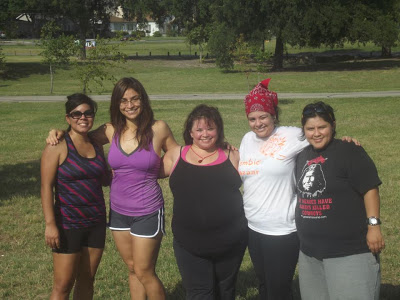
Fulanas Con Ganas Collective. L-R: Monica Morales, Larissa M. Mercado-López (Photo Credit), Selena Navarro, Giomara Bazaldua, and Jessica Hawkins.

Fulanas Con Ganas Collective. L-R: Monica Morales, Larissa M. Mercado-López (Photo Credit), Selena Navarro, Giomara Bazaldua, and Jessica Hawkins.

By Larissa M. Mercado-López

As I type this, I stop every few minutes to pull my spine up tall, clasp my hands above my head, and slowly move side to side, gently stretching the muscles around my shoulders and latissimi dorsi, or my “lats.” I place my hands on my lower back, elbows bent, and puff out my chest—bones shift and joints pop. My 4 year-old runs up to me, asking for a spin, and I scoop up her 60- pound body and spin her dizzy. Slowly, I return to my writing position and resume working.

In Loving in the War Years, Cherrie Moraga writes, “A friend of mine told me once how no wonder I had called the first book I co-edited (with Gloria Anzaldúa), This Bridge Called My Back. You have chronic back trouble, she says. Funny I had never considered this most obvious connection … And the spot that hurts the most is the muscle that controls the movement of my fingers and hands while typing.”1 We can “read” the pain metaphorically, as the burden that is placed on women of color to write against colonialism and to forge spaces in the women’s movement; however, Moraga may very well have had repetitive stress syndrome, or a similar musculoskeletal ailment, that could have been improved with strengthening exercises.

In my dissertation that I completed in 2011, I read texts in Chicana literature to examine how mestiza mothers read the social and somatic experiences of their maternal bodies, deploying critical and often oppositional knowledges. Similarly, scholars such as Suzanne Bost and Eden Torres, and emerging graduate student scholars such as Christina L. Gutiérrez and Sara A. Ramírez, are articulating decolonizing theories of the bodies and psyches of Chicanas. But in addition to this bodywork, I’ve been consumed with another kind of bodywork: fitness.

Exercise kept me sane through three degrees and three children. Though I won’t deny that the gym has been a space of frustration—especially as I painfully cardio-ed for excessive amounts of time in my attempts to “bounce back” after my pregnancies—it has also helped me reaffirm my sense of strength. The traditionally male-dominated free weight area has become my most empowering space, where I routinely lift heavy weights to strengthen my lower back that was strained and weakened by years of writing, motherhood, and running on pavement. I delight in my growing muscles and find the task of carrying my children and books far easier. Though one reason I exercise is to maintain low levels of body fat, I am driven more by my desire to prevent injury, manage stress, and strengthen my bones and cardiovascular system.

But, I often find myself alone in the free weights area. Among those who do come, many opt for the 5-pound weights because they want to become “toned but not bulky” (never mind the fact that the average weight of a woman’s purse is 7 pounds!).

However, I don’t judge. In many ways, hegemonic (and gendered) constructions of “fitness” and “fit women” conflict with dominant constructions of Latina bodies. The cultural valorization of “womanish” curves and the masculinization of muscular bodies constrain Latinas’ exercise choices, limiting them to those that emphasize fat loss over muscle strengthening. Further, the media’s constructions of “fit women” as white, upper-class, and hyper-muscular, and the capitalist culture of fitness, with its pricey supplements and apparel, render “fitness” a financially inaccessible and time-consuming endeavor. And, when it comes down to it, men in the weight room can be downright intimidating.

While these rhetorics and images of fitness have led some Latinas to either pursue more socially accepted forms of exercise for women or to nix them all together, many still revere their maternal ancestors for their bodily strength, recalling the girth of their strong arms and legs as they carried loads of laundry, tilled the hard earth for their gardens, and lifted sleeping children off their floor and into their beds. These images of strength need to be remembered and re-embodied.

I fully acknowledge that my pursuit of the level of fitness that I desire is enabled by my privileges of income, transportation, a flexible job, the support of my husband, and the availability of day care. We need to be critical of social/structural inequalities that limit how, when, and where Latinas exercise. I’ve responded to some of these issues by blogging for my local newspaper (Fitness Cultures) and starting a free exercise group (Fulanas Con Ganas).

It’s my mission to ensure that all Latinas have the access to the resources they need, as well as the support and confidence, to pursue the level of fitness that allows them to live their best lives.

CITATION

1.  Cherríe Moraga, Loving in the War Years: Lo que nunca pasó por sus labios (Boston: South End Press, 1983), v.

Larissa M. Mercado-López received her Ph.D. in English/Latina Literature from the University of Texas at San Antonio. Her research interests include Chicana feminism,maternal studies, phenomenology, and rhetorics of fitness. Larissa is an adjunct instructor at UTSA for Women’s Studies and Sociology. 

Comment(s):

  1. Anonymous  November 20, 2012 at 7:51 AM

    I just started Zumba and like it ok, but I really want to try some weights! Thanks for the motivation!

  2. Seline (Mujeres Talk Co-Moderator)  November 23, 2012 at 6:14 PM

    This comment has been removed by the author.

  3. Seline (Mujeres Talk Co-Moderator)  November 23, 2012 at 6:14 PM

    Larissa,

    Thank you for your essay on fitness and the different ways to love and be in your body.

    I love that you experience the free weight area as an empowering space. The insights you shared remind me of Jackie Martinez’ essay on weight room semiotics, the mental intensity that accompanies brute physical force, and embodied intentionality.

    Keep up the good work that opens pathways to access.

  4. Larissa    November 26, 2012 at 9:53 PM

    Martinez and I both do phenomenology; I used her work in my dissertation 🙂

  5.  Jessica Lopez    April 22, 2013 at 8:12 PM
    As for me, I exercise because I like breaking out a sweat after a stressful day. It is enjoyable since I go to the gym with my friends. It is important to love it and not think about what other people see. It also helps me to regulate my diet and be more aware of proper nutrition.

My Shadow Beast’s Time

November 12, 2012

Photo Credit: "Our Time is Running Out 157/365" by gravity_grave on Flickr

Photo Credit: “Our Time is Running Out 157/365” by gravity_grave on Flickr

By Anonymous

I have been thinking a lot about time and its processes lately. When I took and passed the Candidacy Exam in my graduate program, time was paramount. As in most universities, departmental guidelines dictate that students in the program make timely progress to the degree. There are, however, minimal guidelines for writing the requisite three exam papers. Some said that the reading lists were to help me write the dissertation. Others told me that this exam was completely separate from my dissertation. I then couldn’t figure out what I was supposed to write about my reading lists. “Was I to integrate all 40 books and articles from one reading list into a paper? How?” I kept asking. I was unable to get a straight or clear answer about what to write. Previous students successful in advancing to candidacy did not allow the program to archive their papers as resources for future students working on their exams. Social scientist candidates in the department were willing to share their work with me, but I felt I couldn’t follow their examples because I was working with texts in the humanities.

Still, I read every day. I was determined to finish on time. I joined a writing group, and in two months, I wrote countless drafts of the first paper. The group was organized and led by a senior professor who I eventually learned did not take well to assertive feminists. One day, before a group of other graduate students, the professor asked if I had “a chip on [my] shoulder” because my writing style seemed “bitter.” I conceded that the passion behind my writing stemmed from anger prompted by relentless systemic violence. The professor had not expected my response, and he answered by saying I wouldn’t go far with my “attitude.” I smiled nervously as he initiated the class’s roar of laughter. After our session, I felt even the snowy wind was mocking me. I couldn’t run fast enough into my sister’s arms.

My subsequent anxiety about writing catapulted me into a depression. No matter how much I beckoned it, my writing voice would not come out of hiding. I had to finish these papers within four months in order to be eligible for a fellowship for those who are making “timely progress.” My inner critic wouldn’t go away: STUPID. SLOW THINKER. BAD WRITER. BAD PERSON. IDIOT. LOSER. JUST SIT DOWN! UNFOCUSED. LIMITED VOCABULARY. STOP CRYING. IMPOSTER. It was not until after I suffered a major break down that I learned I could ask for an extension without penalty. Why hadn’t anyone told me this before? Was the break down part of the process? I had been conditioned to believe that the only way I could be a “good person” was by being a “good student.” Facing my Shadow Beast, I realized my self-worth had been dependent upon my ability to produce, my colleagues’ perceptions of me, my professors’ praise, my parents’ “Good girl, m’ija,” and on someone else’s notion of “timeliness.” Western culture has us believe we are essentially flawed, we must constantly work on ourselves, and we must prove ourselves to belong. Resenting the exam process as yet another way for me to prove my worth, I refused to write until I could convince myself that there is no sinful self to redeem. Humans never fell from grace. All beings are essentially good.

Although I certainly learned in the depths of Coatlicue, I knew couldn’t stay there forever. I moved and began the healing process. I stopped thinking so much about what I had to do and what I hadn’t done and tried to focus on each present moment. I began to practice compassion toward myself including my vicious inner critic, my Shadow Beast. I learned that I couldn’t go on ignoring her. We had to dialogue. When I listened, I learned she only wanted to help me achieve that happiness I feel when I read, think, and write. I explained to her that I can’t work with unrealistic daily goals and harsh criticism used as “motivation.” She pointed out that no one taught her how to practice non-violent communication. Together we learned that time is but a construction, a historically specific concept, and we came to a truce. I was finally able to write. I finished my papers, took my exams, and passed at the right time.

I write about my struggle to underscore our continuous negotiations as Chicanas in the academy. Confessing that I embark on more writing with trepidation, I am reminded by my MALCS mentors that I must revel in this moment’s sense of accomplishment and the fact that I found ways to manage an arduous process. Yet I know I must remember my time in the depths of Coatlicue so I too can be compassionate toward my students in their times of crisis. The U.S. university system is not set up to be conducive to our “timely” progress. As a capitalist enterprise, the university embraces competition—a race against time—to produce extraordinary scholarship, thereby discouraging genuine collegiality. This system does not encourage us to satisfy our urge to “make face and heart,” or to find ourselves, by learning from one another through compassionate social interactions. For this reason, I look forward to summers during which MALCS, conversely, focuses on giving shape and meaning to our selves and community. MALCSistas remind me that there have always been philosophers, artists, scientists, and lovers of “making sense” of the world. I dream that it is possible to transform the U.S. university to meet our needs as humans. I look forward to this reemergence from what may be our collective trance in the Coatlicue State. I look forward to our inherently interlinked individual and collective experiences of triumph.

Comment(s):

  1. Monica    November 12, 2012 at 10:55 AM

    Thank you for your words. This is definitely a process many of us go through, and yet very few talk about it. Gracias.

  2. Anonymous   November 12, 2012 at 11:34 AM

    What a “timely” piece! I was driving to my office with my inner critic saying many of the horrible words you mention. It has been a long time since I have written out of joy rather than fear. Deadlines and timelines help me to be “productive” but are sucking the life out of my voice. Thank you for such a thought-provoking piece.

  3. Unknown   November 12, 2012 at 11:45 AM

    Thank you. So very much. Thank you.

  4. Anonymous   November 12, 2012 at 6:26 PM

    This is exactly how I felt a couple of days ago when I was going through my exams. Thank you so much for writing this!

  5. Anonymous   November 12, 2012 at 9:10 PM

    THANK YOU! This is exactly what I experienced.

  6. Theresa Delgadillo  November 19, 2012 at 3:55 PM

    Dear Anonymous Blog Author,
    In the classroom scene you describe, where a focus on the work and the writing would be most beneficial to all, the discussion unfortunately shifts to “correcting a person,” making an individual Latina the problem. Your honesty appears to have been alarming to those present then but shared here, in this space, it is a welcome meditation on the kind of relationships we build together in academia as well as the self-knowledge and skill you have gained in working with others and negotiating your expectations of others and self. I join in thanking you for this beautiful essay, especially the brilliant observation: “I look forward to this reemergence from what may be our collective trance in the Coatlicue State.” It’s a statement that resonates beyond academia as well as sign of the keen insight with which you have emerged from the fire. Congratulations to you! I am so very glad you will be making a difference in higher education!

  7. Anonymous   November 22, 2012 at 7:51 PM

    Dear Anonymous,
    Thank you for your essay, and speaking truth to power.
    My writing style has also been called ‘bitter,’ but by an anonymous manuscript reviewer who also asked why I was complaining about the lack of mentorship if I successfully received my Ph.D.! In other words, the lack of compassion in academia is pervasive. It is scholars like you and other MALCSistas who will make a difference

2012: A Year of Indigeneity and Indignities

November 5, 2012

Photo by Randy Bayne. From Flickr.

Photo by Randy Bayne. From Flickr.

By Adaljiza Sosa-Riddell

2012: For most of this year, I have been reading and writing about the past, present, and future of  la gente indígena de México y Centro América. I followed the news of the efforts of el Movimiento Indígena Nacional to re-establish a pluralist national democracy in México. In Sacramento, I was involved in the Zapatista Solidarity Coalition, a group dedicated to defending the Zapatistas and their revolution. But mostly I worked on my own manuscript explaining my own methods for developing a vastly different interpretation of Malintzin and her role in the conquest of México.

Immersed in my own ideas, I tried to ignore the politics of the day but found myself compelled to listen to the all-white group of men dressed in white-collar garb, who sought to be the Republican Party’s candidate for President of the USA. I came to call the longer-than-tolerable Republican primary season “the moron-athon” because of the ridiculous declarations and many factual errors made by the candidates day after day. The moron-athon turned into a brutal old-fashioned political slugfest after the respective conventions. Both parties continue to neglect the role and future of the worker in the USA. The focus on the middle class has erased the working sector, relegating the service worker to invisibility in the distribution of goods and services. Where were the voices of Hispanics, Latino/as, Mexican Americans, Chicana/os throughout the summer?  Where were the Partido de la Raza Unida, MAPA, LULAC, and all the other politicized groups with which we affiliated during the Chicano Movement years?  I know of several groups holding meetings and anniversaries, but I have not heard any plans, positions, or ideologies that emerged. The two entrenched parties continue to ignore the voices of Latinos until the very last moment because they can. Republicans and Democrats think they are the only game in town.

1960: My very first election was in 1960. It was an exciting time when I and millions of other Americans could still believe in the promise of American democracy. I was a dreamer, a believer that change would come through the electoral process. After all, I was a political science graduate student at UC Berkeley, fluent in Spanish and English, and knew politics backward and forward. I would certainly be offered a job in the JFK environment reflective of my talents. Instead, I learned women were blocked from most foreign service jobs outside of secretarial posts. What? By the end of the decade all my hopes for meaningful change within the two-party system were dashed. The few who promised change, Malcolm X, Dr. Martin Luther King, Jr., and Robert F. Kennedy, were dead, felled by assassins’ bullets. I vowed: From this day forth, I shall vote no more forever. Of course, I was borrowing the words from Chief Joseph of the Nez Perce people.

For the next three decades, women in the United States of America wrote volumes, spoke out often, filling the streets of Washington D.C., New York, and San Francisco with their messages and their bodies proclaiming women’s liberation. People of color involved themselves in their own “identity power movements.” Women of color learned to negotiate multiple terrains, hopscotching among various dimensions, and speaking through scholarly works.

Back to 2012: Why then in this election year are women suffering so many indignities? Women seeking knowledge of sexuality, conception, and/or contraception are accused of being prostitutes (Rush Limbaugh, Newt Gingrich); the concept of legitimate rape is raised and accepted by other congressional Republican candidates (Todd Akin, Richard Mourdock); indignities directed at all Latinos include offering “choices” between deportation and self-deportation, speaking loosely about electrocuting people on the borderline fence (Mitt Romney, Rick Perry, Herman Cain).

Heinous indignities continue to be directed at women, particularly Latinas—and with dire consequences:

1) Violence against women on the US-Mexico borderline comes from multiple sources:coyotes, la migra, los rinches, local police, Mexican federal police, Mexican and USA drug enforcement agents, CEOs of border industries (las maquiladoras), and narco-traficantes who are well-armed and well supplied. The types of violence include rape, stalking, arresting, assault, robbery, and kidnapping.

2) Latinas, especially indigenous women, suffer negatively from official policies and values of government, organized religion, and medical professionals as well as other service providers intent upon limiting fertility. Women also rarely benefit from costly medical procedures intended to increase fertility. Issues of access to contraceptive knowledge, abortion, sterilization has begun to be well researched by Latina scholars including Elena Gutierrez, Adela de la Torre, and Angie Chabram.

3) The stigma attached to the status of single-motherhood is particularly insidious, as Gov. Romney placed the responsibility for the existence of gangs on single mothers. Governor Romney exposed his reliance on negative stereotypes for his decision-making, making this remark it in the context of speaking about needs of Latino community. “Gangs” and gang violence occur in all ethnic/racial categories, gendered settings, and economic strata.

Why do we, las mujeres, Chicanas, Latinas, Mexicanas continue suffering so many indignities, no matter on which side of the U.S.-Mexican borderline we reside?

¿Qué no nacimos iguales?
Aren’t we your partners?
Aren’t we your sisters?
Didn’t we raise you well?
Didn’t we bear and raise your children?
Haven’t we toiled in the fields a su lado?
Now that I’m educated, don’t I earn enough?
Haven’t I brought home a paycheck as meager as yours?
And now when I am educated,
Don’t I support our family in good style?
Yo como tortillas y tomo tequila, hací como tu!
Fui soldada y soldadera también
y cuidé el hogar para los soldados revolucionarios.
¿Qué no soy mujer trabajadora?
Don’t I deserve igualdad?

2012 is bound to be a momentous year with expectations ranging from mass destruction of the planet to a test as to whether or not our fractured populace can unite long enough to hand over a second term to our first elected president of mixed racial descent. I voted in 2008 and 2012 because I pay taxes, and I live here.  If Chicana/os and Latina/os are in need of perfect timing to speak out on their needs, demands, and dreams, this is it. We need to hear the voices of the workers of society. The numbers are on our side; the stars are in alignment; the Maya y Azteca elders have spoken.  SE PUEDE!!   

MALCS Founder, Adaljiza Sosa-Riddell, Ph.D., is Chicano Studies Professor Emeritus at The University of California, Davis. She lives in Los Angeles and studies politics, Chicana/o issues, and class struggle. 

TransGenderInter

October 29, 2012

Photo of "The Art of Inclusion #1" by Stella Beli.

Photo of “The Art of Inclusion #1” by Stella Beli.

“Gender as a category of analysis explodes as technologies remap the category to reinvent fresh ways of interpreting sexualities and social/political desire.”

Emma Pérez, The Decolonial Imaginary (14)

By Marie “Keta” Miranda 

It has been more than two years that the MALCS membership has been in a challenging discussion on inclusion in our organization. As I try to draw lines from so many conversations, I see that the issue of a “woman’s space” has permeated the contentious arguments for or against expanding categories of membership. What has developed in this process, what has become a central focus of Chicana feminisms is the conscious effort to negotiate, to shift from the types of binary oppositions that fix and position us at the margins.

As Gloria Anzaldúa, Chela Sandoval, Emma Pérez articulated a fronteriza/border- lands, differential consciousness, and decolonial imaginary—each in their own way defining a third space, a way to express lived experience—the concepts served to explode existing categories, producing many more liberatory forms of analysis and ways of examining life lived at the borderlands. Similarly, Jose Esteban Muñoz’s concept of “disidentifications” acknowledges the theories of women of color and particularly Chicana feminisms to understand how subordinate subjects resist dominance. Disidentification becomes a decolonizing act–a political strategy of survival that finds alternative routes of desire, identification, and power.

As MALCS emerged from the debates about gender within NACCS in the eighties, these questions remained “unsettled” and continued to make our MALCS space one where our differences are left open-ended…unsettled, waiting, and anticipating. As Chicana feminists began defining what occurs in third spaces —the processes, the ways of doing things—has rested on a continual need to find our histories, of learning again what our practice was and what it could be like. MALCS has also become that alternative space, the third space of developing ideas, nurturing our voices and building solidarity.

As MALCS began to work through these topics we additionally processed the memberships discussion when it came time to update our bylaws, to develop more inclusive terms of membership. Through workshops directly addressing inclusion and in workshops discussing our bylaws, we discussed what a change in membership would mean. We also learned that bylaws are guidelines and therefore are not only amendable, but can reveal or reflect a future vision, directing or indicating a move forward. Ex-Officio Monica Torres and I shared a conversation in this process where we both expressed pride in how this organization takes up very problematic issues. We jump into the fray of battle; we take up previous questions, one that we thought or assumed settled long ago. We are challenged each of us by other members…we can’t be too comfortable…there is much more to understand…to perceive differently.

As MALCS’ previous chair, at various times, I had to write to members to request that they un-invite their partner who significantly contributed to the work, or to a professor to un-invite a student who provides a different path to understanding, or to ask a chapter to un-invite a participant/member from attending the MALCS Institute. At those times, I worked and revised and reworded these requests, looking for words that would honor the restrictions. How to express that MALCS space was a mujer space, woman’s space, to give us the space to articulate, to conjecture, to find, to express in words that go against the grain, negotiate and resist without also excluding. That is what our space has meant to us, and it has been an important one. Yet, so many more have engaged the essays, the poems, the films, the art of women of color feminists, moved by or ignited by new ways of thinking about race, class, gender, sexualities, abilities no longer contained by borders.

It was Maylei Blackwell who best expressed for me our decision to include trans and gender non-conforming people in the membership of MALCS as the legacy of Chicana feminisms: “they are the children” of our labor. Finding space in MALCS–the issues of who to include and to exclude–aren’t put to rest with a bylaw change. Will transgender and intergender folks want to come to this space? What can/will MALCS do to make this a safe(r) space? Is this changed space only a temporary one? A place to hone one’s voice, to find some respite—as it has been for so many of us?

As I think through my own process of thinking what inclusion means to MALCS—from an essentialist definition of woman/mujer—to consider what MALCS can become, I find that we, MALCSistas, have to go to new ground, new engagements, new territory, to unsettle what we have assumed. We need to re-consider, review, and even rework what “feminist practice” is. In many instances, it seems that feminist practice is about cordiality as discussions become heated. Yet each discordant voice helps us to hear; each clamor alerts us to listen. At other times, feminist practice underscores love for one another. I think love is the premise of our discussions and that it should recognize disagreement. We have a long way to go. The inclusion of transgendered and intergendered folks has shifted the ground…this MALCS space. It shows us where we have to go and it reveals that we need to find our definition of feminist practices, of good practices. Our MALCS elders brought these issues to the table when it was founded and it shows how difficult yet unafraid our elders are. We are the children of those irreverent theories, those conflicting experimentations, of those words that speak to our multiple experiences, of this MALCS space.

As I took up this essay I heard that disagreements were circulating, that emails were starting up re-engaging the bylaws change on membership. I wish this conversation could take place on our MALCS web, here on Mujeres Talk or via the listserv to all members. Our engagements, our disagreements, our differences make MALCS the unique organization that it is. Our work, our discussions and debates attempt to make MALCS a “safe(r) space” to find ways of creating bridges between our many communities.

Our bylaws change reflects more than three years of discussion. Members disagreeing, members finding ways to bring the discussion to the table, finding ways of putting the hallway discussions onto the floor of our panels and workshops, on our agendas. It has been and will continue to be debated, however, I don’t think we will go back; I think the discussion of inclusion has never been closed/settled.  Our membership finds ways of interrogating, intervening and changing what we look like, of who we are. The bylaws change begs the question: who else will be included? That answer will reveal itself as we find how our practices and theories sometimes blend, collide, sometimes even confuse. And as we develop a working definition of feminist practice, I believe, we will develop discursive and material practices, revealing our limits as well as showing us new paths/circuits for liberation.

Marie “Keta” Miranda is on the faculty at University of Texas at San Antonio in Mexican American Studies and a former Chair of MALCS.