12/12/12: This Time Is Our Time

December 12, 2012

DSCN0026By Inés Hernández-Ávila

Compañeras, hermanas, hijas, nietas, abuelas, madres, madres, madres, todos somos madres, de una manera u otra, porque todas tenemos la profunda capacidad de crear:

Hoy es un dia muy importante, today is an important day, 12/12/12, there will not be another one in our lifetimes, we must give ourselves a moment in our lives to stop our ordinary activity and feel, see, touch, taste, smell, be with the Earth, the Mother of Us All, y darle Grácias. This is the day that tells us that it is time to be the way we want to be, without reservation, unconditionally, to realize ourselves con firmeza, con coraje, con Amor, to remember who we are, as mujeres, as guerreras, as voces, as thinking hearts.[1] Today is a llamamiento to our very innermost beings to stand up and be counted on behalf of the Earth, on behalf of all of Life, on behalf of toda la naturaleza, todos los seres inocentes que comparten esta planeta con nosotras. De nosotras dependen, quién sino nosotras? Humans are not the only peoples on this Earth. Si va a ver Justicia, que sea para todos los seres que vivimos en la Tierra. Interestingly, the U.N. designated April 22 as International Mother Earth Day (I knew it was called Earth Day, I just learned it is officially Mother Earth Day). Día 12 is the Mexican Mother Earth Day. Perhaps not all peregrinos, devotos, would see it this way—for many of them, la Virgen de Guadalupe es, en términos estrictamente Católicos, la Madre de Diós, la Madre de Jesucristo, la interlocutora mas alta que hay para llegar a Diós. Mis respetos a todos ellos.

But for those of us who have been reflecting on her being, thinking about our (dis)connections to Catholicism, thinking about Chicana/indigenous spiritualities, envisioning “transnational feminist spiritual communities,”[2] coming to terms with the idea of Spirit in our lives, we know that La Virgen is much more than how she is defined by the Catholic Church. We know her differently. As our beloved Gloria Anzaldua said, “I’ve always been aware that there is a greater power than the conscious I.  That power is my inner self, the entity that is the sum total of all my reincarnations, the godwoman in me I call Antigua, mi Diosa, the divine within, Coatlicue-Cihuacoatl-Tlazolteotl-Tonantzin-Coatlalopeuh-Guadalupe—they are one.”[3] This is immense knowledge. La Virgen se manifiesta como imagen Católica, some say she was an invention of the missionization campaign, a tool of the imperial project, pero de todas maneras, we have triumphantly (re)indigenized her, claimed her as our own, and she has become an activist on behalf of the people, for so many who know her this way.  If she was an invention of missionization, the invention traicionó al proyecto colonial, because the foundational elements of her being are here, in this hemisphere, in the Land. She is the Land. She is the Earth. Punto.

Today is 12/12/12, but we should see the date as a marker of the momentum of transformation that is happening all around us.  The latter part of the month, some say 12/21/12, will mark the entrance, completed, of the next age, the New Sun. My colleague Victor Montjeo, Jakaltek Maya, from Guatemala, tells us that this is a time of world renewal, not world destruction. In the Conchero Dance tradition, I was told that we are moving from Nahui Ollin, 5 Movement, the age we have been in since before the invaders arrived, to the New Sun, Nahui Coatl, 5 Serpent, and that this New Sun will manifest more predominantly as female, and her symbol will be the Venado, the Deer. For at least two decades, the elders of this dance tradition have indicated that the New Sun has been arriving, coming in behind the present one, dancing. I remember dancing at the Basilica de la Virgen de Guadalupe in Mexico City, one December 12th, and suddenly as I was dancing, I felt the earth move beneath my feet, gently, almost unnoticeably, but it was certain, the Earth Mother was dancing with us, happy that we were dancing for her. She is so alive, she sings, she dances, she witnesses, she grieves, she disrupts, she balances, she suffers, she loves.

During this time (during all of our time on this earth in this life), we should walk, as the Yoeme say of saila maaso, the little brother deer, leaving flowers wherever we step.  Tenderly, gracefully, attentively, with abundant awareness of our surroundings, not only our academic or work surroundings, that, too, but our homes, our yards, our jardines (if we are lucky enough to have them), the spaces where we choose to spend time. Spend time, such a Western concept. Even time is cast in monetary, acquisitive terms. Spend time. Take time. Waste time. Don’t waste time. The spaces, circles, spheres where we love to be.

We know we are always in Nepantla (grácias a los antiguos Nahuas por este concepto). Somos Nepantleras (grácias a Gloria por la contemporización del concepto). As Nepantleras, in this time of great transformation, change, shape-shifting, we are ready for whatever comes our way. We must keep our senses, have our wits about us, trust our intuition, and constantly fine-tune it, remember humility, and know deeply that our Spirits are present, always. My Spirit guides me, my Spirit has the answers, my Spirit protects me. This I must remember. This we must remember. And my Spirit helps me see the signs of this new time that has come. Our spirits are ready. This time is our time.

Inés Hernández-Ávila is a Professor and Chair of the Department of Native American Studies at UC-Davis. She is a member of the Mujeres Talk Editorial Collective. 


[1] The term “thinking heart” is from Kathryn Shanley, Nakota scholar of Native American Studies.

[2] Theresa Delgadillo, Spiritual Mestizaje: Religion, Gender, Race, and Nation in Contemporary Chicana Narrative, p. 94.

[3] Gloria Anzaldúa, Borderlands/La Frontera: The New Mestiza, p. 50.

Comment(s):
Carrie Castañeda-Sound    December 12, 2012 at 3:22 PM

With all the end-of-semester chaos, commercialism, and high expectations from family and friends, I found this blog very grounding. Thank you for that gift!

Reflections from Within: Explorations of Spirituality, Identity and Social Justice

December 10, 2012

Photo by Crysti, (Flickr, taken June 19, 2008)

Photo by Crysti, (Flickr, taken June 19, 2008)

By Brenda Sendejo and students at Southwestern University

This trensa, or braid, weaves together the voices of a group of students in this semester’s Latina/o and Latin American Spiritualities course at Southwestern University. The course is cross-listed in anthropology and feminist studies and students come from a wide array of majors. I invited students to reflect upon the ways in which the class and our explorations of spiritualities, identities, ways of knowing and issues of social justice have impacted them. I am grateful to them for “risking the personal”[i] and for serving as teachers to me in so many ways.

***

I took this class hoping to find something, a tradition, a practice, anything to help me better define myself.  I have always struggled to identify as Latina.  My mother was adamant about it, “you are not white, you are not biracial, que gacho, you are Latina.” Not that I didn’t want to be Latina, but I questioned it sometimes, it was easy to: I was never treated as a Latina by anyone.  I can’t blame people, I don’t speak Spanish and I don’t look the part, my mother’s family gave me nicknames like güera — sometimes it felt like one step above gringa. I never thought my spirituality would give me this identity until I took this class and I realized that this spirituality, this piece of my identity was uniquely Latina, uniquely Mexican. What I now see as the source of my Latina identity I fought growing up. It wasn’t until I was older that I appreciated the relationship with God, the relationship to my ancestors, the relationship to my culture. Bless my mother for her patience because I fought her every day, resisting her spirituality, which I now cling to, for they are the roots of my Latina identity.
–A. O.

My entire life I have grown up with the Catholic faith: going to church every Sunday, being baptized, celebrating my first communion and becoming a godparent in the eyes of the Catholic Church, twice. Now, I find myself going to full moon drumming circles, using sage to cleanse my room and experiencing nature and peace at Alma de Mujer. Part of me wants to embrace the spiritual side, the one that gives me the agency to find my true self and empowers activist work. The other part of me wants to rid itself of the Catholic faith, but this is the side that also represents my family and my family’s faith and comfort, so I hang on to it. “It is this learning to live with la Coatlicue that transforms living in the Borderlands from a nightmare into a numinous experience. It is always a path/state to something else.”[iii] I signed up for this course out of the pure interest in knowing what it was; it was never about knowing who I was. My identity continues to be questioned, even today, but the path that I am on has taught me to not simply continue going through it but the experience of “growing through it.”[iv]
-L.C.

My concern with religion has always been of an epistemological nature. I’ve understood religion as different peoples ways of articulating the world for themselves. I must admit that rooted as I was in a ‘Modern’ way of thinking—that privileges the empirical and scientific over the spiritual—I viewed religion with skepticism and sometimes disdain. However, Latino/a/Latin American Spiritualities provided me with different insights. The colonization of the Americas tends to present itself as the domination of the colonizer over the colonized.  In particular, colonial violence lies in the subject’s (colonizer) attempts to strip the ‘other’ (colonized) of their subjectivity. However, Latino/a/Latin American Spiritualitites, demonstrates that these attempts have failed to be successful. The course provided me with numerous examples of different peoples exercising their subjectivity through their spirituality. In particular, it demonstrated to me how knowledge can be both geopolitical and geohistorical. New identities were crafted in response to attempts of domination, new subjectivities  and new epistemologies. Spirituality has gained new significance for me. It seems to be the manner by which the ‘other’ not only resisted objectification, but carved out a space for itself, providing Latin America with new meaning.
-A.J.

I now truly understand the importance of remembering the past in order to shape a brighter future because of this class. Recently, by overcoming a bout of susto, I have developed a new routine of meditation every morning to align myself in the divine light. My true nature is God, but as I stray from that point of awareness, interesting things happen. Gloria Anzaldúa is an excellent scholar who eloquently explains the experience of conocimiento: the path towards the “Ah HA!” moments in life. In reading her work, I felt a sense of security and ease, in realizing that all of my personal hardships and setbacks were not in vain. Every experience has a purpose, and our lives are valuable, not only to our friends and family, but to society and the entire global population. Stemming further from that note, I now am able to see immediate connections through indigenous practices and beliefs across the world. Eastern religions use similar practices like ridding the body of negative energy, or using prayer or meditation to quiet the mind. Coming from a purely spiritualistic approach, this class has shown me the ways in which scholarship can be applied to spiritual aspects of life.
-I.M.

I grew up praying once a week and spent every day watching out of the corners of my eyes for duendes and earth-bound spirits that my family told me about. Later, my mother began immersing us more in the Catholic faith. I began to study the Catholic Church. Soon I studied any religion: Buddhism, Wicca, etc. In many religions, something would strike a chord with me. The chakras in eastern religions, the worship of a feminine deity in Wicca, the pillars of Islam, all fell in with the way I perceived the world and my existence in it. I believe “God” to be genderless yet able to take on a gender. Catholics perceived God as male, but Wiccans saw the Moon Goddess and the Horned God. Likewise, monotheism, duotheism, polytheism- all rang true. I became confused about how to practice what I believed in. I confirmed Catholic, but my other beliefs remained. This course has given me concepts that eliminate that past confusion. The writers whose theories and practices we have explored, the fusion of indigenous beliefs with more organized religions we have studied, all of it, has enabled me to grow comfortable in my practices and beliefs.
-J.E.

This class has been a unique experience. I have been able to vocalize ideas and emotions that haven’t been validated within my academia before. Meeting other people, students, professors and Austinites, who are “all in the same boat” has renewed a sense of peace within myself and sense of solidarity with my communities. It has given me a framework to think about my experience in activism and spirituality. This and the communities we build give me strength to deal with hardships concerning activism and spirituality. I’d like to share a poem concerning a difficult conversation with a friend over what we discuss in class.

It’s because I like the mountains and you like
the ocean. Both lack oxygen, and we like to have
our breath taken away. Despite our similarities, there are
clear boundaries where water ends and sky begins. I admire
that you haven’t changed as much as I have. You are still
conservative, steady as the tide. But there are problems
bigger than your own anxiety. I was fourteen
the first time I was called an exotic beauty
by your parents. My skin is olive but my eyes
are light; to most who see me, my race doesn’t
compute like they think it should. But I am not made
of palm trees and sand; and while activism
may not be important to you, it is important to me.
And you’re only Irish on St. Patrick’s Day.
-A.G.

From the black they are revealed to me. First, and most clearly my granddad, shining a bright radiant gold.  More vibrant than he ever was in those last few years. He does not say anything; indeed, none of them do, but his smile is the best of family-acceptance, understanding, home. To his right is grandma sitting on that same couch from her trailer behind my grandparents’ house—piles of family albums stacked up beside her, holding the vaguely remembered mythology of my childhood. The next and least clear of the recognizable ones shifts shape—boy then girl, old then new, toddler, youth, each flickering seamlessly into the next. The one who never was. Surrounding these filling in the gaps, linking to the time the living ancients do not remember are the old ones. They are more a feeling than a reality now, I hope of a time to come, a time when I will know them and gain some connection, some rooting to this me that is more than my time here. This is the way I see—my classroom daydream. But I question—imagination, vision or possibility, I wish it the legitimacy of a drumming circle, a prophetic vision, the safety of sacred space-of the earth or church. Still, I do not desire to care. This is what has been given to me or maybe what I have taken for myself. And I dare you to try to assign it a religion. I am embraced by “the practice of imagination. . . its ability to speak to [me] about [my] worlds”, by the notion that “to imagine spiritual mestizaje is in some ways to enact it.”[ii]
– A.H.

Brenda Sendejo is an Assistant Professor of Anthropology at Southwestern University. She researches religion, spirituality, the U.S.-Mexico borderlands, racialization and feminism. She shares authorship of this week’s Mujeres Talk blog essay with her students.


[i] “Risking the Personal: An Introduction.” Interviews/Entrevistas by Gloria E. Anzaldúa, edited by AnaLouise Keating. New York: Routledge, 1-15.
[ii] Delgadillo, Theresa. Spiritual Mestizaje: Religion, Gender, Race, and Nation in Contemporary Chicana Narrative. Durham: Duke University Press, 2.
[iii] Anzaldúa, Gloria. Borderlands/La Frontera: The New Mestiza. San Francisco: Aunt Lute Press, 95.
[iv] This was a statement made by A.G. in class.

Comment(s):

Sara Ramirez    December 13, 2012 at 9:48 PM

Brenda, it sounds like you’ve impacted these students for life! Thank you and congratulations!

Another (Reauthorization) Act to Follow

December 3, 2012

Photo: "Human Trafficking" by Leonard John Matthews from Flickr/Creative Commons

Photo: “Human Trafficking” by Leonard John Matthews from Flickr/Creative Commons

By Susan C. Méndez

There seems to be no end to the potential human collateral that can be caused by the United States Congress’s inaction. Along with the delay in renewing the Violence Against Women Act, recent news coverage has focused on another delay in reauthorizing the Victims of Trafficking and Violence Protection Act of 2000 (TVPA). The United Nations Office on Drugs and Crime defines human trafficking as “an act of recruiting, transporting, transferring, harboring or receiving a person through a use of force, coercion or other means, for the purpose of exploiting them.” According to a news article by Mounira Al Hmoud in the Times Argus online, more than 2,500 alleged incidents of human trafficking were filed between January 1, 2008 and June 30, 2010 in the United States. About 82% of these reported incidents involved sex trafficking: more than 1,200 incidents involved adult sex trafficking and 1,000 incidents involved child sexual exploitation. And these are just the reported cases for this time period. Notably, human traffickers largely target women and children of color. As such, those who have rose up to speak on this issue are tied closely to this community. Recently Jada Pinkett Smith and her daughter Willow Smith made the news with their appearances in Washington, D.C. to talk to government officials about this issue. Reportedly, more than 2,500 alleged incidents of human trafficking were filed between January 1, 2008 and June 30, 2010 in the United States. About 82% of these reported incidents involved sex trafficking: more than 1,200 incidents involved adult sex trafficking and 1,000 incidents involved child sexual exploitation. And these are just the reported cases for this time period. Pinkett Smith founded an anti-trafficking group named “Don’t Sell Bodies” and sang a song in Spanish entitled “Nada,” whose video highlights the story of a young woman being trafficked by a love-interest and is directed by Salma Hayek. It is no coincidence that these key actions which stress the issue of human trafficking have come from members of the larger women of color community; such actions and participants are good indicators as to who should be paying attention to human trafficking.  Pinkett Smith and her daughter’s most recent actions include participating in the Senate Caucus to End Human Trafficking. Their advocacy on this issue has brought much needed attention back to the fate of the Victims of Trafficking and Violence Protection Act of 2000 (TVPA).

This act, also known as the largest piece of human rights legislation in the United States, was the first federal law to address comprehensively trafficking as a crime on both the international and domestic fronts. According to Polaris Project (a non-profit, non-governmental organization that fights modern day slavery and human trafficking), the TVPA is composed of three aspects: “prevention through public awareness programs overseas and a State-department led monitoring and sanctions program; protection through new T-visa and services for foreign national victims; and prosecution through new federal crimes.” This legislation was significant because it created an Office to Monitor and Combat Trafficking, whose task it is to rank other countries based on their efforts to halt human trafficking (and the President of the United States may choose to impose sanctions on countries that do not meet the minimum standards to end trafficking); established the temporary legal status of “continued presence” and the new T visa which allows survivors of human trafficking to stay in the United States temporarily and to apply for permanent residency after 3 years; and made trafficking a federal crime along with the new crime of forced labor (individual and corporate employers are the ones liable to be charged with these crimes). The TVPA of 2000 (P.L. 106-386) was an astounding act of humanity and compassion; it was reauthorized in 2003 (H.R. 2620), in 2005 (H.R. 972), and in 2008 (H.R. 7311) easily. Its renewal is purposefully scheduled every two to three years in order to address that fact that traffickers change their modes of operation periodically. Each time this act was reauthorized, improvements were made that enhanced the original bill’s approach to end human trafficking.

Although various academics, journalists and activists may have differing perspectives on the impact of human trafficking and the methods and language used to convey assistance to those who are trafficked, the impetus behind this act appears to be extending offers of help to those who find themselves to be survivors of exploitative practices. Consequently, the need for this act still is apparent and the Trafficking Victims Protection Reauthorization Act of 2011 (S.1301) began its renewal process on June 29, 2011 when the act was introduced and referred to its committee led by Senator Patrick Leahy (D-VT). Initially, this Reauthorization Act had 42 Senatorial co-sponsors (it now has 52). According to Leahy aides, when this committee turned to the House of Representatives, there was a need to strike a deal and that need has delayed renewal. The Act expired on September 30, 2011. Mounira Al Hmoud reported for the Times Argus online that for the past fifteen months, the Trafficking Victims Protection Reauthorization Act of 2011 has been referred to five different committees of the House, has undergone significant revision, and has Rep. Christopher Smith (R-NJ) as its sponsor. An editorial piece in The New York Times, dated March 21, 2012, explains how these revisions have not always been beneficial. For example, one revised aspect is the moving of financing for survivors’ services from the Department of Health and Human Services to the Department of Justice. This shifting makes little sense as the Department of Justice, in comparison to the Department of Health and Human Services, is not equipped to deal with the multi-faceted experiences and needs of survivors. Besides ill-conceived revisions, another detrimental aspect to the stalling of passing this reauthorization act is the inaccurate application of language used to discuss human trafficking to prosecute undocumented immigrants in states such as Arizona where anti-immigrant fervor is strong.

So what does this act look like now? Where does it stand and what does it have to do with the Senate Caucus to End Human Trafficking? The aforementioned editorial in The New York Times also details how in October 2011, a Senate bill to renew this act through 2015 cleared the Judiciary Committee, yet has not come to a floor vote. The bill for this act’s renewal cuts appropriations to 130 million but increases “victim” assistance to $25.5 million. It also has strengthened enforcement measures. The Senate Caucus to End Human Trafficking is co-chaired by Senators Richard Blumenthal (D-CT) and Robert Portman (R-OH). They aim to engage caucus members in agreeing upon common goals and creating policies to achieve these goals in the quest to end human trafficking. There are 13 Senators on this caucus, and it is fitting that Blumenthal and Portman are co-chairs because in June 2012, they sponsored the End Trafficking in Government Contracting bill. (In this bill, these two Senators hoped to change pending defense fund legislation in order to stop funds for government contractors who employed trafficked laborers.) It is suspected the work and attention that this caucus will garner can only bring the Trafficking Victims Protection Reauthorization Act of 2011 back to both public and governmental discussion. The caucus has already begun productive conversation as Jada Pinkett Smith has expressed her hope that the caucus will establish an advisory council of survivors that can help the government comprehend the various complexities of human trafficking. It appears good results can come out of this caucus.

Recent news reports have restated the need for this act, along with the Violence Against Women Reauthorization Act, to pass Congress before the end of this year. However, with much needed attention and work focused on the “fiscal cliff,” the renewal of these crucial acts seems doubtful and such a delay would be disastrous for those seeking assistance. The same editorial in The New York Times describes recent successful efforts made to reach out to survivors of human trafficking. These efforts include: “a new trafficking hot line, financed through a grant by health and human services, for instance, [which] has taken more than 49,000 calls, connected 5,770 potential victims with services and provided more than 2,155 law-enforcement tips.” Such services are not plentiful and whatever resources exist to help people who find themselves to be survivors of exploitative practices like human trafficking should be maintained if not expanded.

References

Blumenthal, Richard. “Senate Caucus to End Human Trafficking.” n.p. n.d. Web. 16 November 2012.

Hmoud. Mounira Al. “Leahy Seeks Action on Two Upcoming Bills.” Times Argus. Times Argus, 12 November 2012. Web. 12 November 2012.

Polaris Project. Trafficking Victims’ Protection Act (TVPA)-Fact Sheet. Washington: Polaris Project, 2008. PDF file.

“The Fight Against Modern Day Slavery.” Editorial. The New York Times 21 March 2012: A30. Print.

“Trafficking Victims Protection Reauthorization Act of 2011.” Govtrack.us. Civic Impulse, LLC, n.d. Web. 16 November 2012.


Susan C. Méndez is an Assistant Professor in the Department of English & Theatre and the Department of Latin American & Women’s Studies at the University of Scranton. She teaches courses on Multi-Ethnic American Literature and Women’s Studies. Primarily, she conducts research on novels written by Latino/a authors.

Comment(s):

Sara Ramirez    December 13, 2012 at 9:43 PM

Thank you for your post, Prof. Méndez. I voted in California last month, and Prop. 35 had to do with human trafficking and penalties. Like most voters uninformed on this measure, I unquestioningly voted YES for increased penalties on those convicted of human trafficking crimes. I soon learned from my progressive colleagues that I should have voted NO. Do you know about this measure and how it affects people of color?


A Visit From Artist Ana Teresa Fernandez

November 26, 2012

by Ella Diaz

Photo by Rio Yañez

Photo by Rio Yañez

            Ana Teresa Fernandez is a visual artist, sculptor, and performance artist based in San Francisco, CA. Originally from Tampico, Mexico, Ana moved in 1991 with her family to San Diego, California. In the early 2000s, Ana earned her MFA at the San Francisco Art Institute [SFAI], and began teaching drawing and painting around the time I began teaching in the humanities at the SFAI. But before I actually met her, I first encountered Ana Teresa Fernandez through her 2008 exhibition, “Ecdisis: Juarez, Mexico” at the Galería de la raza in San Francisco, California. See http://www.galeriadelaraza.org/eng/events/index.php?op=view&id=1244 

            This exhibit featured Ana’s oversized ex-votos, better known as milagros, which are the diminutive metal fetishes of hands, hearts, arms, and other sacred body parts often used in syncretic and hybrid spiritual rituals in Mexico and Central America. Ana’s replicas of Milagros were “life-size” and hung on a red velvet wall. By isolating these representations of body parts and contextualizing them within a well-known spiritual practice for many Mexicanas and Latinas, Ana reframed the recovery of the mutilated and desecrated bodies of women murdered in Juarez. This show stayed with me for many years as I tried to find ways to talk and teach about Ciudad Juarez and representations of female sexuality and gender in the neoliberal state. See http://anateresafernandez.com/ecdisis/af_111708_prs_001/  

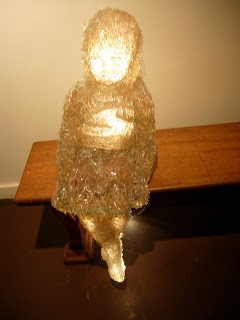
            Another component of the exhibit featured Ana’s creation of glass sculptures of several children, orphaned by the femicide in Ciudad Juarez, Mexico, as well as children left parentless through sexual and labor exploitation in Bangladesh and Vietnam. Ana began the process of creating the sculptures first by taking molds of the children in various poses. She then took the molds and covered them with broken glass from beer bottles. Her choice of material was based on her travels through Haiti and Ciudad Juarez where she noticed that broken glass was often as a type of home security system, placed at the tops of walls as a defense against robbery and other crimes. The broken glass sculptures were illuminated during the 2008 exhibit and positioned against walls of the Galería; one of the sculpture-children was placed on a bench. The figures were at once beautiful, haunting, and lonely. Ana wanted viewers to think about the multi-generational repercussions of the ongoing femicide in Ciudad Juarez, as well as the fallout of other epicenters of violence against women. Ultimately, the broken glass sculptures visually conveyed Ana’s and our inability to protect these children from the crimes against their mothers and the traumas imposed upon them as a consequence and in the future without the protective presence and defense of their mothers.           

Photo by Rio Yañez

Photo by Rio Yañez

            Returning to her recent lecture at my campus on November 8, Ana centered her presentation around her 2010 work, “Borranda la barda/Erasing the border.” (http://anateresafernandez.com/borrando-la-barda-tijuana-mexico/) In 2010, Ana “set an enormous ladder against the border wall separating Playas de Tijuana from San Diego’s Border Field State park, and using a generator and a spray gun, she started painting the bars a pale powdery blue. While wearing a little black cocktail dress. And black pumps” (Jill Holslin, 2010). Writer Jill Holslin concludes that “Erasing the border, then, reminds us of the power of utopian visions, of dreams and the imagination.” Utopian visions are not uncommon in narrative, and Ana works across many mediums, from visual art, to performance and social sculpture, to tell the stories that shape our cultural experiences. For those of you who may not be familiar with social sculpture, it’s an idea put forth by Joseph Beuys in the 1960s and 1970s that proposes sculpture as a potential for and an act of societal transformation. 

            One aspect of “Borranda la barda” that I had difficulty reconciling is Ana’s selected wardrobe for painting the border fence: a little black dress and black high heels. As a Chicana who has witnessed many offensive perceptions of overtly sexual apparel, I didn’t know how to read this component of her performance and intervention on the border. During her lecture, however, Ana explained that the “little black dress” is a loaded symbol—even a kind of capital—in the western imagination. By placing it out of its expected context—the nightclub, the lounge, etc.—Ana is able to channel its co-opted power, or objectifying gaze and turn it back on her viewer. 

            Also, while in the midst of painting the border that perfect shade of sky blue, she was detained by to policemen on the Mexican side, while helicopters hovered above her on the U.S. side. Her negotiation with the police went on for 45 minutes. Ana contends that her little black dress had everything to do with her ability to finish painting the piece. 

            Earlier this year, Ana learned that “Borranda la barda” had been destroyed—repainted the black color of the fence. Prior to arriving at Cornell to give her lecture, Ana returned to the fence and repainted “Borranda la barda” that perfect shade of sky blue that, at a certain distance, restores the horizon to an unbroken, unblocked natural divide, where the ocean meets the land.

Ella Diaz is an Assistant Professor of English at Cornell University. Her research is on the interdependence of Chican@ and Latin@ literary and visual cultures.

8 comments:

  1. Anonymous November 29, 2012 at 7:53 AM

    I had the pleasure of seeing Ana Teresa Fernandez’s work when she came to Cornell University and presented “Blurring Borders: Redefining Truths, Fables, and Folklores”. I was familiar with a few of her works before the presentation, but the highlight of the presentation for me was hearing about how Ana utilized local materials (garbage in Haiti, glass in Mexico) within her art and performance. The lack of accessible “traditional” art materials (paint, paper, brushes, etc.) was incredibly striking when we see the incredible work Ana has done in engaging local materials within a community consciousness in Haiti. Her representation of the children of Mexico orphaned by the Femicides in Ciudad Juarez was a striking portrayal of the multi-generational impact of violence and the inability to protect children from this trauma.

    In her performance of “Borranda la barda”, Ana addressed the binaries of female identity (perceived and performed) along a heavy politicalized border state. Her performance of both female identity and nationalism was particularly striking in the U.S./Mexico borderlands, specifically when looking at the Femicides of Ciudad Juarez.
    I look forward to researching Ana’s work in the future and am extremely thankful I was given the opportunity to hear her present her work at Cornell University.
    -Sarah Anderson

  2. Ester December 3, 2012 at 8:17 AM

    What a courageous artistic intervention into difficult subjects. Thank you Ella, for providing the context of these creations. It makes me appreciate her sensibility to address literal dismemberment, carnage if you will, without producing more injury.

  3. Theresa Delgadillo December 3, 2012 at 8:18 AM

    Dear Ella, Thanks for sharing the pictures and discussion of Ana Teresa Fernandez’s work. The casts of children covered in broken glass are quite moving, and ask us to reflect on violence against children on many levels in new global economies. How wonderful for your students as well that they heard her and had the opportunity to learn about violence at the U.S.-Mexico border through an artist’s engagement with the topic that foregrounds critical discussion. Theresa Delgadillo, Co-Moderator of Mujeres Talk

  4. Ella Diaz December 3, 2012 at 2:22 PM

    “without producing more injury.” What a beautiful response, Ester, to Ana’s work in the Ecdysis show on the murdered women of Juarez.

  5. GGuerra91 December 4, 2012 at 11:34 AM

    I also had the opportunity to attend her lecture and the lunch with her.
    The choice to bring ATF to Cornell, especially given the timing with our class was great. It allowed us to be exposed to a new kind of artist, one that is raising awareness about most of the issues discussed in class.

    She is resourceful and works with her environment, this is very important because it teaches people, specially the natives of the area, that they can use anything to beautify and create art. This was evident in her work in Haiti and in South Africa. In the latter country, she was able to show that artists have the duty to report the beauties of everyday life instead of reporting/focusing on the negative like the news do.
    Overall, it was a great experience being able to meet her and understand the thought process and goals of her art.
    -Gloria Guerra

  6. GGuerra91 December 4, 2012 at 11:34 AM

    I also had the opportunity to attend her lecture and the lunch with her.
    The choice to bring ATF to Cornell, especially given the timing with our class was great. It allowed us to be exposed to a new kind of artist, one that is raising awareness about most of the issues discussed in class.

    She is resourceful and works with her environment, this is very important because it teaches people, specially the natives of the area, that they can use anything to beautify and create art. This was evident in her work in Haiti and in South Africa. In the latter country, she was able to show that artists have the duty to report the beauties of everyday life instead of reporting/focusing on the negative like the news do.
    Overall, it was a great experience being able to meet her and understand the thought process and goals of her art.
    -Gloria Guerra

  7. Sophie Loren December 10, 2012 at 6:03 PM

    Though I know this blog talks about Ana Teresa Fernadez’s work, I really enjoyed the altar of photographs that Maria Teresa Fernandez, who happens to be Ana Teresa’s mother, created and left on display for at the Latino Studies Program here at Cornell University until late November. It was a way of humanizing the border when so many times it is militarized especially by the responses the United States has taken in the past years (because the U.S. must “secure” the border). I was able to actually take an instructor and another peer of mine who would have never stumbled upon this type of work and show them the exhibit. This was a way for me to raise consciousness in others (esp. since that one peer came from a privileged background).

    Moving back to the work that Ana Teresa Fernandez did on the border really struck me. She stated in her lecture that her work was about “transcending the given, by changing the context” and she gave them example of the broom and how it wasn’t dirty on the floor but was dirty when left on a pillow. She does the same with her little black dress and she places it out of context and calls attention to what she is doing but more importantly to the border and how she is erasing it as she paints it blue.

    I could continue to go on but all I can say is that I was taken aback by both Ana Teresa and Maria Teresa’s ingenuity and how they use art to speak and give voice to those who are voiceless in our world.

  8. Vanesa L. December 13, 2012 at 8:43 PM

    Attending Ana Teresa Fernandez’s lecture at Cornell University was a great experience . There were two exhibits that struck me the most. The first one was NanMitaNan: Haiti. I thought it was amazing that Ana Teresa was able to make sculptures out of plastic bottles she found. More importantly, the clear plastic material against the backdrop of oil lamps not only showed Ana’s ability to use the resources around her, it reflected the ghost of the beautiful architectural structures in Haiti, the lack of resources and the invisibility of Haitian people to the rest of the world. I believe that Haiti is stuck “nan mitana” or in the middle between their historic accomplishments of gaining independence in 1804 and the potential of what nation could be. Her Ecdisis:Juarez, Mexico exhibit was also very memorable . The glass figures of the children were beautiful but it made me realize the generational effects that femicides have on these children. The children are fragile but defensive just like the jagged pieces of glass that make up the sculptures. To have their mothers taken way from them without justice being served is devastating. Thus, the femicides in Juarez has serious implications for the future of Juarez.

    I thought Ana Teresa’s work was fantastic. I hope she continues to do more work involving different human rights issues around the world.