Welcome to 2014 Contributing Bloggers

We write today to welcome the inaugural group of Mujeres Talk Contributing Bloggers. Kimberly Blaeser, Linda Garcia Merchant and Elena Herrada have agreed to serve in this position for 2014. As Contributing Bloggers, Blaeser, Merchant and Herrada will be writing for Mujeres Talk throughout the year — so look for their posts! Mujeres Talk readers will remember that Kimberly Blaeser’s poem “Dictionary for a New Century,” launched our 2014 year, and we’re looking forward to more poetry as well as commentary and research this year. An independent filmmaker, Merchant will be writing about some of her current film and research projects. Herrada, who has been active in multiple Detroit communities, plans to write about community projects and experiences.

All three of our 2014 Contributing Bloggers are from the Midwest: Blaeser grew up on the White Earth Reservation in northwestern Minnesota and currently lives and works in Wisconsin; Merchant grew up in and continues to reside in Chicago, Illinois; and Herrada is a lifelong resident of Detroit, Michigan. Their long and rich experience and research in Native American, Chicana/o, African American and Latina/o communities of the Midwest brings additional breadth and depth to Mujeres Talk, and to multiple academic and artistic fields. We invite you to visit the 2014 Contributing Bloggers page on our site to learn more about the newest members of the Mujeres Talk project.


Finishing the Dissertation

stream of colored lights
Energy Stream (1/5) by Flickr User Joe Skinner Photography
CC BY-NC-ND 2.0
Advice from Graduate Students To Graduate Students on Finishing Your Dissertation

by Yalidy Matos

Graduate school can be an extremely isolating and lonely experience for many  students. It is hard to make time to join social organizations, or for anything other than courses or your dissertation, thus, adding to the isolation and loneliness of it. However, one of the main factors that has helped me is the support from other graduate students. Their friendship and advice has been instrumental to my success in graduate school.

Writing a dissertation can be a daunting and overwhelming experience. It can very easily overwhelm you to the point where you feel immobile; you’re not sure where or how to start. The following is some advice from women graduate students who are either working on or have successfully finished the dissertation.

First, remember that “You can’t eat an elephant in one bite.” Writing a dissertation is a process, it needs to be taken one step at a time. Many of the graduate students emphasize pre-planning, outlining chapters, daily scheduling and writing, weekly goals, and making a dissertation calendar as some of the most important ways they were able to write and ultimately finish their dissertation. Setting feasible weekly goals such as “draft literature review section,” or “edit introduction to chapter x,” are both feasible weekly goals. Each goal focuses on a section of the dissertation, not the entire dissertation or even an entire chapter. Feasible weekly goals allow you to actually meet those goals and reward yourself for it.  Another bit of advice from graduate students is to reward yourself for completing a milestone and/or your weekly goal. One of the graduate students, for example, treated herself to a movie when she finished a weekly goal. You are your own cheerleader and advocate!

On that note, get rid of any “negative energy” and speak positively about your dissertation. Getting rid of negative energy can mean many things. Negative energy can come from others, but it can also come from your inner critic. If you have other graduate students who are always speaking negatively about you or your work, make an attempt not to have conversations with them. Always do so politely and professionally. As graduate students we should be able to choose not to have any kind of negativity around us; it hinders our own progress and work. It is the case, however, that we can be our own worst critic. Find a way to release negative energy (exercise, yoga, meditation, counseling, graduate student support groups), and surround yourself with people that cheer you on and love and support you and your work. On a related note, make use of university resources. If your university offers counseling services or graduate student support groups, join! There is no shame in wanting a supportive group of people to talk to and with which to share experiences. Additionally, if your university or department does not offer these types of services, then take the initiative and create a dissertation workshop/group where you only have supportive positive graduate students. Such a group can serve many purposes; it can be a writing group or more of a support group.

Finally, seeking positive energy includes having a supportive dissertation committee. The dissertation process is already difficult and time-consuming; you want your committee to be supportive of you and your work. Committees are not set in stone until you turn in your paperwork to graduate to the graduate school.  Seek mentorship from other faculty members with whom you feel comfortable. At the end of the day your dissertation committee should be a group of people who believe in you and push you to be and do better. The relationships with your committee members will not always result in happiness (dissertations are hard work, after all), but they should always be a relationship marked by professionalism and guided support.

Thank you to the following faculty and students who generously contributed tips and advice to this essay: Devyn Gillette, PhD, Post-Doctoral Researcher, UNC-Chapel Hill; Danielle Olden, PhD, Assistant Professor, University of Utah, Department of History; Desiree Vega, PhD, NCSP, Assistant Professor, Texas State University, School Psychology Program; Delia Fernandez, PhD Candidate, Ohio State University, Department of History; Gisell Jeter, PhD Candidate, Ohio State University, Department of History; Tiffany Lewis, Graduate Student, Ohio State University, Arts Administration Education & Policy.

Suggested Additional Resources:

Books:

Single, Peg Boyle. 2020. Demystifying Dissertation Writing. Sterling, VA: Stylus Publishing.

Miller, Allison B. 2009. Finish Your Dissertation Once and for All!: How to Overcome Psychological Barriers, Get Results, and Move on With Your Life. Washington, DC: American Psychological Association.

Evans, David., and Paul Gruba. 2002. How to Write a Better Thesis. Australia: Melbourne University Press.

Blogs:

Get a Life, PhD at http://getalifephd.blogspot.com

The Thesis Whisperer at http://thesiswhisperer.com

Yalidy Matos is a graduate student in the Department of Political Science at The Ohio State University. Her dissertation focuses on the dynamics driving public opinion on U.S. immigration policy. Matos is currently a National Science Foundation Graduate Research Fellow.

Remembering Nelson Mandela

11206285456_6b5da7bb8f_z(1)
Photo by Flickr User HelenSTB
CC BY-SA 2.O

by Inés Hernandez-Avila

I wrote this poem for Nelson Mandela in 1988 because he truly moved me, all along the path of his life as I began to know about him, and his spirit will continue to move me, always.  The poem speaks for me of what I think of him.  He was a great Spirit who came to this earth to be Nelson Mandela, and he kept the radiance he brought with him from the spirit lands of the ancestors.  With the example of his life, he “lifted us up,” as my own Nez Perce elder, Albert Andrews would say.  I have read the poem at literary events, but it has never been published.  On the occasion of Mandela’s death, my dear colleague, Jualynne Dodson asked, on the Ford Foundation Fellows listserv, what the impact of Mandela had been on the Chicana/o community.  I sent her my poem, from my own Native (Nez Perce) and Tejana perspective.  As I re-read what I had written in 1988, I saw that everything that I wrote for him all these years ago, still holds true.  And I did write the poem while listening to Abdullah Ibrahim’s piano composition, “Mandela.”  Ibrahim, moved by Mandela, composed his piece, and I was moved by the beautiful music for this great human being, this Maestro, who brought his light to the world.  It is a poem from my heart.

For Nelson–Leader, Tribal Person, Elder*

Summer 1988, on the occasion of Mandela’s 70th birthday, when the South African government offered him a six hour visit with his family

Oh Mandela, Mandela

I sing your name

in the name of all peoples locked in and up

in their very cells

weighed down by all the forces

that do not want their hearts light

and spirits lifted

Nelson, Nelson

Triumph is a sweet song

the one you know

saxaphones jubilant for your spirit

concentrating

in your space

to will your conscious waking

sleeping dreams

for all of us to see

And it is hard, Mandela, Mandela

Six hours offered you with family

with Winnie and your daughters

six hours to hold each other

gulp in every detailed facet

talk with hands eyes ears mouth

nose smiles tears

as if the heart of the very mother earth

would burst with joy at such a moment

but this joy cannot be

it is, as you say, not possible

for you are not alone

but one of oh so many whose pain like yours

meted out minutely daily

seeks to engulf you in despair

This visit offered is not to them

but to you

And what is six hours in the face of terror centuries old

horror with the face of most intentional genocide?

Six hours more or less of time

when in those same six hours

Children, little children

sit, like you, in other prison cells for their “subversion”

When heads are cracked and bodies wracked

across the landscape of a continent that is yours theirs

A motherland keeps count of each heart battered to a bloody pulp

to stop its count of life

And you know, too, that count

So you stop the maddened offer of a visit

What would you have said, Mandela, Mandela?

“Shall we have tea, Winnie?

Daughters, rub my back, I am so sore.

What shall we talk about?”

And in the next cells casually inflicting itself

in studied vehemence on seemingly countless others

the obscenity of racial/cultural boundless hatred

Nelson, Nelson

A visit?

We are visiting for you all over the world

for you and with you in our homes your face shines

from  the walls of our hearts

Poets gather to sing for you

Peoples gather to struggle with you

Workers pass the light of your name from mouth to mouth

Races, classes and sexes unite for you and for the people

Children learn of you and of the brave children

through whose eyes and spirits we find courage

Agelessness is where principled commitment is born and lives

Even in the splattered, broken bones of death

that wants so badly to detain the march of liberation

in all its splendor

Mandela, Mandela

you are real

The people you stand firm for are real and true

The visionary will outlast the cynic, the impotent and depraved

It is a matter of time

Only a small matter of time

The freedom spirit is soaring from heart to heart

around the world

To stop for six hours for convenience?

No, Nelson, Nelson

How you knew how time is precious

How you knew to keep on soaring

Oh, Mandela, Mandela

Keep on soaring

*With thanks to Abdullah Ibrahim, because this poem was written to his composition “Mandela.”

©Inés Hernández-Avila 1988

Inés Hernández-Avila is a Professor of Native American Studies at UC-Davis, where she is also Co-Director of the UC-Davis Social Justice Initiative. She has been involved in creating both the MA and PhD program in Native American Studies at UC-Davis. Her research and teaching focuses on indigenous literatures of the Americas and Chicana literature and feminism.


 

Call Me “Doctor”?

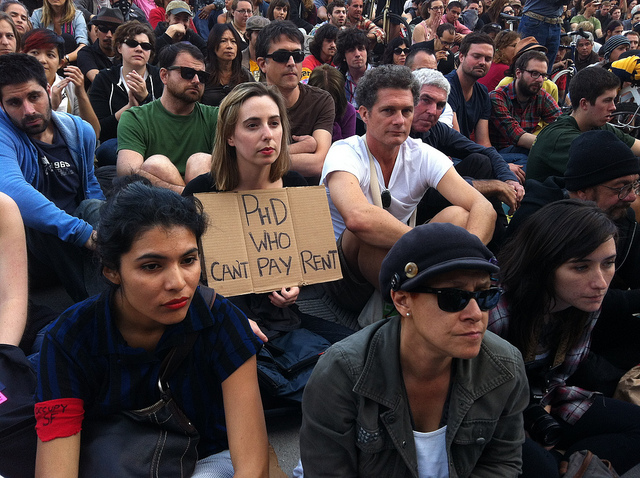
People sitting in Occupy Movement protest.Photo by Flickr User Steve Rhodes, CC BY-NC-ND 2.0

by Erika Gisela Abad 

This past summer, a call center coworker of mine joked that I should have clients call me “Doctor,” because, having recently graduated with a PhD, it was my professional title as well. As we laughed, I recalled graduate school conversations where the title ‘doctor’ or ‘professor’ was not a laughing matter, especially among women and peers of color. Many of us believed that the title could reinforce what respect and authority we had earned. “Doctor” conversations in both graduate student cubicles and call center cubicles reflect how each environment perceived power, authority and, more specifically, respect. As I compare blogs and academic journals that discuss the nature of how faculty are treated to the perceived experiences of customer service workers, and undocumented workers to which they are compared, I ask myself: when did I begin to equate educational training with earned respect?

In attempting to address the question, I bear in mind compared expectations and value assessment in each position. While the comparison warrants longer conversation, I had to come to terms with the reality that the skills of a person with an advanced degree are more transferable to other forms of white collar and or middle class labor than those within other professions. The way some adjunct faculty have reflected on their experiences, it is easy to forget the extent to which one with a master’s or doctorate can apply their literacy, writing and reviewing skills to other professions. While it is an injustice that adjuncts who rely on teaching as their sole income do not make a living wage nor have access to affordable healthcare, it is important to re-examine the context in which the aforementioned concerns are discussed. Particularly that the focus is on one profession which experiences these economic limitations instead of the general limitation as a whole.

The reason one applies for food stamps, could have barely afforded adequate health care insurance, or worries about their economic stability has less to do with education and more to do with both national and regional policies of what we allow a living wage to be for anyone. Those of us who are underemployed or who, despite our training and skills, do not have full time teaching positions, are a testament that professional degrees do not, by default, create a demand to match the supply. As we vocalize our gendered and raced subordination within the profession, it is critical we bear in mind the national policies and practices that shape limited access to education, adequate health care and affordable housing. Moving beyond the disappointment that advanced degrees do not guarantee the higher quality of life expected, what critical lessons are we learning from the economic recession?

I will answer that question specifically focusing on the women of color narratives I have begun to review so far. Women of color, who speak from a position of recognized institutional marginalization, frame their narrative cognizant of how their gendered and raced social locations create student-teacher/teacher-administrator/supervisor tensions (Turner, Harley, Maisto). Such testimonies and theoretical discussions had initially framed the reliance on “Doctor/Professor” as a symbol of authority and respect, especially on campuses whose towns and cities featured fewer middle class and politically organized people of color. Solely relying on resilience built from my graduate school experience tempted me to forget the manners in which working-class women/women of color in my family and former client bases have worked to assert their respect because of their right to human dignity and community empowerment. As much as I worked to resist institutional xenophobia and the resulting micro-aggressions I encountered along the way towards my PhD, my self-righteous resilience transformed into a meritocratic ethos that overlooked the womanist, mujerista ethos that shaped my intellectual and political communities.

At the core of that ethos lies the understanding that formal education is but one avenue by which we can address social disparities. While reflecting on the pressures and stresses experienced as a result of departmental hierarchies and policies, it is imperative to remember the professional and skilled position from which we speak. Many of the readers of and contributors to Mujeres Talk use our position as educators and advocates to disrupt the insular culture of the ivory tower. As we do so, we risk a great deal because of how our commitment to serving students and our greater communities is pitted against our institutions’ expectations of production. As my academic generation negotiates the double-edged sword of cultural capital and racial profiling, how are we coming to terms with the vulnerability of critical pedagogy and the prestige of our formal training? How do we not internalize racial micro-aggressions by presuming our mixed-class position should be the foundation of our economic security?

Returning to my coworker’s joke, a title or formal training does not guarantee the recognition of human dignity, nor should they be required to acknowledge it. I do not ignore the grave concern around society’s devaluing a liberal arts education nor am I ignoring the worth of the time and effort I put into my projects. As we work to call attention to the degradation of liberal arts higher education and to social justice oriented pedagogy and scholarship, what would it look like if we addressed those concerns within the greater injustices experienced by those whose labor in literal and figurative ‘service’ work is undervalued?

References

1) Firmage, Ed. “Wage Slaves in the Ivory Tower.” UVU Review the Student Voice. 26 March 2013. 2) Harley, Debra A. “Maids of Academe: African American Women Faculty at Predominantly White Institutions.” Journal of African American Studies 12 (2008): 19-36. 3) Leonard, David. “Adjuncts Aren’t Slaves. Let’s Stop Saying They Are” Vitae 4 December 2013. 4) Maisto, Maria. “Adjuncts, Class, and Fear.” Working-Class Perspectives. 23 September 2013. 5) Snodgrass, Langston. “Adjuncts: The Slave Labor of Higher Education.” Langston Snodgrass. May 2013. 6) Turner, Caroline Sotello Viernes. “Women of Color in Academy Living with Multiple Marginality.” The Journal of Higher Education. 73.1 (2002): 74-93.

Erika Gisela Abad received her PhD from Washington State University’s American Studies Program in May 2012. Her work and poetry have been published in Diálogo and Mujeres de Maiz, and she has work forthcoming in Latino Studies and Sinister Wisdom. An alumni of AmeriCorps and long-time volunteer of organizations serving Latino youth and their families, she does her best to maintain communities ties that foment a theory in praxis. Since finishing graduate school, she has been supporting the Latino community of her North Portland parish, running between the kitchen and the food pantry, going to where she is needed.