Collective Imaginaries

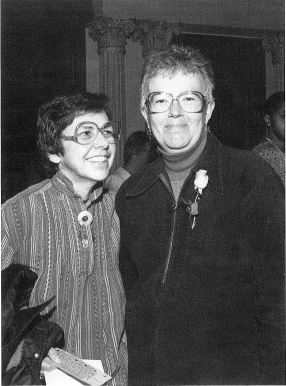
Photo of two women side by side, June L. Mazer and Bunny MacCulloch

June L. Mazer (right) and Bunny MacCulloch. All rights reserved UCLA Center for the Study of Women

by Lizette Guerra

Yolanda Retter-Vargas, my mentor and predecessor at the UCLA Chicano Studies Research Center, taught me that even within my own perceived community there were many communities: Latinas, Chicanas, Lesbianas, feminists, and others. She drilled into my work ethic the notion that I could not truly be at the service of my community, or any community for that matter, if I did not make a true concerted effort to represent everyone, women, men, lesbian, gay, rich and poor, of all cultural backgrounds and beliefs. Yet, historically, this belief has not been central to our profession. Archivists have been privileged with the power to decide what is deemed historical and what is not. What do we preserve for future generations and what do we leave out of our collective imaginaries?

Despite the reality that Los Angeles is one of the most diverse cities in the world, people of color and the LGBT community in particular continue to be underrepresented and in effect invisible within archival collections, the public record, and historical research. The partnership between the UCLA Library, CSW, and the Mazer Archives reflects an increasing awareness amongst archivists and librarians about the importance of collecting more ethnic studies and LGBT materials. In recent years, our profession has been moving away from exclusionary collecting practices and progressing toward more community-oriented approaches that include donors and patrons in the archival process. The collections in the Mazer Archives project not only reflect this nation’s rich history, but also, more importantly, provide communities who have long been under-served and under-documented within the historical record with a resource that respectfully reflects their experiences and contributions to U.S. history. Each step of the way, we have made it our priority to include the Mazer Archives’ staff and affiliates in the archival process. We have chosen to do so because each of the stories contained within the collections represents a community’s memories. The presence of such materials within an institution such as UCLA contributes to a community’s visibility, legitimation, and continuity.

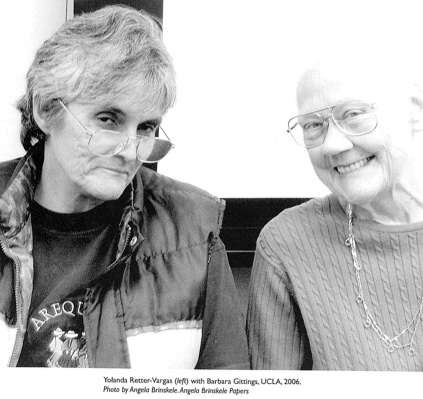
Yolanda Retter-Vargas and Barbara Gittings standing side by side.

Yolanda Retter-Vargas (left) with Barbara Gittings, UCLA, 2006. Photo by Angel Brinkele. Angela Brinkele Papers. All Rights Reserved UCLA Center for the Study of Women.

“If we don’t collect these things,” Yolanda always said, “no one else will.” The partnership between UCLA and the Mazer Archives is a perfect example of the type of innovative project that Yolanda would have supported. This partnership has allowed us to document and provide wide access to documentation of early lesbian activist and literary history in Los Angeles since the 1930s—stories that might otherwise have been lost or forgotten. As Yolanda wrote in her dissertation, On the Side of Angels: Lesbian Activism in Los Angeles, 1970-1990 (University of New Mexico, 1999), “Amid the criticisms, let it be remembered that once there was a vibrant movement that put women first. In a world that was (is still) bent on undermining women, that kind of prioritizing and commitment deserves respect and study. Regardless of what terms are used to describe (or disparage) the lesbian activist movement, its spirit persists within the generational cohort that created it during a ‘social moment’ in U.S. history. It persists as a vision, an ideology, a submerged network and as a significant contribution to the tradition of resistant consciousness and pro-woman advocacy. Blessed Be.”

This essay is reprinted with permission from June L. Mazer Lesbian Archives: Making Invisible Histories Visible: A Resource Guide to the Collections. Edited by Kathleen A. McHugh, Brenda Johnson-Grau, and Ben Raphael Sher. Los Angeles: UCLA Center for the Study of Women, 2014. ISBN: 978-0-615-99084-2.

Appendices

Herstory Archives

http://www.lesbianherstoryarchives.org/

June Mazer Lesbian Archive

http://www.mazerlesbianarchives.org/

In the June Mazer Archive, the following are Latina collections:

Terri de la Pena Papers

http://www.oac.cdlib.org/findaid/ark:/13030/c8sx6f0m/

Terri de la Peña is a novelist, short story writer, and children’s book author whose writings deal with complex issues of identity, homophobia, assimilation and resistance focusing on the lives of Chicana lesbians. This collection contains materials related to the creation, dissemination, publication and revision of both fictional and nonfictional works by Terri de la Peña. The bulk of the collection is made up of drafts of her first novel, Margins, also considered to be the first lesbian Chicana novel. The collection includes correspondence, contractual information, promotional materials, drafts and notes.

Connexxus /Centro de Mujeres Collection

http://www.oac.cdlib.org/findaid/ark:/13030/kt1779r55b/

The Connexxus/Centro de Mujeres Collection contains the administrative records of Connexxus / Centro de Mujeres, one of the first Los Angeles non-profit organizations that catered and provided services to lesbians.

Lizette Guerra is the archivist and librarian at the UCLA Chicano Studies Research Center Library and Archive. She received an MA in Latin American Studies and an M.L.I.S. in Information Studies from UCLA in 2007. She has research experience working in museums both in Mexico and Guatemala. She has done archival, curatorial, and cataloging work for the Autry National Center’s Southwest Museum of the American Indian and the Museum of the American West in Los Angeles, CA.

“Adam’s Rib: Island Taboo Unveiled”


by Iris Lafé

I had long forgiven my father. For the sake of my battered mother’s dignity safely folded the skeletons in the family closet as good little Puerto Rican girls and boys so often do. Five decades later and our homecoming to their native Puerto Rico (1999), the dreadful specter of domestic violence returns to haunt me again—this time, in high definition. In this essay, I explore a silent tragedy ravaging La Familia Puertorriqueña of the 21st Century: Femicide.

My story begins with a visit from The Muse. While languishing in the remote, rural quiet solitude of my aging parents’ Barrio down south, my heart cries out for the battered mujeres of Puerto Rico. I was expecting her.

“There’s a reason you came back to the troubled homeland when you did,” she prompts. “Family violence, child abuse and benign neglect, the traumatic ripple effects on victims and to society is a subject you know all too well. Remember your experience. Don’t be afraid. You lived it and carry your mother’s memories deep inside the well of your anguished soul. You both survived, as a single mother you broke that cycle of abuse and your only daughter remains virtually unscathed. But look at the future, getting bleaker by the day for the next generation of women and girls, if they survive at all. Be the light, tell your story and break the silence.” The Muse emboldened me and possessed my disenchanted body right on the spot.

Day after day I was riveted to the Spanish local TV news. During breaks from my 24/7 caregiver duties, I began to chronicle my life on the island, to document what I was witnessing—it became a feverish compulsion—a reflex and residue from my California days in broadcasting and the media: Where’s the story? Get the story and get the scoop. Switching channels, clearly, from the missing coverage on mainstream networks beaming down by satellite, I had the scoop.

On the U.S. Caribbean colony—population 3.7 million “Forgotten Americans”—violence against women had reached unbridled, unconscionable proportions. From January to June 2011, in only six months, an unprecedented nineteen (19) mujeressuffered brutal, gruesome deaths, mortal mutilations and slayings reminiscent of a Stephen King novel—an abomination to our noble society.[i]

Despite La Ley 54 (domestic violence protection and prevention act of 1989) Puerto Rico had the highest per capita rate in the world of women over 14 murdered at the hands of a spouse or partner and the numbers kept climbing, ending 2011 with 30 femicides, scrutinized in an ACLU report.2 These are terrorizedwomenthe police failed to protect (whether by omission or commission) among the total of 1136 men, women, and children violently murdered that year.[ii]

The vivid scenarios of families trapped in violence, condemned to unmitigated poverty, beamed me back to my childhood household in 1960s New York.

The sweltering Lower East Side tenement, exuding the aroma of festering refuse from the back alleys, made me gag each time I scurried past the dingy hallways into our fire escape window apartment #1. The humble hearth Mami, the dutiful domestic—Boricua clean freak—whitewashed using her penetrating Pine Sol cleaner and irresistible sautéing sofrito vapors rising from the stove. Her story I’d begun to write:

Everything I am, ever was or ever shall be I owe to mi santa madre. Mami was a saint— “Saint Tolerance.” She put up with my father´s “casca rabia” irascible, grumpy temperament, early years of matrimonial hell, always on her knees, praying without cease at her overworked altar of Catholic Christian faith. Holding high hopes for a miracle, that one day, Papi would stop getting drunk, using her as his punching bag; while she still loved “el macho de la casa” (her sole provider) unconditionally. To the day he passed away, she justified, “tu Papá es bueno.” Your father is a good man, her misty eyes imploring me to forgive him, her final dying wish.  

It hadn’t looked that way to me. I’d seen “The Hulk” crush her face into one bloody pulp. From the age of five in Loisaida, I witnessed the “War of the Lópezes” time and time again. The silent and sullen type, under the influence Papi was “a bad drunk,” your standard Dr. Jekyl and Mr. Hyde. Generous shots of rum fueled a strange combustion unleashing the beast, a cruel monster of a two-legged kind. No civility whatsoever, he fumed and roared, the foul-mannered brute he became, ¿Pendeja, cómo dejastes que’se nene se queme? Idiot, how could you let the child get burned? he charged. No questions asked of Mami, as if she were chattel, less than human to boot, and beat!—reared on erroneous illusions of greater male entitlement.  

Earlier, my curious brother reached up to the hot stove toppling the simmering pot of yummy habichuelas (beans) onto his 3-year-old frame. An ossified Papi arrived from his midtown-Manhattan garment district job pushing clothes racks (earning a paltry $35 a week) to find little Junior badly burned.    

A sewing machine operator (he forbade to keep her factory job) Mami was busy too; in the living room sewing piecemeal to earn some cash to feed her hungry brood. The roach-overrun cupboards were bare again. Accidents were common with my hyperactive brother. Impatient for dinner on the table, he wiled into the kitchen to silence the grumbling in his belly. Mami feared Papi squandered his meager earnings again—drinking.

“Yo no tengo la culpa.” It´s not my fault, Mami pleads Papi to hear her out. “You don’t help me raise these children. You’re their father.” It never failed, on pay day, Papi took a detour to the liquor store for his panacea and was plastered by the time he got home, swearing ¡hijo eh putas!, those sons of bitches, without a care our little hearts were pumping fear. An in-your-face Mami dares to “sass” her Lord and master! “¿Pa´ qué fué eso?” She went there? Not again!

Papi clenches his teeth, huffs and puffs arrogance. His sledgehammer fist craters the walls, crashing into Mami’s lovely cinnamon-colored face, rapid fire licks meant to show her who´s boss. The heavyweight punches dislodging her front teeth vanished her cheerful alabaster smile. “Why don’t you leave that man, he will kill you the next time,” I begged my inconsolable mother, afraid I could be next, to suffer the wrath of a drunken, domineering father. A future feminist was burning inside the “Mini-me.”  

“I can’t. I will not raise my children without a father,” she despaired; Adam’s Rib beaten but not broken. Down her swelling face cascaded red rivulets of tears.

Loving, as it were, Papi was a tormented man from the time he learned he was a “castaway”—a love-child kicked to the curb. “Yo no tengo familia,” I have no family, he bemoaned to me on his death bed. “Ello sí.” Of course you do. “You have us, Daddy,” I retorted consolingly, switching from Spanish to English, like we always did since the time I was a little girl, feeling the sting of his rejection all over again. And yet, I empathized with his frail human condition.

Hijo de crianza (adopted by next of kin) Papi never knew his biological parents. Emotional baggage he was not up to the task of handling in marriage; Mami captured his heart at the tender age of 17—she was 27. He piled his arrested development issues on her, inflicted bodily and emotional injuries no child should grow up seeing as my three siblings and I did during the formative years. Early childhood traumas leave an enduring emotional scab that can harden one’s heart.  

On July 14 2011, reported our daily Primera Hora, outraged women advocates, representing the organization Coordinadora Paz Para La Mujer, a women’s collective of emergency shelter and service providers; and the civil rights coalition Movimiento Amplio de Mujeres, MAMPR, (General Mobilization of Women of Puerto Rico) denounced the government for not doing more to confront this issue and declared Un Estado de Emergencia Nacional (National State of Emergency) to stop the killings, demanding government action.[iii] Decrying the failures of La Ley 54 for lacking the muscle (and greater goodwill) of a male-dominated police and judiciary on the island; for not observing the tactical plans and protocols implemented, since 2005, by La Oficina de la Procuradora de Las Mujeres (Women’s Legal Advocate Office); for sanctioning the consequential violation of victim’s rights: bottom line, for being part of the problem, not the solution.

Puerto Rico suffragettes earned the right to vote in 1935. Eighty years later, women victims of gender violence fall victim to another crime, the cavalier machismo attitude judging that “the woman asked for it” including my own Papi until the thrashings stopped.

I pondered Mami’s fate, had not the NYC police handcuffed him and placed him behind bars, shielding her from her abuser. Not so in the case of la colonia:

  • 20,000 domestic violence incidents, on average, are officially reported each year
  • 130,000 women and girls subjected to family violence each year eschew the unresponsive system.[iv]

According to the ACLU, 107 femicides over the five years 2007–2011highlight the new normal today.[v]

My Mami’s action in defending herself scared my Papi straight. The thrashings stopped. To my parents’ credit, true love killed the beast.

[i] González, Leysa Caro. “Emergencia nacional por muertes de mujeres víctimas de violencia doméstica.” Primera Hora. 14 de julio de 2011.

[ii] Alvarez, Lizette. “Economy and Crime Spur New Puerto Rican Exodus.” New York Times. Feb. 9, 2014. [iii] González, Leysa Caro. “Emergencia nacional por muertes de mujeres víctimas de violencia doméstica.” Primera Hora. 14 de julio de 2011.

[iv] Mollmann, Marianne. A Step Backward for Puerto Rican Women.Women’s Rights Advocacy Director for Human Rights Watch. Puerto Rico Daily Sun. August 4, 2011.

[v] ACLU. “Failure to Police Crimes of Domestic Violence and Sexual Assault in Puerto Rico.” June 19, 2012.

Iris Lafé is the pen name for an emerging Afro-Latina writer who reports on 21st Century “Colonial” Puerto Rico from her perspective as a Diasporican returnee to the homeland in stylized personal vignettes. A Writer’s Well Literary Competition winner (2012), contributor to herkind.org Global Woman, and former writer KCBS News Radio (SF), Lafé is a Bronx Science alumna, holds a BA in Black and Puerto Rican Studies from Hunter College, and works and lives in the San Juan Metropolitan Zone with her daughter. Currently editing her back-to-roots memoir, Lafé can be reached at: boricua.freedom.writer@gmail.com

Contending Worldviews in Leslie Marmon Silko’s Almanac of the Dead

by Theresa Delgadillo

This essay, originally prepared in 1996 for Professor Cherríe Moraga in her course on “Prophets/Scribes of Aztlán” at UCLA, has been updated and edited to meet Mujeres Talk requirements. Professor Moraga required students to do a kind of writing different from that typically required in a graduate seminar. She asked us to put ourselves into our critical work, and I took this to mean that we should write in a way that explicitly acknowledged the perspective from which we wrote, making clear and concrete, in writing, our investments and histories in the intellectual projects we undertake. For me, what it yielded was a creative non-fiction essay about a piece of literature, a form different than the academic article and made more so here through editing into a blog essay, a form that also calls upon authors to share more of oneself that one might in an academic journal. The blog essay is also a form necessarily focused on a small part of the literature under discussion, meant to provoke reflection, discussion, and further reading. I refer interested readers to the many excellent articles on Silko’s novel on the MLA International Bibliography.

In Almanac of the Dead (1991) Leslie Marmon Silko re-writes the history of the encounter between Europeans and indigenous peoples in the Americas. It is no longer the story of “civilization” meeting the barbarians, not the moment at which Indians begin to disappear, but a brutal, cunning, bloody, savage conquest that spawns equally brutal societies. It is almost as if Silko, in one massive novel, attempts to reverse generations of schooling on the history of this continent, though one has to be open and ready to hear new stories in order to understand the Almanac.

Growing up Chicana anywhere in the United States presents many challenges to one’s “story,” because our experience is undervalued or denied. We live in a nation where ours is not the official story, and yet it is ours. Like the speaker in Lorna Dee Cervantes’ poem who says, “I’m marked by the color of my skin” (35-7), so, too, have I been marked in every school I’ve been in since childhood. Though I knew it from my first day in school in Milwaukee, Wisconsin, I only began to understand it in seventh grade. One of my older brothers gave me a copy of Bury My Heart at Wounded Knee (1970), which I read while my Social Studies class studied the period of westward expansion into the Dakotas and the Black Hills Gold Rush. I was stunned by the glaring difference in these narratives. The two books had completely different things to say about the same events. While Indians were nowhere to be found in the school textbook, they were everywhere in Dee Brown’s account, prompting me to ask our teacher about this discrepancy.

My question to the teacher was not simply about facts or words, it was, as Linda Hogan says, about “ways of thinking and being in the world” (12). Around that time, there were a series of marches and protests by Wisconsin Native Americans in the news. Having already been mistaken for Native American, I knew that discriminatory treatment toward Native Americans was not unlike that directed against Mexican Americans. I was disturbed by how our textbook completely erased Native American peoples from history. Our teacher, however, insisted that our textbook was accurate. He dismissed my question. When I tried to explain what Dee Brown reveals in Bury My Heart at Wounded Knee, he told me to be quiet. I continued, but the teacher yelled at me. I then did something completely surprising to all, myself included: I yelled back. Another supervising teacher was called in. Lots of tense whispering, then the bell rang, and so did discussion.

When I read Almanac of the Dead, I thought back to this youthful confrontation with history. Today, I also have to wonder about where Latina/os were in that curriculum, but back then I was just beginning to understand then what the novel illustrates so well — the difference between dominant history and story/ies/histories. A conception of history in the singular as the static and unchangeable past shields it from inquiry and allows it to be compartmentalized and separated from both the present and the future. New knowledge cannot alter it. History in that sense is perhaps why the teacher could not accept another version of the same events in the Dakota Hills and why he did not even consider it important enough to discuss–the events were safely in the past and therefore not of major concern, not to mention that Dee Brown’s version of events was in conflict with the textbook narrative.

In Almanac of the Dead, there are two conceptions of the past diametrically opposed to one another: dominant history versus story/ies/histories. These distinct conceptions are really competing worldviews and they create conflicts for individual characters, who must decide which view will guide their lives. One character who experiences this conflict is Sterling:

[He] had been carefully following advice printed recently in a number of magazines concerning depression and the best ways of combating it. He had purposely been living in the present moment as much as he could. One article had pointed out that whatever has happened to you had already happened and can’t be changed. Spilled milk. But Sterling knows he’s one of those old-fashioned people who has trouble forgetting the past no matter how bad remembering might be for chronic depression. (24)

The past Sterling wants to forget is his banishment from Laguna Pueblo, yet he was raised on the stories of his Pueblo, including the dispossessions and indignities imposed upon them by  government and dominant knowledge systems (31). He cannot forget one portion of the past without forgetting it all. He enjoys reading the Police Gazette, with its stories of criminals past, in part, because this is one place where Indians to appear in the history of the West with some attempt at understanding their perspective (39-40).

An awareness of the contrast between dominant history and story/histories also operates for the character of Clinton, who, as an African-American Vietnam veteran now homeless, tracks on the discrepancies between the two. Clinton remains highly critical of what he learns in university classes  yet he also finds there, in Black Studies, research that confirms his sense of his people as more than mere pawns of history, and gains a wealth of knowledge on the experiences and cultures of Blacks (414-431). When he critically recalls how wealthy Cherokee Indians had been rounded up by orders of Andrew Jackson, Clinton insists that a “a people’s history” must include all the stories: “That was why a people had to know their history, even the embarrassments when bad judgment had got them slaughtered by the millions” (415).

In the novel, characters who refuse the stories of others are racked with fear, and in the novel, doomed to failure. As Linda Hogan observes, “the Western tradition of beliefs within a straight line of history leads to an apocalyptic end” (93). This is what the characters Beaufrey and Serlo see in the future–cities burning and anarchy reigning–which is why they want to develop modules to survive in space (542). An apocalyptic ending is also what the character Menardo sees and why he is obsessed with insurance and security (266). In the novel, his first wife, Iliana, too, proud of the historical pedigree of having been descended from the conquistador De Oñate “still was gnawed by the fear that disaster was stalking all of them” (270). That fear is also one shared and preyed upon in the novel by characters representing the military regimes of Latin America and their U.S. collaborators.

Another view of the future emerges in the novel from the character of the Barefoot Hopi, who presents a perspective challenging for humans when he says:

            You destroyers….don’t know how much the spirits of these continents despise you, how the earth hates you….All the riches ripped from the heart of the earth will be reclaimed by the oceans and mountains. Earthquakes and volcanic eruptions of enormous magnitude will devastate the accumulated wealth of the Pacific Rim. (734)

Unlike Serlo’s view or Menardo’s view, this prediction of cataclysmic events is not a prediction of end, but of beginning. In the Hopi’s view, the world does not revolve around humans and therefore the end of things human is not a catastrophe. He predicts that the Earth will cleanse itself and continue; this he does not fear. His view parallels Yoeme’s, who says that the sacred Earth “would go on, [it] would outlast anything man did to it” (718). This is what Sterling comes to understand, too: “Burned and radioactive, with all humans dead, the earth would still be sacred. Man was too insignificant to desecrate her” (762). In the course of the novel, several characters arrive at this understanding of the earth’s story, and must re-consider human interaction with it. Yet, do the Barefoot Hopi’s words leave us off the hook for what happens to the Earth or inspire responsibility?

The old woman Yoeme’s notebook, carried by the children in the novel, says, “sacred time is always in the Present” (136). Though it may sound like the same message of the magazines Sterling reads to cope with depression, it is not. Instead, it is akin to what Linda Hogan’s grandmother articulates: “Our work is our altar” (148); or what Hogan herself describes as “what happens to people and what happens to the land is the same thing” (89). The idea of the sacred in the present recognizes the web of existence that links humans with the natural world. It is also an idea that imposes demands on characters in this novel. As Silko says in an article in Artforum, “for the old people, no one person or thing is better than another; hierarchies presuming superiority and inferiority are considered absurd.”

The conception of story in the novel knits together past, present, and future. Story is alive and everything has a story, but not the same one. Story in this novel is not only the narratives characters create to make meaning of life, but movements and experiences of peoples, the variety of plants and animals in the natural world, the Earth itself. To embrace story appears as a way to embrace a worldview that accepts the interconnectedness of organisms through time.

Many characters in Almanac struggle to make sense of their story, trying to fit their past with their present and future. Some try to forget their own story and instead embrace history, like Menardo; some are rejected because they are evidence of a past that their families want to forget, like Root; some think that their own history is everybody’s history, like Bartolomeo; some see only part of the past and therefore mistakenly think they know what the future will be, like Beaufrey and Serlo; some make connections between other stories and their own and organize people to act with others, such as Angelita and El Feo; some people tell their own stories/histories, such as Clinton, Tacho, the Barefoot Hopi, Wilson Weasel Tail Clinton, Angelita and Lecha; while others, most, struggle to understand the relationship between their stories and other stories. Like the children carrying the pages of the almanac north (246-253), each person in Silko’s novel carries a story that is incomplete without the other stories/histories.

The almanac-carrying children are fleeing “the Butcher” who is enslaving and murdering their tribe, an allusion to both a historical genocide and contemporary circumstances forcing children to flee north. In this storyline, the novel represents the very real experience of the Yaqui tribe, who created a testamento of their creation and their land that is passed down today in handwritten notebooks, and even, as Evers and Molina point out, has been carried by messengers who had the document sewn into their clothes (32). Like Silko’s fictional almanac, both a document and an oral story altered with the additions of each narrator, it is expected and necessary that the Yaqui testamento be “unfixed” by those re-telling it (Evers and Molina 23). These are only two examples of the many stories and histories that are embedded in Almanac of the Dead.

As the character Clinton points out in the Almanac, denying people their histories helps to ensure submission and subordination (431), cutting people off from the stories of their ancestors means stranding them in madness and meanness (424). The novel seems to ask us: Do we recognize story/ies/histories, recognize “differences” as Calabazas says (203), and learn from them? Or do we continue to privilege destruction?

Works Cited

Cervantes, Lorna Dee. Emplumada. Pittsburgh: University of Pittsburgh Press, 1981.

Evers, Larry and Felipe S. Molina. “The Holy Dividing Line: Inscription and Resistance in Yaqui Culture.” Journal of the Southwest. 34:1. (1992): 3-46.

Hogan, Linda. Dwellings: A Spiritual History of the Living World. New York: Norton, 1995.

Silko, Leslie Marmon. Almanac of the Dead. New York: Simon & Schuster, 1991.

Silko, Leslie Marmon. “The Fourth World.” Artforum. 28:10. (1989): 124-125.

Theresa Delgadillo is an Associate Professor of Comparative Studies and Coordinator of the Latina/o Studies Program at The Ohio State University. She has served as Editor of Mujeres Talk since January 2011. 

 

Reports from “Imagining Latina/o Studies: Past, Present, and Future”

“Imagining Latina/o Studies”: Perspectives on the First International Latina/o Studies Initiative Conference

It’s not everyday that new professional and academic organizations are formed. That’s why the decision to join together in a new association, made by over 500 scholars gathered in Chicago for the “Imagining Latina/o Studies: Past, Present, and Future” Conference on July 17, 2014, was a historic moment. As the Program Committee, composed of leading scholars in multiple fields from all regions of the country, stated in the program:

With this conference we hope to spotlight the dynamic work being carried out in a range of disciplines with a particular focus on the interdisciplinary impulse that shapes and motivates work produced under the banner of Latina/o Studies. We recognize the decades-long history and crucial work of national-origin studies, such as Chicana/o Studies and Puerto Rican Studies, from which many of us have emerged; and we further ask how might we conceptualize the field so that it reflects the complex histories, social formations, and cultural production of Latinas/os even while seeking to imagine a larger sense of belonging that might transcend nationalisms?

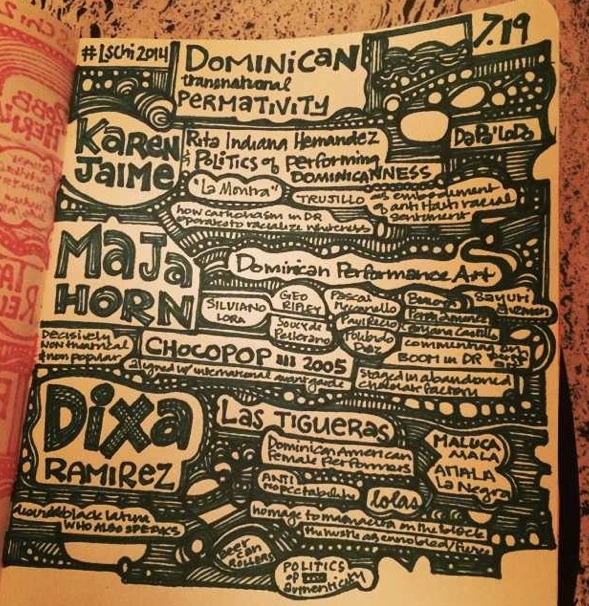
Fourteen sessions, with eight to ten panels in each session, took place over the three days of this gathering, providing a wealth of rigorous and creative scholarship as well as insights on pedagogy in this interdisciplinary field. The growing establishment of Latina/o Studies Departments in colleges and universities across the country was evident at the gathering, as well as valuable regional networks of Latina/o Studies scholars in many parts of the country. Another indication of the significance of this professional gathering was the participation of eleven academic presses and four academic journals in the book exhibit. Eighteen (18) of the forty-one (41) ads in the program booklet were from Latina/o Studies Departments, programs, journals and presses based in the Midwest, representing a significant new trend in the field. Conference organizers allowed all participants to join in the work of creating a new association by scheduling business meetings over the lunch period. Participants either picked up something to go or took advantage of a limited number of conference free lunches and joined in the business discussions, voting to form a new association, discussing possible names for the new group, deciding on an initial leadership and governance structure, and establishing a Coordinating Committee to guide the next steps. The new Coordinating Committee includes: Elena Machado, Carmen Lamas, Deb Vargas, Raúl Coronado, and Isabel Porras. Along with Frances Aparicio and Lourdes Torres, who will not continue on the Coordinating Committee, this group worked together to organize the events.  Included here are some of the comments and observations of those who participated in the conference. The colorful notes/doodles on conference sessions of Brian Herrera, in Theater at Princeton University – used with his permission — also provide additional commentary here.

From Adriana Estill, English, Carleton College, Minnesota

On Thursday morning, July 17, 2014, I was one of “those people” — the members of the audience in a conference session that get thanked because they came out so early. (In this case at 8:00 a.m.) But on that Thursday morning, “those people” were out in droves. The excitement was palpable at the session “Latina/o Representation in Mass Media and Popular Culture,” not only because the papers were riveting and engaging, but because we knew — I knew — that this was a historic moment. The energy at the Palmer Hotel in Chicago was unflagging, from 8 a.m. to 6 p.m. every day. Even our business meetings occupied a crowded Empire ballroom. Things that I deeply appreciated about the inaugural conference of a new Latina/o Studies Association:

  • feeling like I was “at home,” that people could understand the basic motivation for my work and that, maybe more importantly, they saw me;
  • hearing exciting new ideas insistently framed in relation to past Latin@, Chican@ and Puertorriqueñ@ scholarship. There was no amnesia here;
  • the sense of empowerment. Here, in this space (unlike at my home institution), it felt like our ideas, our curricula, our Latina/o Studies initiatives, and our scholarship could, should, and can matter. Part of this feeling stemmed from hearing about the amazing work that colleagues are doing, but part came from feeling heard in a number of different arenas.

Things that I hope we’ll work on in this new organization:

  • I saw the photo of our amazing conference organizers recently. Out of 10 (?) people, only one was cisgender male. I’d like to make sure that service to our association doesn’t fall primarily on cisgender female shoulders, given historical imbalances in that arena.
  • In that vein, a number of sessions that I attended that had “feminism” or “Latina” as one of the organizing rationale drew mainly cisgender women. Two thoughts: men involved in Latin@ studies should care about these issues; are we thinking deeply about masculinities?

Last but not least, a number of scholars used twitter at this conference, mainly to help get out the word on the sessions they attended. It was exciting to watch the ideas circulate not just in the rooms they were uttered, but out in “the open,” ready to be engaged by wider publics. And Iván Chaar López has archived our #LSCHI2014 in order to preserve those conversations for the archives.

From Luz Baez, M.A., Studies of the Americas, CUNY/City College of New York

First, I congratulate the Conference organizers for coordinating, what was in my estimation, a very successful event. Each panelist was distinguished and presented research in their field of study passionately and eloquently. It was enlightening to hear about the research each is conducting in their field.  There were several that resonated loudly and peak further interest in the subject matter, specifically how the construct of race has evolved and developed in a different space as Latina/os migrate to the South specifically Alabama, Mississippi and Florida; how inequality in media representation distorts the Latino/a image, and creates identity confusion and economic disparities; and, finally, the impact that the Treyvon Martin and George Zimmerman case had on the Latino/a community.  The benefits I received from attending the conference are countless and will further assist me in the development of my research.  Thanks again to the Organizers.  I look forward to the next Latino/a Studies Conference.

From Diana Rivera, Librarian and Archivist, Michigan State University

I attended the Latino Studies Conference in Chicago from July 17 to July 19, 2014.  It was the launching of the Latina/o Studies Association; an idea discussed throughout the previous year at national-origin studies conferences (whose focus are Latin American Studies, Puerto Rican Studies and Chicana and Chicano Studies) and the American Studies Association, the Modern Language Association, the Organization of American Historians and the Recovering the US Hispanic Literary Heritage conferences.  The new organization will meet biennially and discuss the shifting landscape of Latina/os (including Chicana/os) in the humanities, social sciences and professional schools. My presentation, in a roundtable/workshop on Mujeres Talk, discussed Chicana and Latina blogs generally, and the work I have done as an associate editor of Mujeres Talk, which is a unique format with a two-editor review of submitted and solicited posts.  Ohio State University Libraries is the hosting institution for the blog. Sessions I attended included:

  • Latina/o Representation in Mass Media and Popular Culture
  • Roundtable on Latina/o History in the American Midwest
  • Roundtable on Libraries, Institutional Pressures and Cultural Politics
  • Latin@ in the Upper Midwest and Canada
  • Printing Latinidad: The Power of Paper in Latina/o Art
  • Roundtable – La Bloga Contributors in Person: Talk about Blogging, Writing, Publishing
  • Theorizing an Alternative Ethos of Preservation: Land, Space and Place in Latina/o Literature and Culture
  • Roundtable – Archive as Social Practice, Contestation, Queer Gesture, and Chisme

Librarians from Stanford University, UC San Diego and I moved a motion forward to have librarians as part of the executive leadership structure of the new organization to educate, improve and establish a continued library/archives use among the new faculty entering the ranks of academia. It was a conversation that was well received.

To reach the Coordinating Committee for a new Latina/o Studies Association use the Contact Form on their website, or look up “Latina/o Studies Initiative” on Facebook.