
Category Archives: Native American Studies

Holders of the Light

People holding placards with lighted letters spelling out words.

Overpass Light Brigade at American Indian Sovereignty and Resource Management Conference, UW-Milwaukee, April 2014. Courtesy of Overpass Light Brigade.

by Kimberly Blaeser

In 1986, when I should have been writing my PhD dissertation, I was reading boxes (no exaggeration) of Department of Energy materials regarding the planned siting of high level nuclear waste repositories. One of the sites proposed was on my home reservation at White Earth, amid Minnesota’s basalt and granite hardrock deposits—very near the headwaters of the Mississippi River.  I don’t now remember details of the science I learned during that time about crystalline rock, fractures, and ground water, but I do remember the urgency with which I investigated, the weeks and months during which I wrote, went to meetings, knocked on doors, and testified.

I had reason to recall that urgent dedication recently when Edith Leoso, Tribal Historic Preservation Officer for the Bad River Ojibwe of Wisconsin, spoke of the way her life had shifted unexpectedly with the proposal of mining in the Penokee Hills of Wisconsin. Likewise, Bad River Tribal Chairman, Michael Wiggins, Jr. was forced to quickly educate himself in the pertinent science and legal intricacies in order to lead the ongoing anti-mining efforts, to protect the land and the people, to guard the future.

Of the many ways to say please stand, I have chosen a few.

∂, Partial Differential Equation

All things being equal, things are never equal. Think of scope. Like the reach of the imperial.  Or consider variables. Value. Or commodity. Ways of seeing. Angles and perspectives. Or how to solve for survival. 

The consideration of seven generations. This wisdom rule has become common knowledge. Leaders teach that tribal decisions should be made taking into consideration seven generations in the past and seven generations in the future.

The national sacrifice.  Lesser known, and frequently unacknowledged, this convenience policy has marked many generations. Uranium mining. The fallout from atomic bomb detonation at White Sands.

What we erase from polite conversation. Bodies on fire. The historic cleansing of the landscape, the sweep of humanity west, west, west. Environmental r  ism. 

Zongide’en, Be Brave.

Another partial differential equation. Let’s say a corporation proposes a mine. Variables include Tyler Forks. Bad. Potato. Rivers. A 22-mile, 22,000-acre strip of land. Jobs. Maanomin. Open pit. Exceptional or Outstanding Resource waters. Legislation. Iron oxide.  Fish. Blasting and pulverizing. New legislation. The functions depend upon the continuous variables. Fluid flow, for example. And changing laws. Somewhere along the granite line, someone enters. Let’s say they have put down one life and taken up another: the solution of the PDE. They face arbitrary functions. Changing laws. Guards. Guns. If the life is stretched over two points.  It vibrates. We cannot measure that vibration in this generation. We can sing it, or make it into light. (See above for a partial illustration.)

Minobimaadizi, Live Well.

This past week an environmental warrior from the Pacific Northwest passed away. Billy Frank, Jr.  Frank was quoted as saying about himself, “I was not a policy guy. I was a getting-arrested guy.” But in the end he changed policy. A Nisqually tribal member, his battle for tribal sovereignty in resource management protected the salmon and left its mark on contemporary understanding of treaty law. To accomplish that he was jailed, beaten, tear-gassed, and chose to sacrifice much of his time and liberty. A life stretched over two points.

The Anishinaabe word minobimaadizi translated gives us the English live well. But it means something more. To live this good life in ways both obvious and less so. Though we may feel dwarfed by the largeness of passion and action of people like Billy Frank, Jr., we remain variables in the equation and can tip the balance one way or the other.

When we held an American Indian Sovereignty and Resource Management Conference at the University of Wisconsin-Milwaukee campus recently, we invited my colleague Lane Hall and his Overpass Light Brigade to participate one evening. Lane’s idea to create lighted letters and spell out protest messages above freeways has caught on around the country. At our event, we spelled words in Anishinaabemowin. (For these Lane needed more vowels!)  I am not an OLB regular holder of the light, but I volunteered to be one of those to carry and display the large placards. You will find me at the “I,” the third “O,” and the “G.”  One lighted letter in a 14-letter word? Only a pair of legs beneath a billboard? Ahem. Can you spell m  taphor without me?

Gego Googiibike, Don’t Dive Into the Metal.

I’d like to ask you to fold up your deck chair and head to the Penokee Hills protests. But the truth is, you probably have an environmental threat within biking distance. Or canoeing distance. Mining companies are pushing to conduct a toxic new form of extraction for sulfide, right next to the Boundary Waters Canoe Area Wilderness in northeastern Minnesota, near the 1,090,000-acre (4,400 km2) wilderness area that is located in the Superior National Forest.  Where insistence is a function of insanity. If x then why.  A mine parallel to 1,000 miles of canoe routes, in the habitat of moose, beaver, wolves, bear, lynx, deer, bobcats, bald eagles, peregrine falcons and loons, within easy polluting distance of our once remote family cabin. We’ve hardly hands enough to hold all the signs or mics needed in this indifferent world of resource capitalism.

And yet.

Poetry is one letter when we spell resistance.

Debwetaan, Believe.

Eloquence of Earth

Nominal signs, these words we use—future, ecology, seven generations

have yellowed into clichés, editorials that line the cages

of captured birds, or burn in unransomed stone fireplaces

of America’s aspiring, royal mining families.

These green futures cast as fairy story,

sealed beneath the calloused ideals of legislators—

sleek smiling handshakes who seal bargains like Jabez Stone;

Our I-do-solemnly-swear paper-promise leaders

enticed by industry frenzy, slight of lips,

the short-sighted tally (seven hundred jobs)

coveted like Stone’s seven years of prosperity.

Though publicly professed (against all enemies, foreign and domestic),

and leather-oath sworn (will bear true faith and allegiance),

still quid pro quos reign, sell the soul of this land—

our waters our manoomin our children, abiinoojiihnyag.

Each season gavels strike new bargains with our oldest enemies

maji-manidoog, handsome fast-talking strangers disguised as prosperity.


Daily we watch patient warnings swim the Wolf River,

migrate to absent wetlands, trumpet old calls.

How do we translate the flashing fins of poisoned fish?

What other alphabet do you know to spell contaminated waters?

Like banned books words still burn on my tongue—reciprocity,

sacred, preservation, earth, tradition, knowledge, protect.

Even the vellum of justice has crumbled in fiendish fire.

Meanwhile we gather here, descendants of ajijaak and maang

lift our ancient clan voices in longing, for a chant of restoration

in a Faustian world.

Before a jury of the tricked and trapped and bamboozled,

before the very devil, Daniel Webster sang

the healing brush of common memory

a child’s wonder at each day’s waking

the freshness of a fine morning—waaseyaaban.


If I say Gichigami—Lake Superior—a turquoise plain, stretches

infinite, gete-gaming. If I say Wiikonigoyaang, she invites us to her feast,

how many will remember the eloquence of earth itself?

At dawn when jiibay mist backstrokes across the copper of northern prairies

eerie white hovering, damp and alive,

will you stretch out your hands in hope

cup the sacred like cedar smoke,

draw it toward you—a gesture

fervent and older than language?

Now I say wiigwaasikaa, everywhere we look

there are many white birch,

bark marked with sign, scrolls a history.

I say ritual, continuum, cycle of belonging,

I say daga, please; ninandotaan,

you must listen for it—aki.

Yes, our very earth speaks.

Who among us will translate?

Kimberly Blaeser is a 2014 Contributing Blogger for Mujeres Talk and a poet, critic and essayist. She teaches Creative Writing, Native American Literature and American Nature Writing at the University of Wisconsin-Milwaukee, where she is a Professor. Her publications include three books of poetry: Trailing You; Absentee Indians and Other Poems; and Apprenticed to Justice. Her scholarly study, Gerald Vizenor: Writing in the Oral Tradition, was the first native-authored book-length study of an Indigenous author. Of Anishinaabe ancestry and an enrolled member of the Minnesota Chippewa Tribe, Blaeser grew up on the White Earth Reservation in northwestern Minnesota and worked as a journalist before earning her MA and PhD from the University of Notre Dame. Her poetry has also been translated into several languages including Spanish, Norwegian, Indonesian and French.

12/12/12: This Time Is Our Time

December 12, 2012

DSCN0026By Inés Hernández-Ávila

Compañeras, hermanas, hijas, nietas, abuelas, madres, madres, madres, todos somos madres, de una manera u otra, porque todas tenemos la profunda capacidad de crear:

Hoy es un dia muy importante, today is an important day, 12/12/12, there will not be another one in our lifetimes, we must give ourselves a moment in our lives to stop our ordinary activity and feel, see, touch, taste, smell, be with the Earth, the Mother of Us All, y darle Grácias. This is the day that tells us that it is time to be the way we want to be, without reservation, unconditionally, to realize ourselves con firmeza, con coraje, con Amor, to remember who we are, as mujeres, as guerreras, as voces, as thinking hearts.[1] Today is a llamamiento to our very innermost beings to stand up and be counted on behalf of the Earth, on behalf of all of Life, on behalf of toda la naturaleza, todos los seres inocentes que comparten esta planeta con nosotras. De nosotras dependen, quién sino nosotras? Humans are not the only peoples on this Earth. Si va a ver Justicia, que sea para todos los seres que vivimos en la Tierra. Interestingly, the U.N. designated April 22 as International Mother Earth Day (I knew it was called Earth Day, I just learned it is officially Mother Earth Day). Día 12 is the Mexican Mother Earth Day. Perhaps not all peregrinos, devotos, would see it this way—for many of them, la Virgen de Guadalupe es, en términos estrictamente Católicos, la Madre de Diós, la Madre de Jesucristo, la interlocutora mas alta que hay para llegar a Diós. Mis respetos a todos ellos.

But for those of us who have been reflecting on her being, thinking about our (dis)connections to Catholicism, thinking about Chicana/indigenous spiritualities, envisioning “transnational feminist spiritual communities,”[2] coming to terms with the idea of Spirit in our lives, we know that La Virgen is much more than how she is defined by the Catholic Church. We know her differently. As our beloved Gloria Anzaldua said, “I’ve always been aware that there is a greater power than the conscious I.  That power is my inner self, the entity that is the sum total of all my reincarnations, the godwoman in me I call Antigua, mi Diosa, the divine within, Coatlicue-Cihuacoatl-Tlazolteotl-Tonantzin-Coatlalopeuh-Guadalupe—they are one.”[3] This is immense knowledge. La Virgen se manifiesta como imagen Católica, some say she was an invention of the missionization campaign, a tool of the imperial project, pero de todas maneras, we have triumphantly (re)indigenized her, claimed her as our own, and she has become an activist on behalf of the people, for so many who know her this way.  If she was an invention of missionization, the invention traicionó al proyecto colonial, because the foundational elements of her being are here, in this hemisphere, in the Land. She is the Land. She is the Earth. Punto.

Today is 12/12/12, but we should see the date as a marker of the momentum of transformation that is happening all around us.  The latter part of the month, some say 12/21/12, will mark the entrance, completed, of the next age, the New Sun. My colleague Victor Montjeo, Jakaltek Maya, from Guatemala, tells us that this is a time of world renewal, not world destruction. In the Conchero Dance tradition, I was told that we are moving from Nahui Ollin, 5 Movement, the age we have been in since before the invaders arrived, to the New Sun, Nahui Coatl, 5 Serpent, and that this New Sun will manifest more predominantly as female, and her symbol will be the Venado, the Deer. For at least two decades, the elders of this dance tradition have indicated that the New Sun has been arriving, coming in behind the present one, dancing. I remember dancing at the Basilica de la Virgen de Guadalupe in Mexico City, one December 12th, and suddenly as I was dancing, I felt the earth move beneath my feet, gently, almost unnoticeably, but it was certain, the Earth Mother was dancing with us, happy that we were dancing for her. She is so alive, she sings, she dances, she witnesses, she grieves, she disrupts, she balances, she suffers, she loves.

During this time (during all of our time on this earth in this life), we should walk, as the Yoeme say of saila maaso, the little brother deer, leaving flowers wherever we step.  Tenderly, gracefully, attentively, with abundant awareness of our surroundings, not only our academic or work surroundings, that, too, but our homes, our yards, our jardines (if we are lucky enough to have them), the spaces where we choose to spend time. Spend time, such a Western concept. Even time is cast in monetary, acquisitive terms. Spend time. Take time. Waste time. Don’t waste time. The spaces, circles, spheres where we love to be.

We know we are always in Nepantla (grácias a los antiguos Nahuas por este concepto). Somos Nepantleras (grácias a Gloria por la contemporización del concepto). As Nepantleras, in this time of great transformation, change, shape-shifting, we are ready for whatever comes our way. We must keep our senses, have our wits about us, trust our intuition, and constantly fine-tune it, remember humility, and know deeply that our Spirits are present, always. My Spirit guides me, my Spirit has the answers, my Spirit protects me. This I must remember. This we must remember. And my Spirit helps me see the signs of this new time that has come. Our spirits are ready. This time is our time.

Inés Hernández-Ávila is a Professor and Chair of the Department of Native American Studies at UC-Davis. She is a member of the Mujeres Talk Editorial Collective. 


[1] The term “thinking heart” is from Kathryn Shanley, Nakota scholar of Native American Studies.

[2] Theresa Delgadillo, Spiritual Mestizaje: Religion, Gender, Race, and Nation in Contemporary Chicana Narrative, p. 94.

[3] Gloria Anzaldúa, Borderlands/La Frontera: The New Mestiza, p. 50.

Comment(s):
Carrie Castañeda-Sound    December 12, 2012 at 3:22 PM

With all the end-of-semester chaos, commercialism, and high expectations from family and friends, I found this blog very grounding. Thank you for that gift!

Decolonize Your Diet!

September 10, 2012

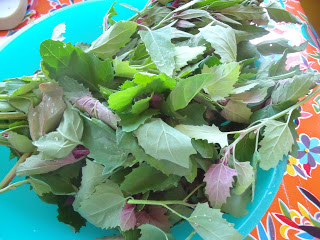
Quelites Harvest

Quelites Harvest

By Luz Calvo and Catriona R. Esquibel

We have a passion for Mexican food. We have a passion for gardens, for healthy food, for food justice, and for people of color reclaiming our histories. All of this has led us to our current project, Decolonize Your Diet. This is a project to reclaim the heritage foods of greater Mexico and Central America as a way improving the physical, emotional, and spiritual health of US Latinos/as.

SOME BACKGROUND

In the US, a person’s health is almost pre-determined by their socio-economic status. For the most part, upper and middle class people, who have access to health care, higher education, healthy foods, and safe spaces to exercise, have significantly better health than poor folks who lack health insurance, education, access to grocery stores, and who live in poor and often dangerous neighborhoods. Public health scholars evaluate the health of demographic groups by looking at mortality, infant mortality, obesity, heart disease, high blood pressure, diabetes, and cancer rates. Poor people have worse health on all these measures. This is not surprising: Social inequality affects people’s health and lifespan.

However, there is one notable exception to the equation of poverty = poor health—public health scholars have found that recent immigrants from Mexico have very low rates of mortality, infant mortality, and illness compared to other groups. Public health scholars have dubbed this phenomenon “The Latino/a Paradox.”(1) Recent Latino/a immigrants, mainly from Mexico and Central America, have better health than Latinos and Latinas who were born in the US. The health of recent immigrants rivals the health of the [w]healthiest Americans! This fact is somewhat astounding given that Latino/a immigrants face so many challenges: in general, Latino/a immigrants arrive to this country with very few economic resources. They don’t have access to preventative health care and are often afraid to seek care when they are sick. They work in difficult and dangerous jobs and they are under extremely high levels of social, spiritual, and economic stress. One would expect their health to suffer under these circumstances.

Public health scholars have not been able to explain Latino/a immigrants’ health; but there is significant evidence supporting the health benefits of traditional diets of Mexico and Central America. We believe that these food traditions protect Latino/a immigrants from disease, including diabetes, heart disease, obesity, and some cancers. Unfortunately, the health of immigrants declines over time. The longer immigrants stay in the US and the more they assimilate into US culture, the worse their health becomes. By the second generation, Latinos/as face the same issues as other poor folks in the US, with skyrocketing rates of diabetes, obesity, and heart disease. Cancer rates also start to increase.

DECOLONIZE YOUR DIET

We feel it is imperative that Chicano/a Studies engage food justice in research and teaching. We call to our comrades, colleagues, and students to look at their personal food choices as political acts. Resist cultural imperialism by reclaiming ancestral foods. Honor our ancestors and their wisdom by learning how to cook beans, make corn tortillas, and grow food.  Above all, share your knowledge!

The following chart outlines some of the differences between what we think is a Colonized Standard American Diet (¡Qué SAD!) and a decolonized approach:

WESTERN DIET
DECOLONIZED DIET
Advertising and Fads
Ancestral Knowledge/Oral Tradition
Hybrid Seeds and GMO
Heritage Seeds and Seed Saving
White Supremacy
Respect for Mexican and Indigenous Knowledge and Traditions
White sugar, White flour, White rice
Brown is Beautiful: Honey, Whole Wheat, Brown Rice
Assimilation, Submission, Capitulation
Resistance, Resilience
No connection to the land. Reliance on Chain Grocery Stores.
Community Gardens, Guerilla Gardening, Urban Farming,
Boredom
Creativity
Conspicuous consumption
Simple, accessible food
Disavowal, Thoughtlessness
Intentions, Blessings and Ceremony
Processed Foods
Real, whole food
Anti-union/anti-immigrant
Fair labor practices, Worker cooperatives
Pesticides and Monoculture
Permaculture and Biodiversity
Pharmaceutical industry
La Comida es Medicina, Herbal remedies
Wasteful
Resourceful

As part of our project, we are collecting and sharing knowledge and recipes. We are inspired by Native food activists like Winona LaDuke (2,3,4), Devon Abbott Mihesuah (5) and the Tohono O’odham Nation (6). We’re very excited by the significant health benefits to be gained from eating cooked dried beans (7,8,9), nopales (10,11), chia (10), quelites (12), and verdolagas (13, 14, 15).

JOIN US AND LEARN MORE!

We invite you to join us in the reclamation of Mexican heritage foods: join “Luz’s Decolonial Cooking Club” on Facebook or follow our blog at decolonizeyourdiet.blogspot.com

CITATIONS
  1. Viruell-Fuentes, Edna A. 2007. Beyond acculturation: immigration, discrimination, and health research among Mexicans in the United States. Social science & medicine (1982) 65 (7): 1524–35.
  2. LaDuke, Winona. 1999. All Our Relations: Native Struggles for Land and Life. Cambridge, MA; Minneapolis, MN: South End Press; Honor the Earth.
  3. LaDuke, Winona. 2005. Recovering the Sacred: The Power of Naming and Claiming. Cambridge, MA: South End Press.
  4. LaDuke, Winona, and Sarah Alexander. n.d. Food is Medicine: Recovering Traditional Foods to Heal the People. Honor the Earth/White Earth Land Recovery Project.
  5. Mihesuah, Devon Abbot. 2005. Recovering Our Ancestor’s Gardens: Indigenous Recipes and Guide to Diet and Fitness. University of Nebraska Press.
  6. Tohono O’odham Community Action with Mary Pagnelli Votto and Frances Manuel. 2010. From I’Itoi’s Garden: Tohono O’Odham Food Traditions.Blurb.com.
  7. Reynoso, Camacho, R. 2007. El consumo de frijol común (Phaseolus vulgaris L.) y su efecto sobre el cáncer de colon en ratas Sprague-Dawley. Agricultura técnica en México 33 (1): 43–52.
  8. Guevara, Lara, F. 2006. Phenolics, Flavonoids and Other Nutraceuticals in Mexican Wild Common Beans {(Phaseolus} Vulgaris).
  9. Serrano, José, and Isabel Goñi. 2004. [Role of black bean Phaseolus vulgaris on the nutritional status of Guatemalan population]. Archivos latinoamericanos de nutrición 54 (1): 36–44.
  10. Guevara-Cruz, Martha et al. 2012. A dietary pattern including nopal, chia seed, soy protein, and oat reduces serum triglycerides and glucose intolerance in patients with metabolic syndrome. The Journal of nutrition 142 (1): 64–69.
  11. Gutierrez, Miguel Angel. 1998. Medicinal Use of the Latin Food Staple Nopales: The Prickly Pear Cactus. Nutrition Bytes 4
  12. Barakat, Lamiaa A A, and Rasha Hamed Mahmoud. 2011. The antiatherogenic, renal protective and immunomodulatory effects of purslane, pumpkin and flax seeds on hypercholesterolemic rats. North American journal of medical sciences3 (9): 411–17.
  13. Huang, Yun, and Lei Dong. 2011. Protective effect of purslane in a rat model of ulcerative colitis. Zhongguo Zhong yao za zhi = Zhongguo zhongyao zazhi = China journal of Chinese materia medica 36 (19): 2727–30.
  14. Huang, Zhiliang, et al. 2009. Total phenolics and antioxidant capacity of indigenous vegetables in the southeast United States: Alabama Collaboration for Cardiovascular Equality Project. International journal of food sciences and nutrition 60 (2): 100–08.
  15. Shobeiri, S F, et al. 2009. Portulaca oleracea L. in the treatment of patients with abnormal uterine bleeding: a pilot clinical trial. Phytotherapy research: {PTR} 23 (10): 1411–14.

Luz Calvo is an associate professor of Ethnic Studies at Cal State East Bay.  After their breast cancer diagnosis in 2006, Calvo became interested in food justice activism.

Catriona R. Esquibel is an associate professor of Race and Resistance Studies at San Francisco State University. Esquibel started writing about ancestral foods after she and Calvo ate verdolagas at her father’s morada on Good Friday in Holman, New Mexico.

Comment(s):

  1. Elena Gutierrez  September 11, 2012 at 5:46 PM

    Verdolagas grow in the sidewalk cracks here in Chicago and I have more than once excavated and cooked them with friends. We get a few stares but they are so yummy and worth it! Thanks too for these references- not I can show my mom the “proof” that nopales really will help her diabetes. Excited to hear about your further works in this area.

  2. Theresa (Mujeres Talk Co-Moderator)  September 12, 2012 at 12:33 PM

    When my dad became diabetic i started looking into healthier traditional foods and yes, nopales are, indeed, good for diabetes! Luz and Catriona, thank you for sharing some of this exciting new work, and your emphasis not on the pricey and expensive and hard to find ingredients but on the readily available and traditional prepared in healthy ways. I am curious if anyone has done studies on the practices of keeping milpas that are mentioned in fiction that describes early and mid 20th century Chican@ life and health.

  3. Dianna Ching  November 21, 2012 at 5:06 PM

    I want to get rid of my tummy fats but I can’t deprive myself on foods so I never considered diet. But this one sounds so easy so I think I’ll give it a shot. Instead of having a liposculpture right away, why not try this. Thanks a lot!

Learning from Mexican and Native Women

August 20, 2012

Photo Credit: Pepe Rivera. Taken June 26, 2011. From Flickr.

Photo Credit: Pepe Rivera. Taken June 26, 2011. From Flickr.

By Theresa Delgadillo

Yesterday, as I continued my work on translating an oral history interview from Spanish into English, I was struck by something that this particular participant in the project said – as I often am in this work. I’ve had the honor of interviewing some very wise and determined Latinas in the project that I began in 2008 to collect the oral histories of Latina leaders in Milwaukee, Wisconsin. These are some very interesting women! Fortunately, I am near the end of the editing and looking forward to sending it off the publisher soon. To get back to my point: my interviewee, commenting on the social customs of Mexico and the U.S., says at one point, “There it is the same as here, exactly the same as here. The only difference is that there is still a fiction that in Mexico it’s different.” She was talking about the acceptability of divorce, but it resonated with me on other levels, such as the changes in daily life, work and environment, partially because there was some interesting news from Mexico recently in the The New York Times about a group of indigenous women in Cherán, Michoacoán, who mobilized against armed illegal loggers and are now defending their town from violence and their forest from deforestation. To readers of Latina/o literatures, or literature about migration, the name Cherán might be familiar, since it was one of the sites of migration to the U.S. portrayed in Ruben Martinez’s Crossing Over: A Mexican Family on the Migrant Trail(2001). The August 2, 2012 article by Karla Zabludovsky titled “Reclaiming the Forests and the Right to Feel Safe,” describes the events in Cherán and the women’s actions as “extraordinary” as it details their effectiveness. Motivated in part by the loss of the beautiful forest that was once their patrimony, a loss that must be visible to them on a daily basis, the women see themselves acting not only for themselves but for future generations. When I read it, I wondered, and not for the first time, if Luis Urrea’s novelInto the Beautiful North (2009) hadn’t come to life – because this is not the first instance in recent years of Mexican women taking the lead to end violence and environmental destruction. Meanwhile, New York State is set to join the ranks of states allowing fracking. In an August 19, 2012 CBS News Report, “New York State to Allow Fracking,” Jeff Glor’s article notes that the process of fracking releases dangerous contaminants that have high potential to endanger air and water supplies, yet quotes local farmers who need the money. The women of Cherán, Michoacán, also need money to live and they are supported in part, according to the article, by remittances from residents who have migrated to the U.S., yet it seems they are living in the aftermath of a disastrous environmental decision and working to make it right. Like the people of Cherán, Michoacán, Mexico, we face some very difficult decisions in these energy-gobbling times, and we might consider what we can productively learn through a comparative perspective that doesn’t consign indigenous women to a lost past, but instead examines the experience of both residents and migrants from particular regions about what doesn’t work – because as my interviewee says: “There it is the same as here, exactly the same as here. The only difference is that there is still a fiction that in Mexico it’s different.”

Theresa Delgadillo is on the faculty at Ohio State University.

  1. María Antonietta Berriozábal  August 20, 2012 at 4:27 PM

    Dear Theresa:

    I find your work fascinating. I am a lover of oral history. Next month my book, María, Daughter of Immigrants, will be published. The first chapters include the stories that my parents told me as a child. With just their stories – no genealogical searches for me – I was able to share the story of my great grand mother and grandparents going back one hundred years. That is rather astounding. To think that these women can share a story, you chronicle them and one hundred years from now someone will be sharing them.

    Another reason for my interest in your work is that in 1995 I attended the Fourth World Conference on Women in China as a member of the US delegation. During the conference I met with women from Central America and some from Peru. Some could not even speak Spanish. They spoke their native dialects, but they had leaders who had learned Spanish and they were our interpreters. One of the reasons they had gone to the Beigjing conference, through great sacrifice, was to tell their stories of how their ancestral lands were being taken by businesses. It is the same story that continues to this day of multi-national corporations raping the environment in other countries so they can provide goods and food for the developed countries like the US and others. But the women were fighting; they were organizing and using their voices. I found it interesting that the leaders of the movements, at least of the ones I met, were mujeres. They wore their colorful clothing almost as the shield of warriors.

    In any event, I appreciate what you are doing very much.

    Sincerely,

    María Antonietta Berriozábal
    San Antonio, Texas

  2. Theresa (Mujeres Talk Co-Moderator)  August 20, 2012 at 6:14 PM

    Dear María Antonietta,

    I am looking forward to reading the preview of your book that appeared in Frontiers, and to your new book. Please send us an announcement for it as soon as it appears. My project was motivated, too, by the desire to record and share the life stories of Latinas whose experiences don’t appear elsewhere.

    Research in the U.S. has shown that indigenous migrants to the U.S. from Latin America often face difficulties precisely because of the language assumptions that you noted in your experience. Despite language differences, we are all struggling with the same difficult questions about how we use our natural resources.

    Thank you so much for your comments and encouragement, and thank you for sharing your work.

    Take care, Theresa

  3. Lourdes Alberto  August 28, 2012 at 8:31 PM

    In reading this post I am reminded that indigenous people think of themselves as planetary citizens–they fight for their people, their cultures, their history, but also all of our well-being and that of future generations.
    As an indigenous person myself (Oaxaqueña), I struggle with my own part in the depletion of the Earth’s natural resources.
    You know, three seasons ago I started growing a garden with the goal of eventually meeting all of my family’s summertime food needs. It was so fulfilling, so liberating, so unexpected. I know now that my challenge is to remember and live the knowledge my grandparents left me about the land, about plants and about the importance of well-being. As you mentioned, there are tens of thousands of indigenous people from Latin America in CA. Growing up we had an informal plant co-op/exchange. Someone would manage to bring over a plant, flower, hierba, from Oaxaca and we would literally share cuttings–yerba santa, varieties of avocado, ruda. It was amazing! A kind of urban indigenous transnational environmentalism!

  4. Theresa (Mujeres Talk Co-Moderator)  September 3, 2012 at 5:25 AM

    Dear Lourdes,

    It’s good to hear from those that grow gardens for sustainability, and I appreciate the work you’ve put into this important task for three seasons, which, as you say, is a combination of memory work, and living a connection to others and growing food. Thank you for your beautiful note!

    Take care, Theresa