
January 28, 2013

From left to right: Translator (name unknown), Maria Reyes of the National Domestic Workers Alliance, Guillermina Castellanos of the National Day Labor Organizing Network, panel moderator Kathy Coll of Stanford University. Photo by author.
By Seline Szkupinski Quiroga, Ph.D.
Last November in Oakland, at the meetings of the National Women’s Studies Association, I attended a session entitled “Imagining New Solutions for Old Problems: Domestic Workers Create Networks – Transforming the Struggle for Social and Economic Justice”. The panel offered academic, activist, and worker voices reflecting on the current state of labor activism in a field comprised largely of immigrant women.
Historian Eileen Boris provided a context for current struggles as she outlined the dialectical history of strikes (protests) and standards (laws). Maria Reyes of Mujeres Unidas y Activas (an immigrant rights organization) and the National Domestic Workers Alliance described initiatives such as the California Domestic Workers Bill of Rights which would have given housekeepers, childcare providers and home health care workers rights such as overtime pay, mandated meal and rest breaks, adequate sleeping conditions for live-in workers, and the right to use employers’ kitchens to cook their own food. (The bill was vetoed by Governor Brown).
Nicole Brown-Booker, a professional woman with a significant disability who must employ personal care attendants in order to live independently, spoke of Hand in Hand, a coalition of domestic workers and their employers working together to educate about and advocate for dignified and respectful working conditions. Pam Tau Lee, a long-time community and labor activist, shared her experience as a daughter now employing care workers for her elderly parents.
The entire session was inspiring and enlightening but it was these last two presenters who had the most impact on me. Their stories resonated with me because I have had experience with the ethical dilemmas associated with employing a home health care worker. My mother had Parkinson’s disease and osteoporosis. In her later years, she lived with my sister and her family as she was no longer able to live independently due to her frailty and advancing symptoms. My sister and her husband both worked fulltime and couldn’t provide the 24-hour care my mother needed.
As for many families in this situation, financial concerns were paramount. My mother had limited resources—social security, a small pension and some savings. She did not have long-term care insurance so while her health insurance covered a few hours of home health care, the majority was paid for out of pocket. Daunted by the task of finding qualified workers with experience and figuring out tax withholdings at the same time as learning about my mother’s rapidly changing needs, we decided to contract with a private company, and the monthly expense quickly mounted.
My mother immigrated to the United States in the 1950s. She was completely bilingual but as she aged, she was more comfortable expressing herself in Spanish. We were grateful to find home health care workers who could easily communicate with her in Spanish, but I was uncomfortably aware that the limited English abilities of some would limit their ability to advance or to be employed in other sectors. I learned that few companies provided opportunities for training and certification.
I have respect for the work of caring for others. It is not an easy job, and it is more than just providing another pair of hands. In my mother’s case, for example, it required confianza as workers helped her make purchases and with intimate daily tasks; and patience as the side effects of her medications—hallucinations and paranoia—caused personality changes. In one particularly difficult period, her aides would spend hours looking for something that had been ‘lost’ only to then be accused of theft. My sister, in addition to managing her own household, had to mediate these clashes.
Over the years that my mother needed home health care workers, we learned that of the daily amount she was charged, only a small portion actually went to the worker. I don’t know if this is standard or just a practice of the companies we dealt with. We wanted to pay a fair wage and give the work and care provided the dignity and value it deserved. At one point, we intervened when we found out that one of my mother’s aides was consistently receiving her paychecks late. The company’s proposed ‘solution’ was for my mother to buy out the worker’s contract at a cost of over $30,000. The situation was so messy we had to seek legal counsel. As my mother’s medical condition was rapidly declining, shifting from using a company to employing home health care workers directly would have meant finding a new team of workers who could attend to her needs, and forming new relationships at a time when stability was important.
The decision of what to do was eclipsed by my mother’s entrance into hospice.When my mother passed away, her home health care workers attended her memorial service, and I am still in contact with some of them as they share the accomplishments of their children and other milestones.
Domestic workers, such as the many women who helped my mother in her last years of life, provide vital services yet these workers often face unjust social and economic conditions. The industry is unregulated, domestic workers are excluded from the protections of federal wage-and-hour laws, and abuses are rampant. However, as the presenters in the session noted, the coalitions and networks that domestic workers are forming are having effect. In 2010, New York State passed the nation’s first Domestic Workers Bill of Rights into law. Although Governor Brown vetoed the California version, local organizations have not given up the fight. San Francisco’s Mujeres Unidas y Activas has developed an innovative worker-centered skills training, job placement and labor rights program called Caring Hands. A national campaign to coordinate efforts and educate the public called Caring Across Generations launched in 2011.
As our population ages, it is estimated that the number of people who will need care will only grow.[1] We may all face similar dilemmas, as we have to make decisions about a sick parent or partner who needs help. It is time to organize to change the current structures and policies. We must improve the working conditions and job quality of domestic workers but not at the risk of making such care inaccessible for low-income families.
Seline Szkupinski Quiroga is a child of immigrants and a medical anthropologist living in Phoenix, Arizona. She is a member of the Mujeres Talk Colectiva.
[1] Salinas, Robert. “Home Care.” Long-Term Care Medicine (2011): 3-14.
Comment(s):
- Elena Gutierrez February 6, 2013 at 12:32 PM
Thanks for your thoughts on the complex relations women face as both carefivers and receivers- roles we all play at some point in our lives. Do you have any resources that those of us who would like to keep up on these issues can use? - Seline (Mujeres Talk Co-Moderator) February 7, 2013 at 3:52 PM
Hi Elena,
In addition to the links in the essay, the websites of the following organizations will keep you up to date:
National Domestic Workers Alliance
http://www.nationaldomesticworkeralliance.org/
Caring Across Generations
http://www.caringacrossgenerations.org/
The Domestic Employers Association
http://domesticemployers.org/
-ssq

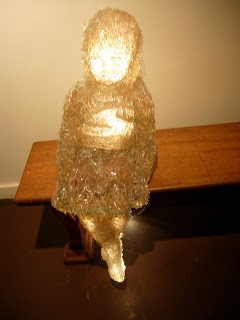

I had the pleasure of seeing Ana Teresa Fernandez’s work when she came to Cornell University and presented “Blurring Borders: Redefining Truths, Fables, and Folklores”. I was familiar with a few of her works before the presentation, but the highlight of the presentation for me was hearing about how Ana utilized local materials (garbage in Haiti, glass in Mexico) within her art and performance. The lack of accessible “traditional” art materials (paint, paper, brushes, etc.) was incredibly striking when we see the incredible work Ana has done in engaging local materials within a community consciousness in Haiti. Her representation of the children of Mexico orphaned by the Femicides in Ciudad Juarez was a striking portrayal of the multi-generational impact of violence and the inability to protect children from this trauma.
In her performance of “Borranda la barda”, Ana addressed the binaries of female identity (perceived and performed) along a heavy politicalized border state. Her performance of both female identity and nationalism was particularly striking in the U.S./Mexico borderlands, specifically when looking at the Femicides of Ciudad Juarez.
I look forward to researching Ana’s work in the future and am extremely thankful I was given the opportunity to hear her present her work at Cornell University.
-Sarah Anderson
What a courageous artistic intervention into difficult subjects. Thank you Ella, for providing the context of these creations. It makes me appreciate her sensibility to address literal dismemberment, carnage if you will, without producing more injury.
Dear Ella, Thanks for sharing the pictures and discussion of Ana Teresa Fernandez’s work. The casts of children covered in broken glass are quite moving, and ask us to reflect on violence against children on many levels in new global economies. How wonderful for your students as well that they heard her and had the opportunity to learn about violence at the U.S.-Mexico border through an artist’s engagement with the topic that foregrounds critical discussion. Theresa Delgadillo, Co-Moderator of Mujeres Talk
“without producing more injury.” What a beautiful response, Ester, to Ana’s work in the Ecdysis show on the murdered women of Juarez.
I also had the opportunity to attend her lecture and the lunch with her.
The choice to bring ATF to Cornell, especially given the timing with our class was great. It allowed us to be exposed to a new kind of artist, one that is raising awareness about most of the issues discussed in class.
She is resourceful and works with her environment, this is very important because it teaches people, specially the natives of the area, that they can use anything to beautify and create art. This was evident in her work in Haiti and in South Africa. In the latter country, she was able to show that artists have the duty to report the beauties of everyday life instead of reporting/focusing on the negative like the news do.
Overall, it was a great experience being able to meet her and understand the thought process and goals of her art.
-Gloria Guerra
I also had the opportunity to attend her lecture and the lunch with her.
The choice to bring ATF to Cornell, especially given the timing with our class was great. It allowed us to be exposed to a new kind of artist, one that is raising awareness about most of the issues discussed in class.
She is resourceful and works with her environment, this is very important because it teaches people, specially the natives of the area, that they can use anything to beautify and create art. This was evident in her work in Haiti and in South Africa. In the latter country, she was able to show that artists have the duty to report the beauties of everyday life instead of reporting/focusing on the negative like the news do.
Overall, it was a great experience being able to meet her and understand the thought process and goals of her art.
-Gloria Guerra
Though I know this blog talks about Ana Teresa Fernadez’s work, I really enjoyed the altar of photographs that Maria Teresa Fernandez, who happens to be Ana Teresa’s mother, created and left on display for at the Latino Studies Program here at Cornell University until late November. It was a way of humanizing the border when so many times it is militarized especially by the responses the United States has taken in the past years (because the U.S. must “secure” the border). I was able to actually take an instructor and another peer of mine who would have never stumbled upon this type of work and show them the exhibit. This was a way for me to raise consciousness in others (esp. since that one peer came from a privileged background).
Moving back to the work that Ana Teresa Fernandez did on the border really struck me. She stated in her lecture that her work was about “transcending the given, by changing the context” and she gave them example of the broom and how it wasn’t dirty on the floor but was dirty when left on a pillow. She does the same with her little black dress and she places it out of context and calls attention to what she is doing but more importantly to the border and how she is erasing it as she paints it blue.
I could continue to go on but all I can say is that I was taken aback by both Ana Teresa and Maria Teresa’s ingenuity and how they use art to speak and give voice to those who are voiceless in our world.
Attending Ana Teresa Fernandez’s lecture at Cornell University was a great experience . There were two exhibits that struck me the most. The first one was NanMitaNan: Haiti. I thought it was amazing that Ana Teresa was able to make sculptures out of plastic bottles she found. More importantly, the clear plastic material against the backdrop of oil lamps not only showed Ana’s ability to use the resources around her, it reflected the ghost of the beautiful architectural structures in Haiti, the lack of resources and the invisibility of Haitian people to the rest of the world. I believe that Haiti is stuck “nan mitana” or in the middle between their historic accomplishments of gaining independence in 1804 and the potential of what nation could be. Her Ecdisis:Juarez, Mexico exhibit was also very memorable . The glass figures of the children were beautiful but it made me realize the generational effects that femicides have on these children. The children are fragile but defensive just like the jagged pieces of glass that make up the sculptures. To have their mothers taken way from them without justice being served is devastating. Thus, the femicides in Juarez has serious implications for the future of Juarez.
I thought Ana Teresa’s work was fantastic. I hope she continues to do more work involving different human rights issues around the world.