
Category Archives: Gender and Sexuality

TransGenderInter

October 29, 2012

Photo of "The Art of Inclusion #1" by Stella Beli.

Photo of “The Art of Inclusion #1” by Stella Beli.

“Gender as a category of analysis explodes as technologies remap the category to reinvent fresh ways of interpreting sexualities and social/political desire.”

Emma Pérez, The Decolonial Imaginary (14)

By Marie “Keta” Miranda 

It has been more than two years that the MALCS membership has been in a challenging discussion on inclusion in our organization. As I try to draw lines from so many conversations, I see that the issue of a “woman’s space” has permeated the contentious arguments for or against expanding categories of membership. What has developed in this process, what has become a central focus of Chicana feminisms is the conscious effort to negotiate, to shift from the types of binary oppositions that fix and position us at the margins.

As Gloria Anzaldúa, Chela Sandoval, Emma Pérez articulated a fronteriza/border- lands, differential consciousness, and decolonial imaginary—each in their own way defining a third space, a way to express lived experience—the concepts served to explode existing categories, producing many more liberatory forms of analysis and ways of examining life lived at the borderlands. Similarly, Jose Esteban Muñoz’s concept of “disidentifications” acknowledges the theories of women of color and particularly Chicana feminisms to understand how subordinate subjects resist dominance. Disidentification becomes a decolonizing act–a political strategy of survival that finds alternative routes of desire, identification, and power.

As MALCS emerged from the debates about gender within NACCS in the eighties, these questions remained “unsettled” and continued to make our MALCS space one where our differences are left open-ended…unsettled, waiting, and anticipating. As Chicana feminists began defining what occurs in third spaces —the processes, the ways of doing things—has rested on a continual need to find our histories, of learning again what our practice was and what it could be like. MALCS has also become that alternative space, the third space of developing ideas, nurturing our voices and building solidarity.

As MALCS began to work through these topics we additionally processed the memberships discussion when it came time to update our bylaws, to develop more inclusive terms of membership. Through workshops directly addressing inclusion and in workshops discussing our bylaws, we discussed what a change in membership would mean. We also learned that bylaws are guidelines and therefore are not only amendable, but can reveal or reflect a future vision, directing or indicating a move forward. Ex-Officio Monica Torres and I shared a conversation in this process where we both expressed pride in how this organization takes up very problematic issues. We jump into the fray of battle; we take up previous questions, one that we thought or assumed settled long ago. We are challenged each of us by other members…we can’t be too comfortable…there is much more to understand…to perceive differently.

As MALCS’ previous chair, at various times, I had to write to members to request that they un-invite their partner who significantly contributed to the work, or to a professor to un-invite a student who provides a different path to understanding, or to ask a chapter to un-invite a participant/member from attending the MALCS Institute. At those times, I worked and revised and reworded these requests, looking for words that would honor the restrictions. How to express that MALCS space was a mujer space, woman’s space, to give us the space to articulate, to conjecture, to find, to express in words that go against the grain, negotiate and resist without also excluding. That is what our space has meant to us, and it has been an important one. Yet, so many more have engaged the essays, the poems, the films, the art of women of color feminists, moved by or ignited by new ways of thinking about race, class, gender, sexualities, abilities no longer contained by borders.

It was Maylei Blackwell who best expressed for me our decision to include trans and gender non-conforming people in the membership of MALCS as the legacy of Chicana feminisms: “they are the children” of our labor. Finding space in MALCS–the issues of who to include and to exclude–aren’t put to rest with a bylaw change. Will transgender and intergender folks want to come to this space? What can/will MALCS do to make this a safe(r) space? Is this changed space only a temporary one? A place to hone one’s voice, to find some respite—as it has been for so many of us?

As I think through my own process of thinking what inclusion means to MALCS—from an essentialist definition of woman/mujer—to consider what MALCS can become, I find that we, MALCSistas, have to go to new ground, new engagements, new territory, to unsettle what we have assumed. We need to re-consider, review, and even rework what “feminist practice” is. In many instances, it seems that feminist practice is about cordiality as discussions become heated. Yet each discordant voice helps us to hear; each clamor alerts us to listen. At other times, feminist practice underscores love for one another. I think love is the premise of our discussions and that it should recognize disagreement. We have a long way to go. The inclusion of transgendered and intergendered folks has shifted the ground…this MALCS space. It shows us where we have to go and it reveals that we need to find our definition of feminist practices, of good practices. Our MALCS elders brought these issues to the table when it was founded and it shows how difficult yet unafraid our elders are. We are the children of those irreverent theories, those conflicting experimentations, of those words that speak to our multiple experiences, of this MALCS space.

As I took up this essay I heard that disagreements were circulating, that emails were starting up re-engaging the bylaws change on membership. I wish this conversation could take place on our MALCS web, here on Mujeres Talk or via the listserv to all members. Our engagements, our disagreements, our differences make MALCS the unique organization that it is. Our work, our discussions and debates attempt to make MALCS a “safe(r) space” to find ways of creating bridges between our many communities.

Our bylaws change reflects more than three years of discussion. Members disagreeing, members finding ways to bring the discussion to the table, finding ways of putting the hallway discussions onto the floor of our panels and workshops, on our agendas. It has been and will continue to be debated, however, I don’t think we will go back; I think the discussion of inclusion has never been closed/settled.  Our membership finds ways of interrogating, intervening and changing what we look like, of who we are. The bylaws change begs the question: who else will be included? That answer will reveal itself as we find how our practices and theories sometimes blend, collide, sometimes even confuse. And as we develop a working definition of feminist practice, I believe, we will develop discursive and material practices, revealing our limits as well as showing us new paths/circuits for liberation.

Marie “Keta” Miranda is on the faculty at University of Texas at San Antonio in Mexican American Studies and a former Chair of MALCS.

Recent Raza Unida Party Commemorations: Chicanas Claiming a History of Progressive and Grassroots Organizing

October 15, 2012

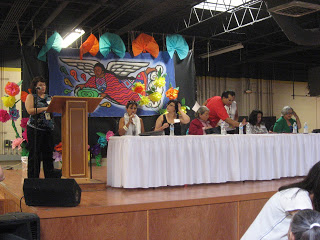
Panel on "Raza Unida Party Legacy"

Panel on “Raza Unida Party Legacy”

By Dionne Espinoza

Over the last three years there have been a spate of “reunion” and “commemoration” gatherings around major moments in the Chicano movement of the late 1960s and early 1970s. This past summer I attended two such gatherings in Texas, one in Austin and one in El Paso organized by raza in each place to reflect upon the historic third party effort to organize as La Raza Unida Party. RUP was founded in Texas to increase the political representation of Chicanas and Chicanos in elected offices and to assert the political voice of the raza community. For me, attending these events was part of my continuing research on women in the Chicano movement and a chance to listen to the veteranas and veteranos about their experiences. I am fortunate to do research that reflects my passion and personal commitment to know this history and to continue to learn about it and from it.

I have to admit that I do sometimes idealize el movimiento to some extent even as my studies have provided me with a strong sense of its limitations, particular with respect to mujeres. While the movement demonstrated limitations, it still stands as a powerful example of a Chicana/o progressive political culture that was forged through grassroots and community based organizing. (Certainly to be credited for the existence of, among other things, Departments of Chicano Studies, like the one where I make my academic home).  My interviews with RUP women and studies of the archive have given me a stronger appreciation of the possibilities of working through the electoral process. Listening to the activists at these conferences was inspiring especially for someone like me who had been rather cynical about electoral politics due to my experience living through the long conservative era (Reagan, Bush, and Bush)—so much so that, while I voted in the 2008 Presidential election, I felt rather distanced from the process.

Of course, we must be specific about the political culture of Texas at the time of Raza Unida’s founding, a state where Governors had been mostly Democratic party candidates since 1874. During the 1970s, the work of RUP was not only to assert a third party option as a challenge to the two party system (famously described by Rodolfo “Corky” Gonzales as “like a monster with two heads feeding out of the same trough”), but also to send a message to the Democratic party of Texas which still reflected pretty deep traces of the race politics of the post Reconstruction-era Southern political culture of exclusion and disenfranchisement including the existence of poll taxes. Poll taxes were in place until the Black Civil Rights Movement called attention to the various forms of disenfranchisement enacted at the polls and subsequent legislation made poll taxes unconstitutional. (For a current debate on a “poll tax by any other name” see http://www.latimes.com/news/opinion/commentary/la-oe-ackerman-texas-poll-tax-20120715,0,6684651.story)  Additionally, in a city like San Antonio, the existence of “at large” elections served to reproduce practices of exclusionary representation on the city council until district based elections were instituted in 1977 (an issue that the Committee for Barrio Betterment–an early form of Raza Unida–raised when it ran candidates, including Rosie Castro and Mario Compean, in the early 1970s).

At the Austin event, there was a sense of the past in the present when it came to gender politics—as was the case in the 1960s & 1970s, it appeared to be mostly mujeres who set up the logistics and worked behind the scenes to help pull the event together. These included many who had been among the most committed RUP activists of the time running for elected office, serving as Precinct Chairs, and, even as the Chair of the Party such as Martha Cotera, Maria Elena Martinez, Lindo Del Toro and Alma Valdez. Then and now, these women can always be counted on to follow through, a sign of a true activista. While women were working the tables (many comadres of the above named women), they were also on stage: Luz Bazan Gutiérrez, the first Chair of RUP in Zavala County, served as an MC and there was at least one woman on each panel (where before there were usually none unless Chicanas called out the lack of representation). I was especially struck by the words of Maria Jiménez, who had been involved in RUP in Houston and had run for State Representative against Ben Reyes (who ran on the Democratic ticket). She reflected upon the legacy of RUP (and I paraphrase from my notes), “electoral politics is seen as reformist but the process was radical.” Her words underscored the massive grassroots character of the RUP effort in Texas, a process that required the construction of a state-wide  infrastructure to gain party recognition, not to mention voter education and identification of candidates willing to undertake the hard work of campaigning.

The Raza Unida concept, which had been circulating in the national movimiento by the late 1960s, brought hope to the movement and in short order RUP’s crystallized in California, Arizona, Colorado, and included Midwest states such as Michigan. It was this national conversation that brought activists to El Paso, Texas during Labor Day weekend in 1972 to create a national party. Forty years later in 2012 a panel at this conference entitled, “Prospects for Reviving RUP or Creating a New Partido” moderated by Armando Navarro and featuring Herman Baca, Ernesto Vigil, Maria Jiménez, José Angel Gutiérrez and Juan Jose Peña, sought to evaluate our present moment and possible next steps. I found the panel riveting as the speakers, each of whom commands a wealth of knowledge from activist work and movement history as key actors in those times, presented their thoughts in elegant, concise and powerful words. While there were some differences among the speakers, what they held in common was a call to “educate, politicize, and organize our people” (Baca) and for the “creation of critical consciousness” (Vigil). Other speakers underscored the importance of the grassroots and “social movement strategies” and cited the work of the Dreamers and the immigrant rights movement as offering recent examples of the ongoing viability of mass movements (Jiménez), the need for more use of social media such as the internet (Gutiérrez) and a communication network (Peña). While there was some optimism voiced by the panelists, it was slightly muted as the enormity of reviving a movement became quite clear–there was not a large attendance although the panel was on a Friday afternoon in a community space and, as one panelist pointed out, he was very tired and quite ready to hand the torch over.

Despite the historiographic creation of “four horseman” and the actual history of male dominance in the leadership of RUP at its higher levels, the organizers of this conference worked hard to make space for Chicana voices. A panel beautifully titled, “Raza Unida Party Legacy” by its organizer, Martha Cotera, featured an intergenerational range of women’s voices –Cotera herself, who stated that Raza Unida provides a “political framework;” Linda Garcia Merchant, a filmmaker whose work has begun to share previously unheard stories of Chicana involvement in the movement; Lydia Hernandez, a school board member in Phoenix now running for State Representative in Arizona; Maria Cotera, a university professor who is not only doing the academic work of documenting Chicana lives but involving her students in the work; Avina Gutiérrez, whose mother and father founded the party and is now involved in grassroots politics in Austin; and, Mary Gonzalez, recently elected as a State Representative for El Paso and also proudly identifying as “pansexual,” pointing to a new context in which LGBT perspectives are included in notions of Chicano electoral politics. Across these voices, it is clear that the RUP legacy continues for Chicanas, who played an equal role in building the party in Texas in the past, and are making their presence known not only in current electoral activism but also in a number of projects that carry out the legacy.

It is important to honor and to remember significant projects and events of the movimiento—perhaps more than anything else to share these projects with new generations that are facing trying times politically and economically in the US. There is a need to convey the continuity of struggles by Chicanos and by Latinos in the US that provide models, lessons, and reservoirs of hope that link into current day issues (and are in the process of being updated and revised, especially around gender and sexuality). The immigrant rights marches of 2006 recalled both Chicano movement marchas and Latin American traditions of social protest manifesting this kind of continuity while also intersecting with the changes in demographics including the pan-Latino constructs that have emerged. Ultimately what I walked away with left me with a sense that the consensus, at least among those who attended both El Paso and in Austin, lies firmly with a commitment to the grassroots—and this to me, is the strength of the Chicana/o political culture manifested in Raza Unida Party, the Chicano movement, and ideally, Chicana/o Studies. This is the emphasis that will keep us relevant beyond 2012.

Maybe we can see hope in new generations of elected officials such as the Castro brothers, Lydia Hernandez, and Mary González (all in Texas, interestingly enough) who are asserting the legacy of a Chicana/o progressive political culture. During the Austin gathering Rosie Castro arrived with her two sons, Julian and Joaquin, named as “rising stars” in the Texas and national Democratic party, a symbol, in my view, of the party’s longer term legacy (even if, ultimately, most of the electoral successes of that time were at the local rather than statewide level.)  (See historian Cynthia Orozco’s brilliant commentary on the Castro’s: http://historynewsservice.org/2012/09/no-julian-castro-without-mother-rosie-castro/). Maybe I have to put aside my cynicism about electoral politics but, as was affirmed at the events, elected officials can only be the voice of the people when there are grassroots efforts and social movements that not only support them but also assert and reflect the needs of the people.

Dionne Espinoza, Ph.D. is on the faculty of California State University, where she teaches Chicano Studies and Women’s and Gender Studies.

Comment(s):
Brenda Sendejo  October 15, 2012 at 12:58 PM

Dionne, thank you for this wonderful reflection on the Raza Unida commemorations and the legacy of Chicana participation and activism. I so enjoyed reading it and will most definitely share it with my students. Mil gracias for your work!

Telling

October 8, 2012

Forever 22


By Ella Diaz

I deliberated over the topic of my first blog for Mujeres Talk this fall 2012. I wanted to pick something big—both central to the upcoming election and to our lives as Chicanas and Latinas. After hearing and reading about rumors of a Monica Lewinsky tell-all book, I realized that a critique of Clinton at this moment in the election season is not only the political maneuver of one party over another. It also yields big insights into how women continue to be perceived in American culture.

There are conflicting reports as to whether or not Lewinsky will write a tell-all memoir of her affair with President Clinton between 1995 and 1997. She is going to: http://www.washingtonpost.com/blogs/she-the-people/post/monica-lewinskys-steamy-account-of-clinton-affair-could-get-12-million-advance-report-says/2012/09/20/43736520-035a-11e2-9132-f2750cd65f97_blog.html  She is not going to: http://www.huffingtonpost.com/2012/09/20/monica-lewinsky-book_n1900960.html)

Many of you may be indifferent to whether she tells or doesn’t tell; others may be screaming “Ella! Who cares?” These points of view represent the majority of reactions on blogs, such as The Huffington Post, which also reported this September that Lewinsky is not planning on writing the book. Some more suspicious commentators also add that, given the election season, Lewinsky could be cashing in on an “expensive rumor.” (See the comments in Huffing Post blog link) Nevertheless, news stories and blogs continue to announce that Lewinsky’s book is on. So why does this story matter?

Hearing about Lewinsky again, and the idea of her telling all, takes me back to my undergraduate days at UC Santa Cruz. I was 20 and a sophomore when the news story broke. I had a friend who met Lewinsky while she was in the U.C. – D.C. program, a pipeline for political science majors to intern at the capitol and other government entities. I remember staring at that famous cover of Time and thinking, “Why and how could you want to do it with an old guy?” I purposely write my reaction to the news story in this way to capture my mindset at 20, someone close to Monica’s age. I didn’t understand attractions to power and I was fairly innocent about sex. Wait, am I suggesting Monica did understand and wasn’t innocent?

So here is why her story continues to matter. Monica Lewinsky is a national (read: white) measure by which I (and numerous women) silently and implicitly judge the sexual propriety of young women and champion personal accountability as equality of the sexes, a big term and idea in the 2012 election. Why—16 years later—do we not remember President Clinton as the source of the scandal or hold him personally accountable? We misuse ‘personal accountability’ with Monica because she is not the one who represents power in the paradigm of President of the United States and intern.

How many of you remember who you were at 22? How many of you are 22? I never attempted to understand Monica, walk in her shoes, or consider her point of view. From the outset, I internalized the mainstream media’s framing of her in the 1990s.

Holding Lewinsky personally accountable for two people’s unethical actions hijacked her life in long-term ways. I remember years after the scandal, I saw her on T.V. attempting to launch a handbag line. I thought it was strange, and I felt sorry for her. It never occurred to me that employment must have been scarce and that she was attempting to harness her unwanted celebrity in a profitable way. Lewinsky did work with author Andrew Morton on a story about the affair and, according to sources, she made about a million dollars. Overall, many news stories on her indicate that finding work is not easy. But I guess we think we’ve come a long way from pinning scarlet letters on women who have sex with men that they shouldn’t.

Interestingly, I revisited some old interviews with Lewinsky (see the Barbara Walters special from 1999 here: http://youtu.be/fpCv-UT2yCU. Lewinsky grew up affluent, white, and had an affair with another married man while in high school. I forgot about that. Walters asks Lewinsky, “Why do you keep having affairs with married men?” Lewinsky claims she didn’t have feelings of self-worth and felt unworthy of being with a man. One wonders if we will ever critically assess these responses. What if we read Lewinsky’s answers to this question through Aida Hurtado’s The Color of Privilege? Hurtado claims that, in many ways, white women and women of color’s interactions and alliances continue to be structured along heteronormative hierarchies of desire. Drawing on Hurtado’s framework, let me be blasphemous: 

Why shouldn’t Lewinsky make money off having sex with Clinton? I can’t help but recall an article by Tiffany Ana López—“Emotional Contraband: Prison as Metaphor and Meaning in U.S. Latina Drama” (2003)—in which she quotes Ashe Bandele’s experience of bodily searches before conjugal visits with her incarcerated husband: “The first two or three times that happened to me, I felt immodest. I felt shame and embarrassment. Now I feel camaraderie with women who work the peep shows or who lap dance for a living. Except, of course, I don’t get paid. But you know I think I should. Every glance that gets held too long, for each time one of those police runs his fingers across my underwear, those motherfuckers owe me, in the very least, cash money.”[i]

In payment for all of our disapproving eyes that lingered a bit too long, I hope Lewinsky gets paid cash money for telling.

Ella Diaz is an Assistant Professor of English at Cornell University. Her research is on the interdependence of Chican@ and Latin@ literary and visual cultures.


[i] Bandele, The Prisoner’s Wife: A Memoir, 1999: 47.

Comment(s):
  1. Sara Ramirez  October 9, 2012 at 5:18 PM

    I was in middle school when the name “Monica Lewinsky” became synonymous with “vieja cochina” at my parents’ house. I didn’t think about Lewinsky’s age though; I just thought about the attention she was getting. Sure, it was negative attention, but, hey, I thought, she didn’t have just *any* affair: it was an affair with the *President of the United States.*

    I was not able to articulate it at age 12, but I knew Lewinsky’s fame had something to do with attaining the kind of power women rappers like MC Luscious (“Boom, I Got Your Boyfriend”) and Salt-N-Pepa (“None of Your Business”) were describing in the early ’90s. I sensed this power came with breaking rules, crossing boundaries.

    Of course, today I know that power is a relative dynamic. While Lewinsky may have learned to be “comfortable with [her] sensuality,” as she explains in the Walters interview, her self-empowerment seems to have been co-opted by a media that caters to an audience inculcated with heteropatriarchal notions of intimacy. Both Lewinsky and Walters repeat the word “sensuality” throughout the first part of the interview, and I can’t help but think how this story would be different if we considered Lewinsky’s energy connection to Oshun, the Yoruba goddess who rules over positive interconnections, including sensuality.

    This was a really provocative and fierce essay, Ella. Thanks for posting!

  2. Theresa Delgadillo  October 10, 2012 at 9:42 AM

    Ella, I want to read your essay as a “hands-off-using-women’s-bodies-to-advance-your-political-agenda” statement, but the possible tell-all book strikes an odd note for me. The Huffington Post article about this possibility cites a 1999 interview as a source (!). While I appreciate your consideration of power differentials, who or what benefited from making a spectacle of one woman’s body seems relevant.

  3. Ella Diaz  October 10, 2012 at 3:17 PM

    Both smart responses. I think that the media and personalities that are the media find Lewinsky an old news story (pun intended) when called on their reposting of an interview that is over a decade old. Using the story as a reminder of the immorality of a president (meaning party) over another is why the story recirculates right now. I wonder if Lewinsky watches the interview with Walters now and just fricking cringes… A story that served as a headliner now careens as a reminder. So, yes, in both contexts female body serving meaning and agendas other than her own.

Las Madres Profesoras in the Academy

September 3, 2012

Castañeda and son, Miguel Angel

Castañeda and son, Miguel Angel

By Mari Castañeda

For the past twelve years, I’ve lived in Amherst, Massachusetts, an iconic New England college town that has a high-income and predominantly white population that often boasts about a family lineage that dates back to the first pilgrim settlers. Luckily for my son Miguel Angel, who is now a seventeen-year-old and about to enter is senior year at the local high school, he’s learned to meet such boasting with his own story of a family lineage that pre-dates those settlers and is tied to the Yaqui Indians of California and Mexico. It has not always been smooth sailing—such as the time his elementary school teacher called me because my son upset his white classmates by telling them with a typical nine-year-old bluntness that “they didn’t belong in this land.” We worked through the incident together, making it the prototypical “learning moment” with his class. For my son Miguel Angel, such historical positioning became necessary in order for him to claim a space in a place that was not originally intended for him. Yet we learned from other friends of color who had a longer history of making space for themselves in the region, and over time built a diverse community of family friends. The making of home and community are indeed socially constructed, in addition to being passed on from generation to generation.

At the 2012 MALCS Institute, Susana Gallardo and I organized a roundtable titled, “Las Madres Profesoras in the Academy” in an effort to create a space to discuss the joys and challenges of working in academic environments while also being a mother/parent. What we found most enjoyable about the roundtable was sharing about how each of us were succeeding and struggling with creating such a balance. In doing so, we learning from each other’s strategies and sabiduria, especially since most of us were the first mujeres in our families to forge this professorial path. We also discussed the institutional realities of faculty positions, which often causes us to be far away from our extended families, thus forcing us to rear our children in communities that are regionally, culturally, and even economically radically different than the ones we grew up in.

When we introduced ourselves at the beginning of the session, we also noted the ages and names of our children—something which often doesn’t happen at conference panels. Although the ages of our kids ranged from four years old to seventeen, it was clear that despite the age differences, we were all trying to figure out how to reconcile our lives in academia (which often negates the personal lives of students, staff, and faculty) with the fact that our children and broader families were at the forefront of our lives.

At the roundtable, we discussed the importance of building such homes and communities on our own terms, regardless of where we were located. Each of us had stories of the lengths we went—whether driving across town, or flying across the country—to make sure our children had a range of experiences that would help them develop a healthy and well-grounded sense of identity. We also discussed ways in which we could influence our institutions to be more sensitive to motherhood/parenthood issues so that we can be in a work environment that allows us to be successful in all the areas of our lives. Increasingly (although perhaps grudgingly), academic institutions are recognizing that they must change their insensitive practices and unrealistic expectations if they are to remain as cutting edge and relevant scholarly environments in the twenty-first century. Creating a work place where mother-scholars are welcomed, encouraged and expected to succeed is central to this shift. For instance, the chair of my department when I first started at UMass Amherst (a white male) was incredibly sympathetic when I told him I needed to teach between 9am-3pm because my son’s inability to be in an after school program as a five-year-old. Not only did he schedule my courses T/Th between those hours, but the faculty meeting was also scheduled between 12-2pm. These seemingly simple accommodations made a world of a difference in mine and my son’s happiness and success.

When I was a graduate student mother in the early-1990s, virtually no conferences held panels, workshops, or roundtables on the topic of balancing motherhood with academia. At this Summer Institute, our panel was one among several on mother-related topics including Danielle Barrazza’s “My Baby Bump” and Karleen Pendleton-Jimenez’ wonderful reading of her memoir on butch pregnancy and motherhood (http://labloga.blogspot.com/2011/11/how-to-get-girl-pregnant.html).

Things are starting to change and it’s great to see that MALCS is once again at the forefront of this important discussion. At the roundtable, it became clear that we wanted to continue the conversation outside of the institute, and thus we are starting a queer-friendly parenting list for MALCS members and affiliates. We hope you will join us in our effort to share experiences, best practices, and a safe space to get advice.  Please join us on our new email discussion list!  To join the “Madres Profesoras” email list, please email Susana@malcs.org

Mari Castañeda is an Associate Professor of Communication Studies at the University of Massachusetts, Amherst.  She studies new media and telecommunication policy, Latina/ethnic media studies, and transcultural political economy of communication industries. Her latest book is Mothers’ Lives in Academia, a collection of essays co-edited with Kirsten Isgro, forthcoming from Columbia University Press.

Comment(s):

Theresa (Mujeres Talk Co-Moderator)  September 5, 2012 at 7:54 AM

Mari, Your essay highlights how much the question of Chicana/Latina/Native American women’s inclusion in the academy is not only about whether an institution provides affordable and quality child care – which is vitally important, but also about the practices of the profession and the services that we can all make use of to help that next generation. I like how much your essay emphasizes that even the seemingly small gestures matter. Thank you!