Category Archives: Gender and Sexuality

Another (Reauthorization) Act to Follow

December 3, 2012

Photo: "Human Trafficking" by Leonard John Matthews from Flickr/Creative Commons

Photo: “Human Trafficking” by Leonard John Matthews from Flickr/Creative Commons

By Susan C. Méndez

There seems to be no end to the potential human collateral that can be caused by the United States Congress’s inaction. Along with the delay in renewing the Violence Against Women Act, recent news coverage has focused on another delay in reauthorizing the Victims of Trafficking and Violence Protection Act of 2000 (TVPA). The United Nations Office on Drugs and Crime defines human trafficking as “an act of recruiting, transporting, transferring, harboring or receiving a person through a use of force, coercion or other means, for the purpose of exploiting them.” According to a news article by Mounira Al Hmoud in the Times Argus online, more than 2,500 alleged incidents of human trafficking were filed between January 1, 2008 and June 30, 2010 in the United States. About 82% of these reported incidents involved sex trafficking: more than 1,200 incidents involved adult sex trafficking and 1,000 incidents involved child sexual exploitation. And these are just the reported cases for this time period. Notably, human traffickers largely target women and children of color. As such, those who have rose up to speak on this issue are tied closely to this community. Recently Jada Pinkett Smith and her daughter Willow Smith made the news with their appearances in Washington, D.C. to talk to government officials about this issue. Reportedly, more than 2,500 alleged incidents of human trafficking were filed between January 1, 2008 and June 30, 2010 in the United States. About 82% of these reported incidents involved sex trafficking: more than 1,200 incidents involved adult sex trafficking and 1,000 incidents involved child sexual exploitation. And these are just the reported cases for this time period. Pinkett Smith founded an anti-trafficking group named “Don’t Sell Bodies” and sang a song in Spanish entitled “Nada,” whose video highlights the story of a young woman being trafficked by a love-interest and is directed by Salma Hayek. It is no coincidence that these key actions which stress the issue of human trafficking have come from members of the larger women of color community; such actions and participants are good indicators as to who should be paying attention to human trafficking.  Pinkett Smith and her daughter’s most recent actions include participating in the Senate Caucus to End Human Trafficking. Their advocacy on this issue has brought much needed attention back to the fate of the Victims of Trafficking and Violence Protection Act of 2000 (TVPA).

This act, also known as the largest piece of human rights legislation in the United States, was the first federal law to address comprehensively trafficking as a crime on both the international and domestic fronts. According to Polaris Project (a non-profit, non-governmental organization that fights modern day slavery and human trafficking), the TVPA is composed of three aspects: “prevention through public awareness programs overseas and a State-department led monitoring and sanctions program; protection through new T-visa and services for foreign national victims; and prosecution through new federal crimes.” This legislation was significant because it created an Office to Monitor and Combat Trafficking, whose task it is to rank other countries based on their efforts to halt human trafficking (and the President of the United States may choose to impose sanctions on countries that do not meet the minimum standards to end trafficking); established the temporary legal status of “continued presence” and the new T visa which allows survivors of human trafficking to stay in the United States temporarily and to apply for permanent residency after 3 years; and made trafficking a federal crime along with the new crime of forced labor (individual and corporate employers are the ones liable to be charged with these crimes). The TVPA of 2000 (P.L. 106-386) was an astounding act of humanity and compassion; it was reauthorized in 2003 (H.R. 2620), in 2005 (H.R. 972), and in 2008 (H.R. 7311) easily. Its renewal is purposefully scheduled every two to three years in order to address that fact that traffickers change their modes of operation periodically. Each time this act was reauthorized, improvements were made that enhanced the original bill’s approach to end human trafficking.

Although various academics, journalists and activists may have differing perspectives on the impact of human trafficking and the methods and language used to convey assistance to those who are trafficked, the impetus behind this act appears to be extending offers of help to those who find themselves to be survivors of exploitative practices. Consequently, the need for this act still is apparent and the Trafficking Victims Protection Reauthorization Act of 2011 (S.1301) began its renewal process on June 29, 2011 when the act was introduced and referred to its committee led by Senator Patrick Leahy (D-VT). Initially, this Reauthorization Act had 42 Senatorial co-sponsors (it now has 52). According to Leahy aides, when this committee turned to the House of Representatives, there was a need to strike a deal and that need has delayed renewal. The Act expired on September 30, 2011. Mounira Al Hmoud reported for the Times Argus online that for the past fifteen months, the Trafficking Victims Protection Reauthorization Act of 2011 has been referred to five different committees of the House, has undergone significant revision, and has Rep. Christopher Smith (R-NJ) as its sponsor. An editorial piece in The New York Times, dated March 21, 2012, explains how these revisions have not always been beneficial. For example, one revised aspect is the moving of financing for survivors’ services from the Department of Health and Human Services to the Department of Justice. This shifting makes little sense as the Department of Justice, in comparison to the Department of Health and Human Services, is not equipped to deal with the multi-faceted experiences and needs of survivors. Besides ill-conceived revisions, another detrimental aspect to the stalling of passing this reauthorization act is the inaccurate application of language used to discuss human trafficking to prosecute undocumented immigrants in states such as Arizona where anti-immigrant fervor is strong.

So what does this act look like now? Where does it stand and what does it have to do with the Senate Caucus to End Human Trafficking? The aforementioned editorial in The New York Times also details how in October 2011, a Senate bill to renew this act through 2015 cleared the Judiciary Committee, yet has not come to a floor vote. The bill for this act’s renewal cuts appropriations to 130 million but increases “victim” assistance to $25.5 million. It also has strengthened enforcement measures. The Senate Caucus to End Human Trafficking is co-chaired by Senators Richard Blumenthal (D-CT) and Robert Portman (R-OH). They aim to engage caucus members in agreeing upon common goals and creating policies to achieve these goals in the quest to end human trafficking. There are 13 Senators on this caucus, and it is fitting that Blumenthal and Portman are co-chairs because in June 2012, they sponsored the End Trafficking in Government Contracting bill. (In this bill, these two Senators hoped to change pending defense fund legislation in order to stop funds for government contractors who employed trafficked laborers.) It is suspected the work and attention that this caucus will garner can only bring the Trafficking Victims Protection Reauthorization Act of 2011 back to both public and governmental discussion. The caucus has already begun productive conversation as Jada Pinkett Smith has expressed her hope that the caucus will establish an advisory council of survivors that can help the government comprehend the various complexities of human trafficking. It appears good results can come out of this caucus.

Recent news reports have restated the need for this act, along with the Violence Against Women Reauthorization Act, to pass Congress before the end of this year. However, with much needed attention and work focused on the “fiscal cliff,” the renewal of these crucial acts seems doubtful and such a delay would be disastrous for those seeking assistance. The same editorial in The New York Times describes recent successful efforts made to reach out to survivors of human trafficking. These efforts include: “a new trafficking hot line, financed through a grant by health and human services, for instance, [which] has taken more than 49,000 calls, connected 5,770 potential victims with services and provided more than 2,155 law-enforcement tips.” Such services are not plentiful and whatever resources exist to help people who find themselves to be survivors of exploitative practices like human trafficking should be maintained if not expanded.

References

Blumenthal, Richard. “Senate Caucus to End Human Trafficking.” n.p. n.d. Web. 16 November 2012.

Hmoud. Mounira Al. “Leahy Seeks Action on Two Upcoming Bills.” Times Argus. Times Argus, 12 November 2012. Web. 12 November 2012.

Polaris Project. Trafficking Victims’ Protection Act (TVPA)-Fact Sheet. Washington: Polaris Project, 2008. PDF file.

“The Fight Against Modern Day Slavery.” Editorial. The New York Times 21 March 2012: A30. Print.

“Trafficking Victims Protection Reauthorization Act of 2011.” Govtrack.us. Civic Impulse, LLC, n.d. Web. 16 November 2012.


Susan C. Méndez is an Assistant Professor in the Department of English & Theatre and the Department of Latin American & Women’s Studies at the University of Scranton. She teaches courses on Multi-Ethnic American Literature and Women’s Studies. Primarily, she conducts research on novels written by Latino/a authors.

Comment(s):

Sara Ramirez    December 13, 2012 at 9:43 PM

Thank you for your post, Prof. Méndez. I voted in California last month, and Prop. 35 had to do with human trafficking and penalties. Like most voters uninformed on this measure, I unquestioningly voted YES for increased penalties on those convicted of human trafficking crimes. I soon learned from my progressive colleagues that I should have voted NO. Do you know about this measure and how it affects people of color?



A Visit From Artist Ana Teresa Fernandez

November 26, 2012

by Ella Diaz

Photo by Rio Yañez

Photo by Rio Yañez

            Ana Teresa Fernandez is a visual artist, sculptor, and performance artist based in San Francisco, CA. Originally from Tampico, Mexico, Ana moved in 1991 with her family to San Diego, California. In the early 2000s, Ana earned her MFA at the San Francisco Art Institute [SFAI], and began teaching drawing and painting around the time I began teaching in the humanities at the SFAI. But before I actually met her, I first encountered Ana Teresa Fernandez through her 2008 exhibition, “Ecdisis: Juarez, Mexico” at the Galería de la raza in San Francisco, California. See http://www.galeriadelaraza.org/eng/events/index.php?op=view&id=1244 

            This exhibit featured Ana’s oversized ex-votos, better known as milagros, which are the diminutive metal fetishes of hands, hearts, arms, and other sacred body parts often used in syncretic and hybrid spiritual rituals in Mexico and Central America. Ana’s replicas of Milagros were “life-size” and hung on a red velvet wall. By isolating these representations of body parts and contextualizing them within a well-known spiritual practice for many Mexicanas and Latinas, Ana reframed the recovery of the mutilated and desecrated bodies of women murdered in Juarez. This show stayed with me for many years as I tried to find ways to talk and teach about Ciudad Juarez and representations of female sexuality and gender in the neoliberal state. See http://anateresafernandez.com/ecdisis/af_111708_prs_001/  

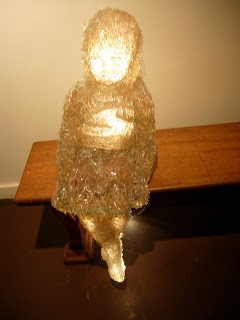
            Another component of the exhibit featured Ana’s creation of glass sculptures of several children, orphaned by the femicide in Ciudad Juarez, Mexico, as well as children left parentless through sexual and labor exploitation in Bangladesh and Vietnam. Ana began the process of creating the sculptures first by taking molds of the children in various poses. She then took the molds and covered them with broken glass from beer bottles. Her choice of material was based on her travels through Haiti and Ciudad Juarez where she noticed that broken glass was often as a type of home security system, placed at the tops of walls as a defense against robbery and other crimes. The broken glass sculptures were illuminated during the 2008 exhibit and positioned against walls of the Galería; one of the sculpture-children was placed on a bench. The figures were at once beautiful, haunting, and lonely. Ana wanted viewers to think about the multi-generational repercussions of the ongoing femicide in Ciudad Juarez, as well as the fallout of other epicenters of violence against women. Ultimately, the broken glass sculptures visually conveyed Ana’s and our inability to protect these children from the crimes against their mothers and the traumas imposed upon them as a consequence and in the future without the protective presence and defense of their mothers.           

Photo by Rio Yañez

Photo by Rio Yañez

            Returning to her recent lecture at my campus on November 8, Ana centered her presentation around her 2010 work, “Borranda la barda/Erasing the border.” (http://anateresafernandez.com/borrando-la-barda-tijuana-mexico/) In 2010, Ana “set an enormous ladder against the border wall separating Playas de Tijuana from San Diego’s Border Field State park, and using a generator and a spray gun, she started painting the bars a pale powdery blue. While wearing a little black cocktail dress. And black pumps” (Jill Holslin, 2010). Writer Jill Holslin concludes that “Erasing the border, then, reminds us of the power of utopian visions, of dreams and the imagination.” Utopian visions are not uncommon in narrative, and Ana works across many mediums, from visual art, to performance and social sculpture, to tell the stories that shape our cultural experiences. For those of you who may not be familiar with social sculpture, it’s an idea put forth by Joseph Beuys in the 1960s and 1970s that proposes sculpture as a potential for and an act of societal transformation. 

            One aspect of “Borranda la barda” that I had difficulty reconciling is Ana’s selected wardrobe for painting the border fence: a little black dress and black high heels. As a Chicana who has witnessed many offensive perceptions of overtly sexual apparel, I didn’t know how to read this component of her performance and intervention on the border. During her lecture, however, Ana explained that the “little black dress” is a loaded symbol—even a kind of capital—in the western imagination. By placing it out of its expected context—the nightclub, the lounge, etc.—Ana is able to channel its co-opted power, or objectifying gaze and turn it back on her viewer. 

            Also, while in the midst of painting the border that perfect shade of sky blue, she was detained by to policemen on the Mexican side, while helicopters hovered above her on the U.S. side. Her negotiation with the police went on for 45 minutes. Ana contends that her little black dress had everything to do with her ability to finish painting the piece. 

            Earlier this year, Ana learned that “Borranda la barda” had been destroyed—repainted the black color of the fence. Prior to arriving at Cornell to give her lecture, Ana returned to the fence and repainted “Borranda la barda” that perfect shade of sky blue that, at a certain distance, restores the horizon to an unbroken, unblocked natural divide, where the ocean meets the land.

Ella Diaz is an Assistant Professor of English at Cornell University. Her research is on the interdependence of Chican@ and Latin@ literary and visual cultures.

8 comments:

  1. Anonymous November 29, 2012 at 7:53 AM

    I had the pleasure of seeing Ana Teresa Fernandez’s work when she came to Cornell University and presented “Blurring Borders: Redefining Truths, Fables, and Folklores”. I was familiar with a few of her works before the presentation, but the highlight of the presentation for me was hearing about how Ana utilized local materials (garbage in Haiti, glass in Mexico) within her art and performance. The lack of accessible “traditional” art materials (paint, paper, brushes, etc.) was incredibly striking when we see the incredible work Ana has done in engaging local materials within a community consciousness in Haiti. Her representation of the children of Mexico orphaned by the Femicides in Ciudad Juarez was a striking portrayal of the multi-generational impact of violence and the inability to protect children from this trauma.

    In her performance of “Borranda la barda”, Ana addressed the binaries of female identity (perceived and performed) along a heavy politicalized border state. Her performance of both female identity and nationalism was particularly striking in the U.S./Mexico borderlands, specifically when looking at the Femicides of Ciudad Juarez.
    I look forward to researching Ana’s work in the future and am extremely thankful I was given the opportunity to hear her present her work at Cornell University.
    -Sarah Anderson

  2. Ester December 3, 2012 at 8:17 AM

    What a courageous artistic intervention into difficult subjects. Thank you Ella, for providing the context of these creations. It makes me appreciate her sensibility to address literal dismemberment, carnage if you will, without producing more injury.

  3. Theresa Delgadillo December 3, 2012 at 8:18 AM

    Dear Ella, Thanks for sharing the pictures and discussion of Ana Teresa Fernandez’s work. The casts of children covered in broken glass are quite moving, and ask us to reflect on violence against children on many levels in new global economies. How wonderful for your students as well that they heard her and had the opportunity to learn about violence at the U.S.-Mexico border through an artist’s engagement with the topic that foregrounds critical discussion. Theresa Delgadillo, Co-Moderator of Mujeres Talk

  4. Ella Diaz December 3, 2012 at 2:22 PM

    “without producing more injury.” What a beautiful response, Ester, to Ana’s work in the Ecdysis show on the murdered women of Juarez.

  5. GGuerra91 December 4, 2012 at 11:34 AM

    I also had the opportunity to attend her lecture and the lunch with her.
    The choice to bring ATF to Cornell, especially given the timing with our class was great. It allowed us to be exposed to a new kind of artist, one that is raising awareness about most of the issues discussed in class.

    She is resourceful and works with her environment, this is very important because it teaches people, specially the natives of the area, that they can use anything to beautify and create art. This was evident in her work in Haiti and in South Africa. In the latter country, she was able to show that artists have the duty to report the beauties of everyday life instead of reporting/focusing on the negative like the news do.
    Overall, it was a great experience being able to meet her and understand the thought process and goals of her art.
    -Gloria Guerra

  6. GGuerra91 December 4, 2012 at 11:34 AM

    I also had the opportunity to attend her lecture and the lunch with her.
    The choice to bring ATF to Cornell, especially given the timing with our class was great. It allowed us to be exposed to a new kind of artist, one that is raising awareness about most of the issues discussed in class.

    She is resourceful and works with her environment, this is very important because it teaches people, specially the natives of the area, that they can use anything to beautify and create art. This was evident in her work in Haiti and in South Africa. In the latter country, she was able to show that artists have the duty to report the beauties of everyday life instead of reporting/focusing on the negative like the news do.
    Overall, it was a great experience being able to meet her and understand the thought process and goals of her art.
    -Gloria Guerra

  7. Sophie Loren December 10, 2012 at 6:03 PM

    Though I know this blog talks about Ana Teresa Fernadez’s work, I really enjoyed the altar of photographs that Maria Teresa Fernandez, who happens to be Ana Teresa’s mother, created and left on display for at the Latino Studies Program here at Cornell University until late November. It was a way of humanizing the border when so many times it is militarized especially by the responses the United States has taken in the past years (because the U.S. must “secure” the border). I was able to actually take an instructor and another peer of mine who would have never stumbled upon this type of work and show them the exhibit. This was a way for me to raise consciousness in others (esp. since that one peer came from a privileged background).

    Moving back to the work that Ana Teresa Fernandez did on the border really struck me. She stated in her lecture that her work was about “transcending the given, by changing the context” and she gave them example of the broom and how it wasn’t dirty on the floor but was dirty when left on a pillow. She does the same with her little black dress and she places it out of context and calls attention to what she is doing but more importantly to the border and how she is erasing it as she paints it blue.

    I could continue to go on but all I can say is that I was taken aback by both Ana Teresa and Maria Teresa’s ingenuity and how they use art to speak and give voice to those who are voiceless in our world.

  8. Vanesa L. December 13, 2012 at 8:43 PM

    Attending Ana Teresa Fernandez’s lecture at Cornell University was a great experience . There were two exhibits that struck me the most. The first one was NanMitaNan: Haiti. I thought it was amazing that Ana Teresa was able to make sculptures out of plastic bottles she found. More importantly, the clear plastic material against the backdrop of oil lamps not only showed Ana’s ability to use the resources around her, it reflected the ghost of the beautiful architectural structures in Haiti, the lack of resources and the invisibility of Haitian people to the rest of the world. I believe that Haiti is stuck “nan mitana” or in the middle between their historic accomplishments of gaining independence in 1804 and the potential of what nation could be. Her Ecdisis:Juarez, Mexico exhibit was also very memorable . The glass figures of the children were beautiful but it made me realize the generational effects that femicides have on these children. The children are fragile but defensive just like the jagged pieces of glass that make up the sculptures. To have their mothers taken way from them without justice being served is devastating. Thus, the femicides in Juarez has serious implications for the future of Juarez.

    I thought Ana Teresa’s work was fantastic. I hope she continues to do more work involving different human rights issues around the world.

The Decolonial ImaGYMary: Working (and Writing) on My Fitness

November 19, 2012

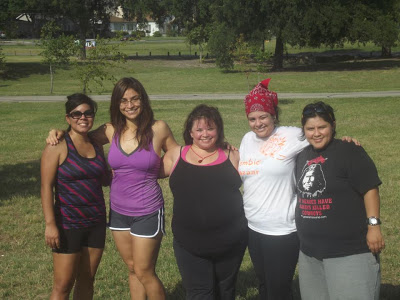
Fulanas Con Ganas Collective. L-R: Monica Morales, Larissa M. Mercado-López (Photo Credit), Selena Navarro, Giomara Bazaldua, and Jessica Hawkins.

Fulanas Con Ganas Collective. L-R: Monica Morales, Larissa M. Mercado-López (Photo Credit), Selena Navarro, Giomara Bazaldua, and Jessica Hawkins.

By Larissa M. Mercado-López

As I type this, I stop every few minutes to pull my spine up tall, clasp my hands above my head, and slowly move side to side, gently stretching the muscles around my shoulders and latissimi dorsi, or my “lats.” I place my hands on my lower back, elbows bent, and puff out my chest—bones shift and joints pop. My 4 year-old runs up to me, asking for a spin, and I scoop up her 60- pound body and spin her dizzy. Slowly, I return to my writing position and resume working.

In Loving in the War Years, Cherrie Moraga writes, “A friend of mine told me once how no wonder I had called the first book I co-edited (with Gloria Anzaldúa), This Bridge Called My Back. You have chronic back trouble, she says. Funny I had never considered this most obvious connection … And the spot that hurts the most is the muscle that controls the movement of my fingers and hands while typing.”1 We can “read” the pain metaphorically, as the burden that is placed on women of color to write against colonialism and to forge spaces in the women’s movement; however, Moraga may very well have had repetitive stress syndrome, or a similar musculoskeletal ailment, that could have been improved with strengthening exercises.

In my dissertation that I completed in 2011, I read texts in Chicana literature to examine how mestiza mothers read the social and somatic experiences of their maternal bodies, deploying critical and often oppositional knowledges. Similarly, scholars such as Suzanne Bost and Eden Torres, and emerging graduate student scholars such as Christina L. Gutiérrez and Sara A. Ramírez, are articulating decolonizing theories of the bodies and psyches of Chicanas. But in addition to this bodywork, I’ve been consumed with another kind of bodywork: fitness.

Exercise kept me sane through three degrees and three children. Though I won’t deny that the gym has been a space of frustration—especially as I painfully cardio-ed for excessive amounts of time in my attempts to “bounce back” after my pregnancies—it has also helped me reaffirm my sense of strength. The traditionally male-dominated free weight area has become my most empowering space, where I routinely lift heavy weights to strengthen my lower back that was strained and weakened by years of writing, motherhood, and running on pavement. I delight in my growing muscles and find the task of carrying my children and books far easier. Though one reason I exercise is to maintain low levels of body fat, I am driven more by my desire to prevent injury, manage stress, and strengthen my bones and cardiovascular system.

But, I often find myself alone in the free weights area. Among those who do come, many opt for the 5-pound weights because they want to become “toned but not bulky” (never mind the fact that the average weight of a woman’s purse is 7 pounds!).

However, I don’t judge. In many ways, hegemonic (and gendered) constructions of “fitness” and “fit women” conflict with dominant constructions of Latina bodies. The cultural valorization of “womanish” curves and the masculinization of muscular bodies constrain Latinas’ exercise choices, limiting them to those that emphasize fat loss over muscle strengthening. Further, the media’s constructions of “fit women” as white, upper-class, and hyper-muscular, and the capitalist culture of fitness, with its pricey supplements and apparel, render “fitness” a financially inaccessible and time-consuming endeavor. And, when it comes down to it, men in the weight room can be downright intimidating.

While these rhetorics and images of fitness have led some Latinas to either pursue more socially accepted forms of exercise for women or to nix them all together, many still revere their maternal ancestors for their bodily strength, recalling the girth of their strong arms and legs as they carried loads of laundry, tilled the hard earth for their gardens, and lifted sleeping children off their floor and into their beds. These images of strength need to be remembered and re-embodied.

I fully acknowledge that my pursuit of the level of fitness that I desire is enabled by my privileges of income, transportation, a flexible job, the support of my husband, and the availability of day care. We need to be critical of social/structural inequalities that limit how, when, and where Latinas exercise. I’ve responded to some of these issues by blogging for my local newspaper (Fitness Cultures) and starting a free exercise group (Fulanas Con Ganas).

It’s my mission to ensure that all Latinas have the access to the resources they need, as well as the support and confidence, to pursue the level of fitness that allows them to live their best lives.

CITATION

1.  Cherríe Moraga, Loving in the War Years: Lo que nunca pasó por sus labios (Boston: South End Press, 1983), v.

Larissa M. Mercado-López received her Ph.D. in English/Latina Literature from the University of Texas at San Antonio. Her research interests include Chicana feminism,maternal studies, phenomenology, and rhetorics of fitness. Larissa is an adjunct instructor at UTSA for Women’s Studies and Sociology. 

Comment(s):

  1. Anonymous  November 20, 2012 at 7:51 AM

    I just started Zumba and like it ok, but I really want to try some weights! Thanks for the motivation!

  2. Seline (Mujeres Talk Co-Moderator)  November 23, 2012 at 6:14 PM

    This comment has been removed by the author.

  3. Seline (Mujeres Talk Co-Moderator)  November 23, 2012 at 6:14 PM

    Larissa,

    Thank you for your essay on fitness and the different ways to love and be in your body.

    I love that you experience the free weight area as an empowering space. The insights you shared remind me of Jackie Martinez’ essay on weight room semiotics, the mental intensity that accompanies brute physical force, and embodied intentionality.

    Keep up the good work that opens pathways to access.

  4. Larissa    November 26, 2012 at 9:53 PM

    Martinez and I both do phenomenology; I used her work in my dissertation 🙂

  5.  Jessica Lopez    April 22, 2013 at 8:12 PM
    As for me, I exercise because I like breaking out a sweat after a stressful day. It is enjoyable since I go to the gym with my friends. It is important to love it and not think about what other people see. It also helps me to regulate my diet and be more aware of proper nutrition.

2012: A Year of Indigeneity and Indignities

November 5, 2012

Photo by Randy Bayne. From Flickr.

Photo by Randy Bayne. From Flickr.

By Adaljiza Sosa-Riddell

2012: For most of this year, I have been reading and writing about the past, present, and future of  la gente indígena de México y Centro América. I followed the news of the efforts of el Movimiento Indígena Nacional to re-establish a pluralist national democracy in México. In Sacramento, I was involved in the Zapatista Solidarity Coalition, a group dedicated to defending the Zapatistas and their revolution. But mostly I worked on my own manuscript explaining my own methods for developing a vastly different interpretation of Malintzin and her role in the conquest of México.

Immersed in my own ideas, I tried to ignore the politics of the day but found myself compelled to listen to the all-white group of men dressed in white-collar garb, who sought to be the Republican Party’s candidate for President of the USA. I came to call the longer-than-tolerable Republican primary season “the moron-athon” because of the ridiculous declarations and many factual errors made by the candidates day after day. The moron-athon turned into a brutal old-fashioned political slugfest after the respective conventions. Both parties continue to neglect the role and future of the worker in the USA. The focus on the middle class has erased the working sector, relegating the service worker to invisibility in the distribution of goods and services. Where were the voices of Hispanics, Latino/as, Mexican Americans, Chicana/os throughout the summer?  Where were the Partido de la Raza Unida, MAPA, LULAC, and all the other politicized groups with which we affiliated during the Chicano Movement years?  I know of several groups holding meetings and anniversaries, but I have not heard any plans, positions, or ideologies that emerged. The two entrenched parties continue to ignore the voices of Latinos until the very last moment because they can. Republicans and Democrats think they are the only game in town.

1960: My very first election was in 1960. It was an exciting time when I and millions of other Americans could still believe in the promise of American democracy. I was a dreamer, a believer that change would come through the electoral process. After all, I was a political science graduate student at UC Berkeley, fluent in Spanish and English, and knew politics backward and forward. I would certainly be offered a job in the JFK environment reflective of my talents. Instead, I learned women were blocked from most foreign service jobs outside of secretarial posts. What? By the end of the decade all my hopes for meaningful change within the two-party system were dashed. The few who promised change, Malcolm X, Dr. Martin Luther King, Jr., and Robert F. Kennedy, were dead, felled by assassins’ bullets. I vowed: From this day forth, I shall vote no more forever. Of course, I was borrowing the words from Chief Joseph of the Nez Perce people.

For the next three decades, women in the United States of America wrote volumes, spoke out often, filling the streets of Washington D.C., New York, and San Francisco with their messages and their bodies proclaiming women’s liberation. People of color involved themselves in their own “identity power movements.” Women of color learned to negotiate multiple terrains, hopscotching among various dimensions, and speaking through scholarly works.

Back to 2012: Why then in this election year are women suffering so many indignities? Women seeking knowledge of sexuality, conception, and/or contraception are accused of being prostitutes (Rush Limbaugh, Newt Gingrich); the concept of legitimate rape is raised and accepted by other congressional Republican candidates (Todd Akin, Richard Mourdock); indignities directed at all Latinos include offering “choices” between deportation and self-deportation, speaking loosely about electrocuting people on the borderline fence (Mitt Romney, Rick Perry, Herman Cain).

Heinous indignities continue to be directed at women, particularly Latinas—and with dire consequences:

1) Violence against women on the US-Mexico borderline comes from multiple sources:coyotes, la migra, los rinches, local police, Mexican federal police, Mexican and USA drug enforcement agents, CEOs of border industries (las maquiladoras), and narco-traficantes who are well-armed and well supplied. The types of violence include rape, stalking, arresting, assault, robbery, and kidnapping.

2) Latinas, especially indigenous women, suffer negatively from official policies and values of government, organized religion, and medical professionals as well as other service providers intent upon limiting fertility. Women also rarely benefit from costly medical procedures intended to increase fertility. Issues of access to contraceptive knowledge, abortion, sterilization has begun to be well researched by Latina scholars including Elena Gutierrez, Adela de la Torre, and Angie Chabram.

3) The stigma attached to the status of single-motherhood is particularly insidious, as Gov. Romney placed the responsibility for the existence of gangs on single mothers. Governor Romney exposed his reliance on negative stereotypes for his decision-making, making this remark it in the context of speaking about needs of Latino community. “Gangs” and gang violence occur in all ethnic/racial categories, gendered settings, and economic strata.

Why do we, las mujeres, Chicanas, Latinas, Mexicanas continue suffering so many indignities, no matter on which side of the U.S.-Mexican borderline we reside?

¿Qué no nacimos iguales?
Aren’t we your partners?
Aren’t we your sisters?
Didn’t we raise you well?
Didn’t we bear and raise your children?
Haven’t we toiled in the fields a su lado?
Now that I’m educated, don’t I earn enough?
Haven’t I brought home a paycheck as meager as yours?
And now when I am educated,
Don’t I support our family in good style?
Yo como tortillas y tomo tequila, hací como tu!
Fui soldada y soldadera también
y cuidé el hogar para los soldados revolucionarios.
¿Qué no soy mujer trabajadora?
Don’t I deserve igualdad?

2012 is bound to be a momentous year with expectations ranging from mass destruction of the planet to a test as to whether or not our fractured populace can unite long enough to hand over a second term to our first elected president of mixed racial descent. I voted in 2008 and 2012 because I pay taxes, and I live here.  If Chicana/os and Latina/os are in need of perfect timing to speak out on their needs, demands, and dreams, this is it. We need to hear the voices of the workers of society. The numbers are on our side; the stars are in alignment; the Maya y Azteca elders have spoken.  SE PUEDE!!   

MALCS Founder, Adaljiza Sosa-Riddell, Ph.D., is Chicano Studies Professor Emeritus at The University of California, Davis. She lives in Los Angeles and studies politics, Chicana/o issues, and class struggle.