
Category Archives: Announcements

¡Ya Es Tiempo!: A Latina for Governor of California

February 4, 2013

Photo from Flickr. Untitled, Marcin Wichery, April 2008.

Photo from Flickr. Untitled, Marcin Wichery, April 2008.

By Adaljiza Sosa Riddell, Ph.D.

Mujeres compañeras, feministas Chicanas, Latinas y mas:
 Have you had enough of electoral politics? Did those congressional wiri wiri’s con bastantes pendejadas(rhetoric, hot air and plenty of stupidities) push you well beyond anger with the two-party system to somnambulist alienation? Politics in the Golden State, now revealed as a solid Democratic state, were not any more exciting, even as California underwent a demographic change unmatched in any other state. Although two women were on the ballot, the California gubernatorial elections of 2010 left me beyond bored and rather angry. Perhaps this is because neither woman, both of whom are CEOs of major companies, met my minimal criteria for candidacy.

A LATINA FOR GOVERNOR OF CALIFORNIA IN 2014? Would a Latina on the ballot make any election more engaging and more meaningful to me? Perhaps, but only if it is a position with the ability to alter the relationship between the rulers and the ruled, entrelos de abajo y los de arriba. How might this work? Inspired by the people of Arab Spring, I submit that an interested group might use the internet and social media toward this end. I proposed this entire plan to my family. My brother, the civil engineer, asked me, the social scientist, how I could even believe this could happen. He argued that my political science knowledge was just so much nonsense. Usually I concede intellectual knowledge vs. community experience arguments in the interest of peace and often end in agreement with him. This time I did not concede.

I refer you to a rapidly growing body of literature demonstrating, among other things, that women continue to develop feminist consciousness and do act on this thought process. In short, class, race/ethnicity, and gender do make a difference in politics. Traditional literatures such as political science, as well as emerging literatures including Women’s Studies and American Studies, affirm a Latina political consciousness. This specific consciousness is made up of a seamless cloth in which women’s personal development is intertwined with their roles in the family, the community, and their emergence as political activists.[1] Most importantly, the literature in Chicana and Chicano Studies has grown rapidly, with a sizeable body of work on Chicanas/Latinas and politics.[2] Since the theory that Chicana/Latina political consciousness is real, well-known, well-documented and reflects experience, then it is time to turn the pyramid upside down and share power rather than continuing to hold up pyramids and bridges on our backs.[3]

THIS IS A CALL TO ACTION. The next California gubernatorial election is in November 2014. I invite you to join me in nominating and supporting one Chicana/Latina feminista to run for and win the Governorship of the state of Alta California. I propose that this is performed “democratically” through the Internet and social media.

Although it is not my intent to encourage anyone to participate in electoral party politics, I am indeed searching for strategies that can actually foster meaningful change in the nature of the relationship between the rulers and the ruled. While American political ideology, including ideals of equality, individual freedoms, and government of the people, by the people and for the people, as stated in the Declaration of Independence and the US Constitution, may have inspired many of us, the marriage of such lofty ideals to raw, unregulated capitalism has rendered the original ideals and everyday practices hollow and harmful. However, the American electoral system occasionally provides some truly democratic moments.

Another such moment is now before the Latino population in California, specifically in the next gubernatorial election. Despite the fact that the U.S. Census seriously undercounts the Latino population, the 2010 U.S. Census and the resulting redistricting plans have given Latinos an unprecedented voice in the electoral process as shown in the 2012 elections. Proposition 11, Voters First Act, passed in 2008, established an entirely new process for reapportionment plans based on the 2010 census. However, the effort to take the reapportionment process out of the California State Legislature ended by increasing representation for new populations, cultural groups, and historical communities previously ignored or underrepresented. This process may not survive the next election. Conservative groups are presently working on changing that process through California’s citizens’ initiative to disallow “overwhelming” power for California’s former minorities. Latinos and Asian/Pacific Islanders especially cannot allow the underrepresentation in state governance to intensify nor continue because it means our communities will be wrongly served and/or underserved.

The 2010 U.S. Census also contains another important figure: Latinas are 51% of the Latino population. This number signifies that mujeres Latinas hold up more than half the sky. Coupled with knowledge and experience of Chicanas/Latinas in the workplace, the home, and the community, this does mean that mujeres do more than half the work. Mujeres should thus have an opportunity to have some of the power. And I expect men, brothers, and partners to wholeheartedly endorse this endeavor. I paraphrase a quote by Gabriel Garcia Marquez, 1982 Nobel Laureate in Literature, in a January 2000 issue of Time magazine: “Men have run the world for well over 2000 years. Women deserve to try their hand at governance in the 21st century.” The eyes of the world are on us. Women must rise to the challenge. California is perfectly poised to meet that challenge.

The following are some of my ideas for this project. If you would like to join me in creating a group, a Comité, separate from MALCS to advance this idea, please email me at adaljizasosariddell@yahoo.com.

STRATEGY. A first round of work will identify a Latina candidate then gather support and verify interest of the candidate in running for governor by signing up for the Primary. This first round should generate a short list of possible Latina candidates gathered by consensus exclusively from among women. The second round will begin with one Latina name, and one only. The Comité will then reach out to all Hispanic, Latino, Mexican American and Chicano organizations in California via listservs and social media, in an effort to recruit male compañeros, to endorse and work for the one consensus candidate.

CRITERIA FOR CANDIDACY. Candidate must:

1.     Demonstrate a Latina women’s political consciousness
2.     Possess electoral politics experience
3.     Have statewide recognition
4.     Exhibit a clean record (no major scandals)
5.     Display support for and from Latina/o grassroots groups including especially non-traditional sexualities
6.     Be highly knowledgeable on California issues
7.     Be familiar to and with large urban centers including Los Angeles, San Francisco, San Diego, and in its most rapidly growing areas such as Fresno, Visalia, and the Inland Empire

Again, I welcome other suggestions for criteria. The Comité will need these later for extensive outreach to garner support.

WHAT YOU CAN DO. If you are interested, join me in forming the Comité, you can:

1.     Nominate a candidate
2.     Volunteer for the Comité to receive names from first round of contact; work with me (or someone else) to come up with one name; conduct second round of outreach
3.     Work on campaign itself
4.     Suggest other forms of participation

¡Ya es tiempo! I look forward to your ideas, suggestions and concerns.

Adaljiza Sosa Riddell, Ph.D., is the founder of MALCS and Chicano Studies Professor Emeritus at The University of California, Davis. She lives in Los Angeles and studies politics, Chicana/o issues, and class struggle. She can be contacted via email at adaljizasosariddell@yahoo.com.


[1] This is a shortened version of the definition of Latina political consciousness from Carol Hardy-Fanta in Women Transforming Politics: An Alternative Reader, ed. Cathy Cohen et al. (New York: NYU Press, 1997), 223-237.

[2] See Carol Hardy-Fanta, Latina Politics, Latino Politics: Gender, Culture, and Political Participation in Boston (Philadelphia: Temple University Press, 1993); P. Cruz-Takash inWomen Transforming Politics, 412-434; Christine Sierra and Adaljiza Sosa-Riddell, “Chicanas as Political Actors,” National Political Science Review 4 (1994): 297-317; Mary Pardo, Mexican American Women Activists (Philadelphia: Temple University Press, 1998); Maylei Blackwell¡Chicana Power!: Contested Histories of Feminism in the Chicano Movement (Austin: UT Press, 2011), among others.

[3] Cherríe Moraga and Gloria Anzaldúa, eds., This Bridge Called My Back: Writings by Radical Women of Color (Watertown, MA: Persephone Press, 1981).

Comment(s):

  1. Rita Urquijo-Ruiz    February 6, 2013 at 11:45 AM

    Querida Adaljiza.

    Mil gracias for your writing this. Although I am now living in TX (another state that could us much of what you propose here). The first woman that comes to mind is Hilda Solís. Other than that, I can’t really think of anyone else.

    Abrazos,

    Rita

  2. Anonymous    February 8, 2013 at 8:08 AM

    I definitely think we should see a Latina on the ballot–it would not be too difficult to put someone there but whether or not she would be elected would be difficult given the two party monopoly. For a while I was a member of the Green Party and had some hope for an alternative space that forwarded progressive folks and that was a diverse group. In the past, I believe some RUP folks in Califas became part of Peace and Freedom. And there has been Latina representation on Peace and Freedom. Unless I’m mistaken, Yolanda Alaniz has been a major figure there in past. I also think we need to be clear about what the platform of a “Latina woman’s political consciousness would be” e.g. worker rights, support for public education, etc. You are certainly on to something, Ada! I agree that Hilda Solis would be a strong candidate–she is democratic party all the way but that could also be strategically useful in her election. But a true challenge should come from someone outside of those circuits who offers a completely different approach to leadership and policy and I think that’s what you are calling for. –Dionne
Happy Holidays!

December 17, 2012

Dear Mujeres Talk Readers and Contributors,

As of today, we are on holiday break. We will resume our weekly Monday publication schedule on Monday, January 7, 2013.

We invite you read over this past year’s essays and, if so moved, to comment, during this holiday break. We thank you deeply for generously sharing your valuable critical insights as writers and readers on Mujeres Talk. In this first year of publishing on a weekly basis, Mujeres Talk posted new blog essays on 46 weeks of the year featuring 53 authors. Writers for Mujeres Talk have spanned a wide spectrum — from those just starting out in college to retired and eminent scholars of Chicana/Latina studies, community activists, artists and professionals.

We invite everyone to submit essays or essay ideas for 2013!

Most of all, we on the Mujeres Talk Editorial Collective wish you and yours a very joyous holiday season!

Decolonize Your Diet!

September 10, 2012

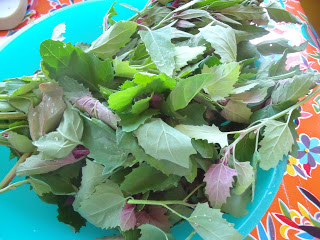
Quelites Harvest

Quelites Harvest

By Luz Calvo and Catriona R. Esquibel

We have a passion for Mexican food. We have a passion for gardens, for healthy food, for food justice, and for people of color reclaiming our histories. All of this has led us to our current project, Decolonize Your Diet. This is a project to reclaim the heritage foods of greater Mexico and Central America as a way improving the physical, emotional, and spiritual health of US Latinos/as.

SOME BACKGROUND

In the US, a person’s health is almost pre-determined by their socio-economic status. For the most part, upper and middle class people, who have access to health care, higher education, healthy foods, and safe spaces to exercise, have significantly better health than poor folks who lack health insurance, education, access to grocery stores, and who live in poor and often dangerous neighborhoods. Public health scholars evaluate the health of demographic groups by looking at mortality, infant mortality, obesity, heart disease, high blood pressure, diabetes, and cancer rates. Poor people have worse health on all these measures. This is not surprising: Social inequality affects people’s health and lifespan.

However, there is one notable exception to the equation of poverty = poor health—public health scholars have found that recent immigrants from Mexico have very low rates of mortality, infant mortality, and illness compared to other groups. Public health scholars have dubbed this phenomenon “The Latino/a Paradox.”(1) Recent Latino/a immigrants, mainly from Mexico and Central America, have better health than Latinos and Latinas who were born in the US. The health of recent immigrants rivals the health of the [w]healthiest Americans! This fact is somewhat astounding given that Latino/a immigrants face so many challenges: in general, Latino/a immigrants arrive to this country with very few economic resources. They don’t have access to preventative health care and are often afraid to seek care when they are sick. They work in difficult and dangerous jobs and they are under extremely high levels of social, spiritual, and economic stress. One would expect their health to suffer under these circumstances.

Public health scholars have not been able to explain Latino/a immigrants’ health; but there is significant evidence supporting the health benefits of traditional diets of Mexico and Central America. We believe that these food traditions protect Latino/a immigrants from disease, including diabetes, heart disease, obesity, and some cancers. Unfortunately, the health of immigrants declines over time. The longer immigrants stay in the US and the more they assimilate into US culture, the worse their health becomes. By the second generation, Latinos/as face the same issues as other poor folks in the US, with skyrocketing rates of diabetes, obesity, and heart disease. Cancer rates also start to increase.

DECOLONIZE YOUR DIET

We feel it is imperative that Chicano/a Studies engage food justice in research and teaching. We call to our comrades, colleagues, and students to look at their personal food choices as political acts. Resist cultural imperialism by reclaiming ancestral foods. Honor our ancestors and their wisdom by learning how to cook beans, make corn tortillas, and grow food.  Above all, share your knowledge!

The following chart outlines some of the differences between what we think is a Colonized Standard American Diet (¡Qué SAD!) and a decolonized approach:

WESTERN DIET
DECOLONIZED DIET
Advertising and Fads
Ancestral Knowledge/Oral Tradition
Hybrid Seeds and GMO
Heritage Seeds and Seed Saving
White Supremacy
Respect for Mexican and Indigenous Knowledge and Traditions
White sugar, White flour, White rice
Brown is Beautiful: Honey, Whole Wheat, Brown Rice
Assimilation, Submission, Capitulation
Resistance, Resilience
No connection to the land. Reliance on Chain Grocery Stores.
Community Gardens, Guerilla Gardening, Urban Farming,
Boredom
Creativity
Conspicuous consumption
Simple, accessible food
Disavowal, Thoughtlessness
Intentions, Blessings and Ceremony
Processed Foods
Real, whole food
Anti-union/anti-immigrant
Fair labor practices, Worker cooperatives
Pesticides and Monoculture
Permaculture and Biodiversity
Pharmaceutical industry
La Comida es Medicina, Herbal remedies
Wasteful
Resourceful

As part of our project, we are collecting and sharing knowledge and recipes. We are inspired by Native food activists like Winona LaDuke (2,3,4), Devon Abbott Mihesuah (5) and the Tohono O’odham Nation (6). We’re very excited by the significant health benefits to be gained from eating cooked dried beans (7,8,9), nopales (10,11), chia (10), quelites (12), and verdolagas (13, 14, 15).

JOIN US AND LEARN MORE!

We invite you to join us in the reclamation of Mexican heritage foods: join “Luz’s Decolonial Cooking Club” on Facebook or follow our blog at decolonizeyourdiet.blogspot.com

CITATIONS
  1. Viruell-Fuentes, Edna A. 2007. Beyond acculturation: immigration, discrimination, and health research among Mexicans in the United States. Social science & medicine (1982) 65 (7): 1524–35.
  2. LaDuke, Winona. 1999. All Our Relations: Native Struggles for Land and Life. Cambridge, MA; Minneapolis, MN: South End Press; Honor the Earth.
  3. LaDuke, Winona. 2005. Recovering the Sacred: The Power of Naming and Claiming. Cambridge, MA: South End Press.
  4. LaDuke, Winona, and Sarah Alexander. n.d. Food is Medicine: Recovering Traditional Foods to Heal the People. Honor the Earth/White Earth Land Recovery Project.
  5. Mihesuah, Devon Abbot. 2005. Recovering Our Ancestor’s Gardens: Indigenous Recipes and Guide to Diet and Fitness. University of Nebraska Press.
  6. Tohono O’odham Community Action with Mary Pagnelli Votto and Frances Manuel. 2010. From I’Itoi’s Garden: Tohono O’Odham Food Traditions.Blurb.com.
  7. Reynoso, Camacho, R. 2007. El consumo de frijol común (Phaseolus vulgaris L.) y su efecto sobre el cáncer de colon en ratas Sprague-Dawley. Agricultura técnica en México 33 (1): 43–52.
  8. Guevara, Lara, F. 2006. Phenolics, Flavonoids and Other Nutraceuticals in Mexican Wild Common Beans {(Phaseolus} Vulgaris).
  9. Serrano, José, and Isabel Goñi. 2004. [Role of black bean Phaseolus vulgaris on the nutritional status of Guatemalan population]. Archivos latinoamericanos de nutrición 54 (1): 36–44.
  10. Guevara-Cruz, Martha et al. 2012. A dietary pattern including nopal, chia seed, soy protein, and oat reduces serum triglycerides and glucose intolerance in patients with metabolic syndrome. The Journal of nutrition 142 (1): 64–69.
  11. Gutierrez, Miguel Angel. 1998. Medicinal Use of the Latin Food Staple Nopales: The Prickly Pear Cactus. Nutrition Bytes 4
  12. Barakat, Lamiaa A A, and Rasha Hamed Mahmoud. 2011. The antiatherogenic, renal protective and immunomodulatory effects of purslane, pumpkin and flax seeds on hypercholesterolemic rats. North American journal of medical sciences3 (9): 411–17.
  13. Huang, Yun, and Lei Dong. 2011. Protective effect of purslane in a rat model of ulcerative colitis. Zhongguo Zhong yao za zhi = Zhongguo zhongyao zazhi = China journal of Chinese materia medica 36 (19): 2727–30.
  14. Huang, Zhiliang, et al. 2009. Total phenolics and antioxidant capacity of indigenous vegetables in the southeast United States: Alabama Collaboration for Cardiovascular Equality Project. International journal of food sciences and nutrition 60 (2): 100–08.
  15. Shobeiri, S F, et al. 2009. Portulaca oleracea L. in the treatment of patients with abnormal uterine bleeding: a pilot clinical trial. Phytotherapy research: {PTR} 23 (10): 1411–14.

Luz Calvo is an associate professor of Ethnic Studies at Cal State East Bay.  After their breast cancer diagnosis in 2006, Calvo became interested in food justice activism.

Catriona R. Esquibel is an associate professor of Race and Resistance Studies at San Francisco State University. Esquibel started writing about ancestral foods after she and Calvo ate verdolagas at her father’s morada on Good Friday in Holman, New Mexico.

Comment(s):

  1. Elena Gutierrez  September 11, 2012 at 5:46 PM

    Verdolagas grow in the sidewalk cracks here in Chicago and I have more than once excavated and cooked them with friends. We get a few stares but they are so yummy and worth it! Thanks too for these references- not I can show my mom the “proof” that nopales really will help her diabetes. Excited to hear about your further works in this area.

  2. Theresa (Mujeres Talk Co-Moderator)  September 12, 2012 at 12:33 PM

    When my dad became diabetic i started looking into healthier traditional foods and yes, nopales are, indeed, good for diabetes! Luz and Catriona, thank you for sharing some of this exciting new work, and your emphasis not on the pricey and expensive and hard to find ingredients but on the readily available and traditional prepared in healthy ways. I am curious if anyone has done studies on the practices of keeping milpas that are mentioned in fiction that describes early and mid 20th century Chican@ life and health.

  3. Dianna Ching  November 21, 2012 at 5:06 PM

    I want to get rid of my tummy fats but I can’t deprive myself on foods so I never considered diet. But this one sounds so easy so I think I’ll give it a shot. Instead of having a liposculpture right away, why not try this. Thanks a lot!

Petition in Support of Ethnic Studies in AZ

June 4, 2012

A Message from MALCS Member Alvina Quintana:

Subject: Superintendent Huppenthal, Stop attacking Mexican American
Studies & reinstate TUSD’s MAS program

Hello MALCS Members and Friends,

Huppenthal has eliminated a successful Mexican American Studies in
Tucson Unified School District, and is now calling for a ban on
Mexican American Studies in AZ’s public universities. The state should
not be telling students what they cannot read and professors what they
cannot teach.

We provide asylum to students and professors in whose countries books,
curriculum, and ideas are banned.  Huppenthal’s actions violate the
most basic spirit of our country’s founding principles.

That’s why I signed a petition to John Huppenthal, AZ State
Superintendent of Public Instruction and TUSD Board of Education.

Will you sign this petition? Click here:

http://signon.org/sign/superintendent-huppenthal?source=s.em.cp&r_by=4530779

Thanks!

Alvina Quintana is on the faculty at the University of Delaware where she is an Associate Professor of Women’s Studies. Her web page is: http://alvinaquintana.com/

Comment(s):

Mujeres Talk Moderator    June 4, 2012 at 10:33 AM

Thanks Alvina! I signed.