
Voices in Humanism
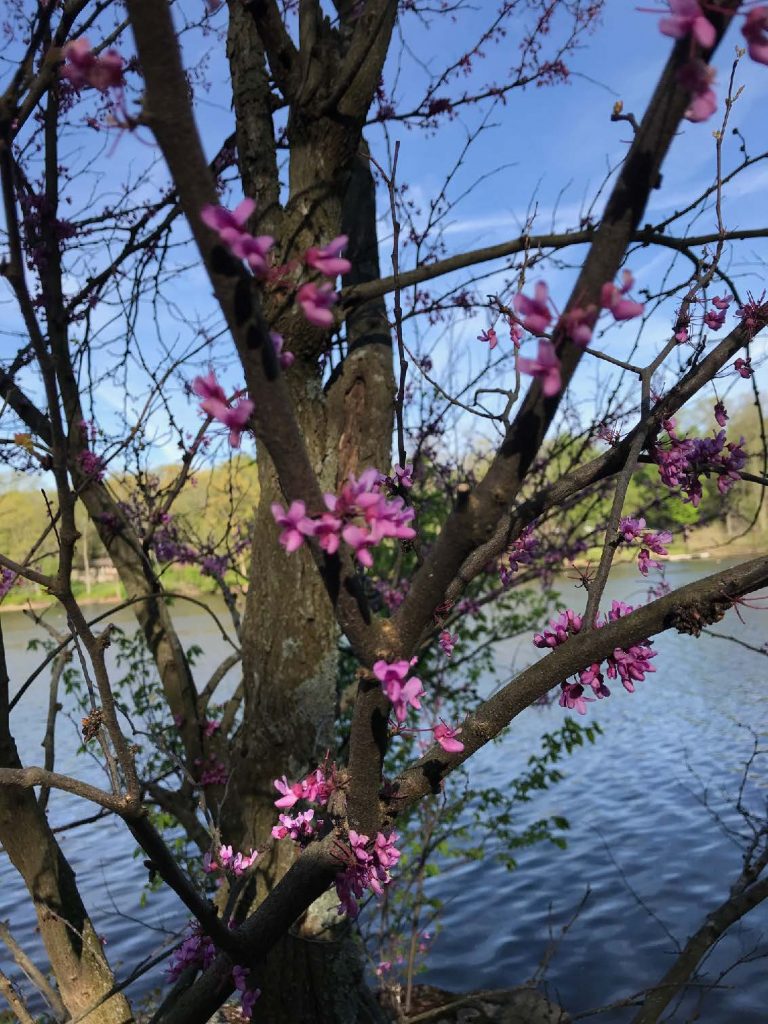
Morning Walk in Spring
Nong Inpanbutr, DVM, MS, PhD
Professor, College of Veterinary Medicine
The Ohio State University
Photographer
Voices in Humanism
Morning Walk in Spring
Nong Inpanbutr, DVM, MS, PhD
Professor, College of Veterinary Medicine
The Ohio State University
Photographer
Voices in Humanism

Bryce Canyon
The Bryce Amphitheater, covered with a layer of fresh snow, as seen from Inspiration Point. The limestone pillars (hoodoos) have been formed over thousands of years by ice, water and gravity in the Charon Formation. They are unique to Bryce Canyon National Park.
“Our family loves to backpack and the Bryce Canyon trip included hiking in the Painted Desert National Park, backpacking rim to rim in the Grand Canyon, hiking Zion National Park and the Capital Reef National Park. We would encourage others to visit our national parks, especially in the Southwest.”
Holly Cronau, MD
OSU College of Medicine, Class of 1985
Associate Professor of Clinical Family Medicine
OSU College of Medicine Distinguished Educator Award, 2006
Ohio Academy of Family Physicians Educator of the Year, 2009
Photographer, Voices in Humanism
Voices in Humanism
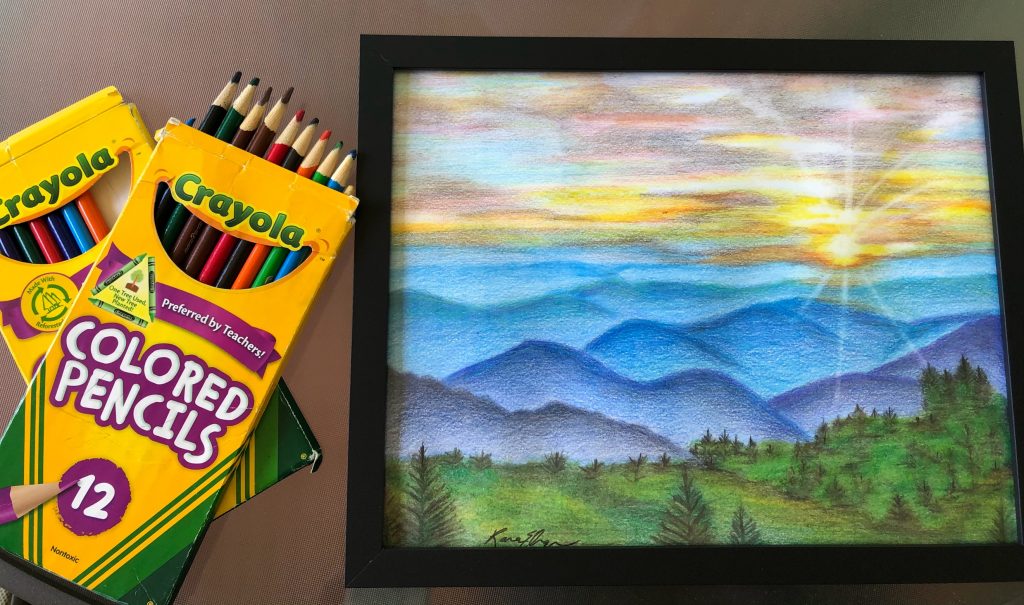
Who says Crayola is just for kids?
“The Smoky Mountains were the inspiration for this drawing.
My recent hiking trip brought me back to my Crayolas.”
Rana Elgazzar, MD
OSU College of Medicine Class of 2021
PGY-1 Internal Medicine
Vanderbilt University Medical Center
Voices in Humanism

Cover Me
Digital drawing made with Apple Pencil on iPad.
Nikol Mladkova, MD, PhD, MPH
Resident PGY-4
Department of Radiation Oncology
Arthur G. James Cancer Hospital & Richard J. Solove Research Institute
Voices in Humanism
Swan & the Folks
Wings fluttering the air with stealth depart,
She froze, deciphering the sound she heard.
The air is trembling, precisely like her heart…
Surely it’s nothing! Merely a bat or bird.
A sudden clench, with aim; unforgiving
Is this for real? Some short-circuited dream?
It’s over! By Jove, it’s just beginning!
She collapses, yet no-one minds her scream.
Conceived with indifference, it will bestow
Inflamed breaths, agony and endless grief
On strangely veiled faces.
In the middle,
The world is asleep, passing days filled with woe.
Metamorphosed bugs promise wry relief
To fractured souls, and her own acquittal.
Nikol Mladkova, MD, PhD, MPH
Resident PGY-4
Department of Radiation Oncology
Arthur G. James Cancer Hospital & Richard J. Solove Research Institute
Voices in Humanism

Lakeside Daisies
“The Lakeside Daisy is one of Ohio’s most spectacular wildflowers. This long-lived perennial grows where few others an, on nearly barren limestone bedrock in full sunlight. All the flower heads track the sun across the sky in unison.”
-Lakeside Daisy State Nature Preserve, Ohio Department of Natural Resources
Holly Cronau, MD
OSU College of Medicine, Class of 1985
Associate Professor of Clinical Family Medicine
OSU College of Medicine Distinguished Educator Award, 2006
Ohio Academy of Family Physicians Educator of the Year, 2009
Photographer, Voices in Humanism
Voices in Humanism
Tahquamenon
Somewhere in the North
beyond forests untouched
past rugged coasts
far from islands standing tall
amidst rippling cerulean aquatic fields
lies a cascade
a cataract that runs red
like the life-blood that unites all of mankind
Crossing the Ether
You never knew me, I never knew you.
Between us lie leagues of vast blue waves and an endless field of stars.
But when I hear a melody carried by your voice
For one second
I rest beneath Eastern skies
With the wind whispering words of comfort in my ears.
Dedicated to the artists, poets, actors, and musicians who inspire me to
find humanity in little things every day.
Bhageerathi “Bhagee’ Ganesan
OSU College of Medicine Class of 2025
B. S. Biomedical Science, OSU, 2021
Public Relations Coordinator, Bowen Circle
Voices in Humanism
Fawntastic!
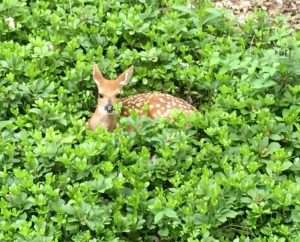
I came upon this lovely fawn nestled down in the pachysandra that covers our back yard. Its mother was nowhere in sight. When this first happened several years ago, we worried that the mother had abandoned the fawn. Upon checking, we found that this is entirely normal.
National Wildlife Federation Blog:
“Finding a Fawn: What To Do—Lone Fawns are Not Abandoned”
There is a strong probability that you did not find an abandoned fawn. Female deer hide their newborn fawns in tall grass or brush and move some distance away to feed to avoid drawing predators to their offspring. With the proliferation of deer in suburban areas, sometimes this happens right in our own yards. The fawn simply waits in hiding until its mother returns. Soon, the fawns will be strong enough to follow the does and run from predators, and they no longer need to spend hours alone in hiding. Though it seems that they are vulnerable, these young fawns are not totally helpless. Their spotted pelts look like dappled sunlight on the forest floor and offer great camouflage. They do not have strong scent that would attract predators. Fawns are also programmed to keep totally still and quiet when hiding while their mother forages. The combination of the physical attributes and the behavior of both does and fawns are remarkably successful at limiting depredation at such a vulnerable time.
Laurence B. Stone, MA
Retired Director of the Ohio Judicial College
Graphic Designer: Voices in Humanism
Linda’s Greatest Fan
Voices in Humanism
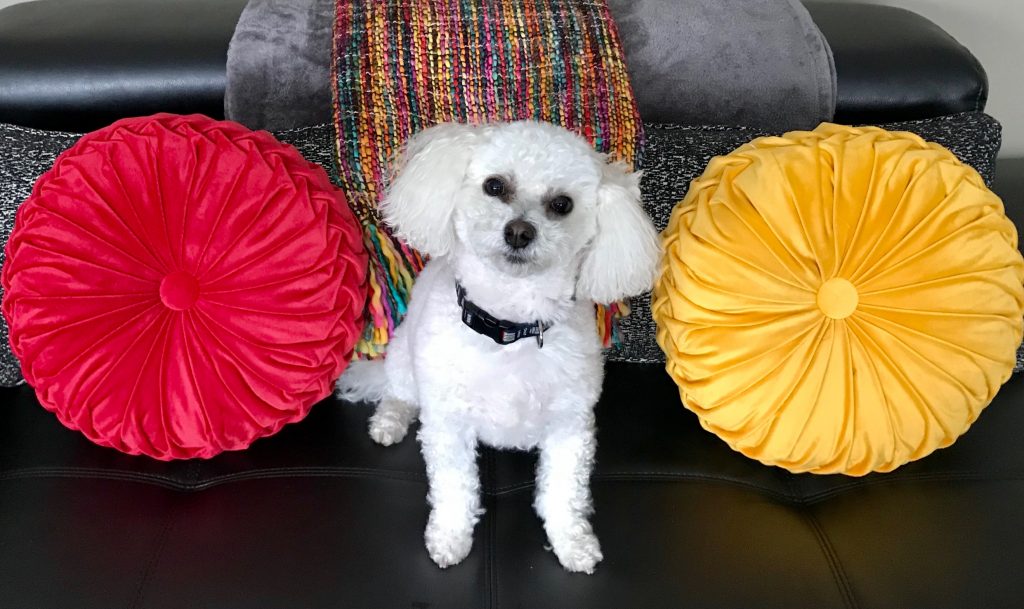
“Gratitude is like sunshine…it helps us grow to our full potential.”
-Anonymous
Jody Glasser Sobol
Photographer
Medical Student Mom
Voices in Humanism Advisor
Voices in Humanism
Unripe Persimmons
The persimmons are out of season.
A commercial convenience-
But, I purchased them anyway.
Its flesh firm beneath my fingertips.
As the paring knife slices,
the unripe fruit into pieces.
Its tannin linger, my lips pucker.
There is no resemblance,
between the glossy fruit
shared over family holidays
and chilled autumn evenings.
Persimmons, so soft –
the skin tore upon contact.
It isn’t the sweetness
of persimmons that I miss.
But, the everyday moments,
I took for granted…
Now my memory is struggling
to recall, to those precious
minutes. So, I eat unripe
persimmons in April instead.
Stephanie Wentzel
The OSU College of Medicine Class of 2023
Poet

© 2026 The Ohio State University - University Libraries
1858 Neil Avenue Mall, Columbus, OH 43210
Phone: (614) 292-OSUL (6785)
Request an alternate format of this page | Accessibility | Privacy Policy | Contact Us |

Recent Comments