Page 28 of 34

Local Nursing Legends

The Local Nursing Legends have made a significant contribution to the nursing profession and the health care of people in central Ohio. Pioneers in their field, these nurses were nominated by members of the central Ohio nursing community as those who provided exemplary service to this population and whose actions and lives can be seen as legendary.

Please visit the Local Nursing Legends digital exhibit at http://hsl.osu.edu/mhc/local-nursing-legends

House Call

House Call is a newsletter produced by the Medical Heritage Center (MHC). It has been in production since Winter 1998. Typically House Call is produced quarterly. It includes happenings of the MHC as well as historical articles related to people, places and activities in Central Ohio. All issues of House Call can be viewed at our website: https://hsl.osu.edu/service-areas/mhc/house-call-medical-heritage-center-newsletter

Collections Open

The Medical Heritage Center Collections reopen to the public today. Our hours are Mondays, Wednesdays, Fridays 10am-1pm and Tuesdays and Thursdays 1-4pm as well as by appointment.

Convertible Monaural Stethoscope

Convertible Monaural Stethoscope

Wood, Circa 1860

Artifact Collection, Medical Heritage Center

The stethoscope is an acoustic medical device for auscultation, or listening to the internal sounds of the body. It is used to listen to lung and heart sounds as well as to listen to intestines and blood flow in arteries and veins.

Initially heart sounds were auscultated by placing the ear directly on the chest of the patient. For the sake of convenience and propriety, in 1816 Dr. Rene Theophile Hyacinthe Laennec rolled up several sheets of paper and placed one end over the patient’s heart and the other end over his ear. Laennec was a skilled wood turner and later replaced the rolled paper with a wooden tube. For his invention of the stethoscope, Laennec is considered the father of chest medicine.

In the early 1850’s there was a rush of designs for a new stethoscope that used both ears. In 1851, Arthur Leared invented a binaural stethoscope, and in 1852 George Cammann perfected the design of it for commercial production.

Stethoscopes are often considered as a symbol of the doctor’s profession, as doctors are often seen or depicted with a stethoscope hanging around their neck.

Skin Grafting Instrument

Dr. Gilman Kirk
Skin Grafting Instrument
88mm mortar shell

This skin grafting instrument was made by Dr. Gilman Kirk during World War II from an 88mm mortar shell. The instruments supplied by the military did not work as well as Dr. Kirk would have liked, so he and a military engineer made this skin grafting instrument out of material that was available: an 88mm shell. This is an example of the ingenuity needed in battlefield medicine.

Collections are Moving!

The Medical Heritage Center staff is hard at work moving collections back into their space on the 5th floor of Prior Hall. Collections will be open to the public again on March 5th. If you have any reference questions in the meantime, please continue to contact us.

Bloodletting Instruments

Scarificator

Bloodletting was the withdrawal of often considerable quantities of blood from a patient in the belief that it cured or prevented a great many illnesses and diseases. It was a popular medical practice from antiquity up to the late 19th century. The practice has been abandoned for all except a few very specific conditions.

The scarificator is a spring loaded instrument that has a series of blades that snap out to cut the skin to allow for bloodletting. The bleeding bowl, as the name implies, is a bowl used to collect blood. The Medical Heritage Center’s bleeding bowl has lines etched into the inside that correspond to different prescriptions.

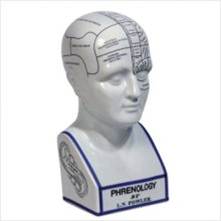
Phrenology Head

L. N. Fowler Phrenology Head (replica)

Porcelain

Artifact Collection, Medical Heritage Center

Phrenology studies the structure of the skull to determine a person’s character. Phrenology’s first heyday was in the 1820s – 1840s. Visiting a phrenologist at that time is akin to seeking the advice of a psychic, clairvoyant or astrologer today as a phrenologist was someone who claimed to have access to special knowledge about people.

A new movement was re-introduced to Britain in the 1860s and 1870s by the American brothers Lorenzo Niles Fowler (1811-1896) and Orson Squire Fowler (1809-1887) who were leading phrenologists of their time. Orson, together with associates Samuel Wells and Nelson Sizer, ran the phrenological business and publishing house Fowlers & Wells in New York City. Meanwhile, Lorenzo spent much of his life in England where he initiated the famous phrenological publishing house, L.N. Fowler & Co., and gained considerable fame with his phrenology head, which is now considered the most famous type of phrenology head.

Although phrenology has been discredited, it did advance the correct notion that different parts of the brain are responsible for different mental functions.

Homeopathy

Homeopathy was first developed by Samuel Hahnemann, a physician, chemist, and linguist in Germany, in 1796.

Homeopathy involves giving extremely small doses of substances that produce characteristic symptoms of illness in healthy people when given in larger doses. This approach is called “like cures like.” Homeopathy aims to stimulate the body’s own healing responses.

Most homeopathic remedies are derived from natural substances that come from plants, minerals, or animals. A remedy is prepared by diluting the substance in a series of steps. Homeopathy asserts that this process can maintain a substance’s healing properties regardless of how many times it has been diluted. Many homeopathic remedies are so highly diluted that not one molecule of the original natural substance remains. Remedies are sold in liquid, pellet, and tablet forms.

Homeopathic remedies are now required to meet certain legal standards for strength, quality, purity, and packaging. In 1988, the FDA required that all homeopathic remedies list the indications for their use on the label. The FDA also requires the label to list ingredients, dilutions, and instructions for safe use.

In the United States, training in homeopathy is offered through diploma programs, certificate programs, short courses, and correspondence courses. Most homeopathy in the United States is practiced along with another health care practice for which the practitioner is licensed, such as conventional medicine, naturopathy, chiropractic, dentistry, acupuncture, or veterinary medicine (homeopathy is used to treat animals).

Worldwide, homeopathy is the most widely practiced alternative form of medicine, second only to allopathic medicine.

Seeking Scholar in Residence Applicants

The Medical Heritage Center at the Health Sciences Library, The Ohio State University is seeking applicants for its scholar-in-residence program for a flexible time period between July 1, 2012 and June 30, 2013.

Founded in 1997 as a partnership effort between the Columbus Medical Association Foundation and The Ohio State University, the Medical Heritage Center collects, preserves, and promotes the rich health sciences history of central Ohio. Part of the institution’s mission is to “provide an environment for the academic and clinical communities to study and research meaningful historical records for the education and understanding of the entire health community.” The scholar-in-residence program is a key part of this mission.

The Medical Heritage Center maintains a rare book, archival, and artifact collection that speaks to the development of central Ohio’s health sciences history.  The collection is particularly rich in documenting innovation in the areas of medical education, dentistry, nursing, nuclear medicine, homeopathy, and surgery. The Nathaniel Coleman Rare Book collection contains over 12,000 volumes representing limited edition and one-of-a-kind references and prints dating back to 1555. The scholar will also have access to the rich holdings of The Ohio State University and regional libraries. The Medical Heritage Center’s archives currently include papers and memorabilia from regional and nationally recognized institutions, organizations, and luminaries such as William G. Myers, PhD, MD; Arthur G. James, MD; Charles Doan, MD; and Robert Zollinger, MD. The artifacts collection represents medical equipment used as early as the 1800’s, and range from those now perceived as quackery to those that were truly innovations at their time.

Suitable potential scholars can come from a variety of backgrounds (i.e. students, clinician historians, PhD historians) and each application will be reviewed based upon the quality of the application and proposed use of historical collections. Preference will be given to scholars whose research is directed toward local or regional medical historic issues. Use of the in-house archival and rare book collections is suggested but not limited to the collections of the Medical Heritage Center. The intent to publish in nationally-known presses and peer-reviewed journals is highly essential. Scholars will be expected to provide a mid-point and final report discussing the progress and result of the residency project. At least one presentation and publication is expected from a successful scholar residency.

The scholar-in-residence program provides a stipend up to $5,000 to support the activities of the scholar. This funding is provided by the Columbus Medical Association Foundation endowment for the Medical Heritage Center and can cover but is not limited to equipment, travel, support staff, publication costs. Scholars also receive office space, basic office equipment, and extensive access to the collections of the Medical Heritage Center.

An application package should be submitted for consideration by March 30, 2012, and a successful applicant will be decided upon by the Medical Heritage Center advisory committee by April 30, 2012. For more program details, including an application package, please contact Medical Heritage Center Head Curator Judith Wiener at 614-292-9273 or wiener.3@osu.edu.

« Older posts Newer posts »