Category: The Ohio State University (page 1 of 5)

Archivists Need to Learn New Vocabulary to Process Scientific Collections

By Lisa Wood, MLS
Archivist

David J. Lim

For well over a year the Medical Heritage Center (MHC) staff has been immersed in arranging and describing the papers of David J. Lim, MD, whose specialty was otolaryngology research. The collection contains over 200 boxes of papers, publications, microphotography and other audiovisual media. It spans Dr. Lim’s career from the 1960s through the 2010s. He completed his medical training in South Korea and arrived in the United States in 1965 for a post-doctoral fellowship then came to The Ohio State University in 1966.  He was named director of Ohio State’s Otological Research Laboratories in 1967. During his directorship the ORL received grants to study the effects of artillery and rifle fire on hearing, the effects of zero gravity on balance and continued funding from the National Institutes of Health (NIH) to study the cause and means to prevent otitis media, also known as middle ear infection. Dr. Lim pioneered the use of powerful scanning electron microscopes to study these conditions.

Throughout his career Dr. Lim was active in professional organizations in the U.S. and other countries, including helping to found the Association for Research in Otolaryngology (ARO).  After leaving Ohio State in the early 1990s Dr. Lim was the director of intramural research for the National Institute of Deafness and Communication Disorders (NIDCD), an institute within NIH. He left the NIH for California in 1995 where he continued his otolaryngology research at the House Ear Institute and was affiliated with both the University of Southern California and University of California, Los Angeles.
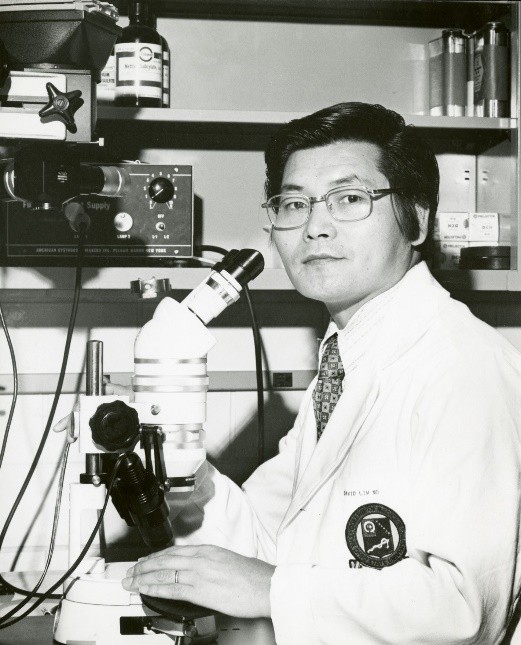
Black and white photograph of scientist Dr. David J. Lim in a lab coat using a microscope in his laboratory at Ohio State.

Dr. David J. Lim in his lab at Ohio State.

New Vocabulary

This sounds very important, but what exactly is otolaryngology? Every medical specialty has its own terms and jargon that may sound like another language to non-practitioners. Each time MHC staff process a collection from a medical provider with a different specialty we learn new terms that are common in their area of practice. After spending so much time with Dr. Lim’s materials, we have learned the meaning of otolaryngology and more related words.

You may have heard of or been treated by doctors who specialize in the ear, nose and throat, commonly called ‘ENTs.’ While these three body parts are closely related and function together, there are words to describe the study of them individually. Otology is the science and study of diseases of the ear, rhinology of the nose and laryngology of the throat. They can be combined to describe the study of multiple parts. While the term otorhinolaryngology is sometimes used, physicians specializing in studying or treating diseases of the ear, nose and throat also describe themselves as otolaryngologists. The root word oto, Latin for ear, can also be paired with pathology, the study of disease. So, otopathology means studying diseases of the ear.

One of the ear diseases that Dr. Lim researched for a significant portion of his fifty plus year career with colleagues at Ohio State and around the globe was otitis media. What exactly is otitis media? It is the term that otolaryngologists use for middle ear infections that are common in younger children. The Merriam Webster medical dictionary defines it as:

Inflammation of the middle ear marked by pain, fever, dizziness, and abnormalities of hearing

In severe cases otitis media can lead to permanent hearing damage. Dr. Lim’s work sought better treatments that would limit hearing damage from otitis media and vaccines to prevent it all together.

Have you ever experienced ringing in your ears? An otolaryngologist like Dr. Lim would describe that as tinnitus. Merriam-Webster’s defines tinnitus as:

A sensation of noise (such as a ringing or roaring) that is typically caused by a bodily condition (such as a disturbance of the auditory nerve or wax in the ear) and usually is of the subjective form which can only be heard by the one affected

Unfortunately, there are cases where tinnitus is a symptom of a far more serious problem. Dr. Lim studied one of these conditions, Meniere’s Disease, and found evidence of viral causes. Meniere’s Disease is defined by Merriam-Webster as: A disorder of the membranous labyrinth of the inner ear that is marked by recurrent attacks of dizziness, tinnitus, and hearing loss

A phrase that stands out in this definition is the ‘membranous labyrinth of the inner ear’? How many parts are inside our ears. From the outside we see the cartilage, the ear lobe, the entry to the inner ear, maybe some wax or small hairs. Dr. Lim was a pioneer in using scanning electron microscopes to take microphotographs of the many parts of the inner ear that we cannot see. Here are definitions of some of the inner ear parts that he photographed:

  • Cochlea – a hollow tube in the inner ear of higher vertebrates that is usually coiled like a snail shell and contains the sensory organ of hearing
  • Eustachian Tube – a bony and cartilaginous tube connecting the middle ear with the nasopharynx and equalizing air pressure on both sides of the tympanic membrane
  • Organ of Corti – a complex epithelial structure in the cochlea that contains thousands of hair cells, rests on the internal surface of the basilar membrane, and in mammals is the chief part of the ear by which sound waves are perceived and converted into nerve impulses to be transmitted to the brain
  • Temporal Bone – a compound bone located on the side of the skull of some mammals including humans

Now that you know what otolaryngology means, the real challenge is to use it in conversation! The David J. Lim, MD Papers are now available for research at the Medical Heritage Center. Please contact the center at mhcmail@osumc.edu if you have any questions about the Lim Papers or other MHC collections.
Medical Center Expansion

In 2014 the Medical Center Expansion project, the largest expansion project in OSU’s history, which included the new home of the Comprehensive Cancer Center – James Cancer Hospital and Solove Research Institute and a new Critical Care Center, was completed.

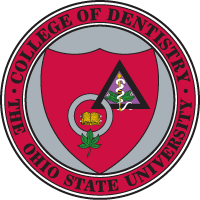
College of Dentistry Seal

The_Ohio_State_University_College_of_Dentistry_seal

The College of Dentistry seal in an “O” with the open book and buckeye leaf with are part of the University seal. The open book signifies education and the buckeye leaf is representative of the Ohio State University. The “O” also represents the Greek letter Omicron which the first letter of the word Odont, meaning tooth.

The triangle, representing the Greek letter Delta, together with the cautery and the branches with the leaves and berries represent the dental profession. The leaves represent the 32 teeth in the permanent dentition and the berries represent the 20 teeth in the primary dentition.

The overlapping of the triangle and the circle represent the joining of dentistry and education.

First Campus Statue

In 1915, the International Dental Federation asked and was granted permission to erect the first campus statue of Dr. Willoughby D. Miller (1853 – 1907). Dr. Miller discovered how and why teeth decay.

The OSU Board of Trustees fixed the temporary location of the statue southwest of the Thompson Library building – it was moved to its present home beside Postle Hall when the building was complete.

The bronze statue is the work of Frederick C. Hibbard, a sculptor from Chicago and costs $5000. It was unveiled December 8, 1915 in the presence of 300 dentists attending the annual meeting of the Ohio Dental Society. Miss Anna Miller of Alexandria, a grandniece of Dr. Miller, performed the act of unveiling.

On the base of the statue is the following inscription: Erected to the Memory of Willoughby Dayton Miller, 1853-1907, Dental scientist and education, Benefactor of his profession, Friend of humanity, a native of Ohio, a citizen of the world, by the dentists of the United States, December 8, 1915.

Expansion in the 1950s

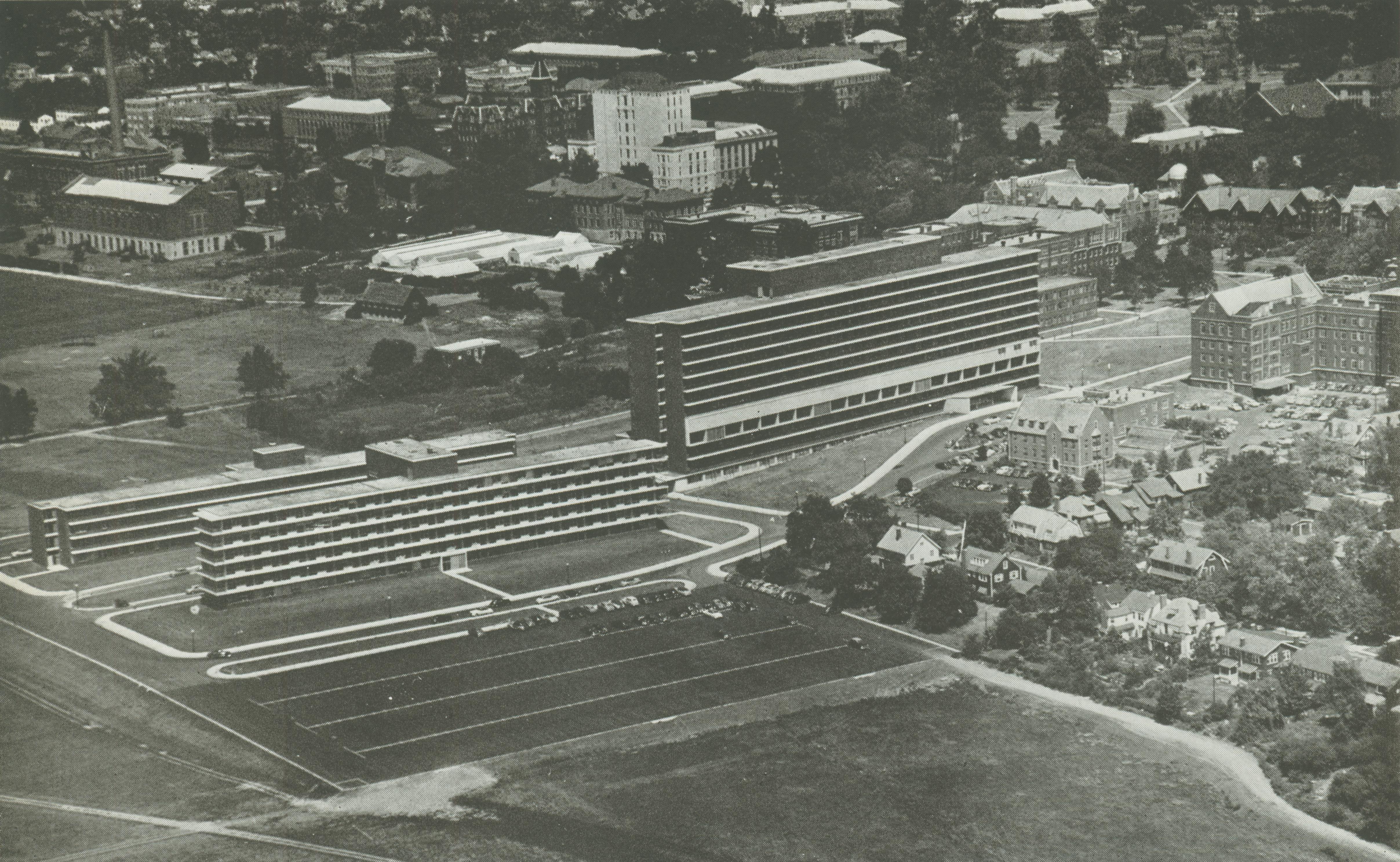
Aerial View of Medical Center in 1952

Aerial View of Medical Center in 1952

The 1950s marked a time of expansion for departments in the OSU College of Medicine with five beginning the Division of Rheumatology and Immunology (1950 as Arthritis and Rheumatic Diseases); the Department of Physical Medicine and Rehabilitation (1951); the Department of Psychiatry (1951); the Department of Plastic Surgery (1952); and, the Department of Urology (1952 formally, but began in 1917 informally).

Expansion in the 1940s

Aerial Drawing of Medical Center, 1947

Aerial Drawing of Medical Center, 1947

The 1940s marked a time of expansion for departments in the OSU College of Medicine with four beginning the Division of Gastroenterology, Hepatology and Nutrition (1945); the Department of Radiology (1947); the Division of Anesthesiology (1947, informally since 1914 developing alongside Surgery); and, the Division of Endocrinology, Diabetes & Metabolism (1949).

Gies Report

In 1926 as part of a series of studies on professional education in the United States funded by the Carnegie Foundation for the Advancement of Teaching, Dr. William Gies published a landmark report, Dental Education in the United States and Canada, that established the importance of dentistry as a healing science and an essential component of higher education in the health professions. The report took five years to research and write and included lengthy descriptions and evaluations of the existing dental schools, each of which Dr. Gies visited.

http://www.adea.org/ADEAGiesFoundation/William-J-Gies-and-Gies-Report.aspx

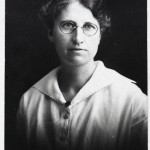
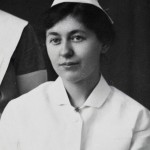
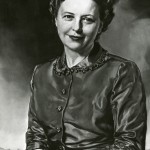
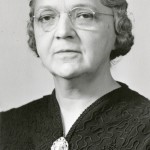
Nursing Leadership at OSU

Nursing Leadership at OSU, 1914 – 2014*

1915-1917: Jessie F. M. Harrod, Superintendent
1917-1922: Gertrude A. Loessel, Principal
1922: Ida G. Webb, Superintendent
1923-1928: Lucy V. Ailer, Superintendent
1928-1929: Lucy V. Ailer, Principal
1929-1930: Margaret Reilly, Principal
1930-1931: Margaret G. Napier, Principal
1931-1933: Alpha Louis Johnson, Director
1933-1938: Ruth Perkins Kuehn, Director
1938-1941: Priscilla Hall, Director
1941-1951: Frances M. McKenna, Director
1951-1968: Mildred E. Newton, Director
1968-1972: Imogene M. King, Director
1972-1973: Lorane C. Kruse, Acting Director
1973-1983: Edna L. Fritz, Director
1983-1984: Kathryn T. Schoen, Acting Dean
1984-1986: Grayce M. Sills, Acting Dean
1986-2001: Carole A. Anderson, Dean
2001-2011: Elizabeth R. Lenz, Dean
2011-: Bernadette M. Melnyk, Dean

*Please note that this is the most accurate listing that could be found piecing together multiple sources, but the leaders and their titles prior to 1931 may not be 100 percent accurate. If you have any source information to share about the leadership between 1914 and 1931, please contact us.

Harding Hospital

Harding Hospital located in Worthington, Ohio was a non-profit organization founded in 1916 by George T. Harding II, MD. The hospital specialized in psychiatric care. As such, Harding had a diverse payroll that ranged from psychiatrists and therapists, to social workers and ministers in training. Harding offered inpatient, outpatient, halfway house, family care, individual psychotherapy, milieu therapy and group therapy services. In 1999 Ohio State and Harding Hospital united their services and moved the hospital facility to the OSU campus in Columbus. Today, OSU Harding Hospital offers the only academic program in central Ohio providing child, adolescent, adult and geriatric inpatient services.

The Medical Heritage Center has an archival collection about the original Harding Hospital and the finding aid for it can be viewed at https://hsl.osu.edu/mhc/pdf/harding-hospital-collection

Arthur G. James

Dr. James in front of Cancer Hospital, c. 1990

Dr. James in front of Cancer Hospital, c. 1990

Dr. Arthur G. James (1912-2001) believed all cancer would eventually be eradicated. That belief coupled with his dedication to the idea that cancer patients needed separate, specialized care, led him to lobby, campaign, and fundraise for thirty-five years to build a cancer hospital in Ohio. The Arthur G. James Cancer Hospital and Research Institute opened at Ohio State on July 9, 1990 when it admitted its first patient. At the time of its construction, only three hospitals – Roswell Park in Buffalo, New York; M.D. Anderson in Houston, Texas; and Memorial Sloan-Kettering in New York City – had comparable resources. After a gift of $20 million from Richard J. Solove in 1999, the facility was renamed the Arthur G. James Cancer Hospital and Richard J. Solove Research Institute, but is commonly referred to as the James. The facility remains the only freestanding cancer hospital in Ohio to this day.

A book written by George Paulson and Kristin Rodgers titled Arthur G. James Surgeon with a Dream is for sale by the Medical Heritage Center for $25 plus applicable sales tax. [link to: https://hsl.osu.edu/service-areas/mhc/services/publications-sale] This publication is primarily based on Dr. James’s archival collection and the finding aid for that can be viewed at https://hsl.osu.edu/mhc/pdf/arthur-g-james-md-collection

Older posts