Category: Medicine (page 1 of 2)

Archivists Need to Learn New Vocabulary to Process Scientific Collections

By Lisa Wood, MLS
Archivist

David J. Lim

For well over a year the Medical Heritage Center (MHC) staff has been immersed in arranging and describing the papers of David J. Lim, MD, whose specialty was otolaryngology research. The collection contains over 200 boxes of papers, publications, microphotography and other audiovisual media. It spans Dr. Lim’s career from the 1960s through the 2010s. He completed his medical training in South Korea and arrived in the United States in 1965 for a post-doctoral fellowship then came to The Ohio State University in 1966.  He was named director of Ohio State’s Otological Research Laboratories in 1967. During his directorship the ORL received grants to study the effects of artillery and rifle fire on hearing, the effects of zero gravity on balance and continued funding from the National Institutes of Health (NIH) to study the cause and means to prevent otitis media, also known as middle ear infection. Dr. Lim pioneered the use of powerful scanning electron microscopes to study these conditions.

Throughout his career Dr. Lim was active in professional organizations in the U.S. and other countries, including helping to found the Association for Research in Otolaryngology (ARO).  After leaving Ohio State in the early 1990s Dr. Lim was the director of intramural research for the National Institute of Deafness and Communication Disorders (NIDCD), an institute within NIH. He left the NIH for California in 1995 where he continued his otolaryngology research at the House Ear Institute and was affiliated with both the University of Southern California and University of California, Los Angeles.
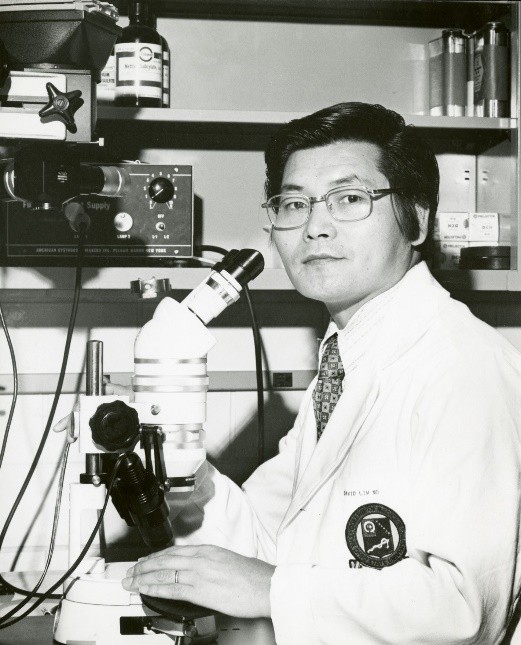
Black and white photograph of scientist Dr. David J. Lim in a lab coat using a microscope in his laboratory at Ohio State.

Dr. David J. Lim in his lab at Ohio State.

New Vocabulary

This sounds very important, but what exactly is otolaryngology? Every medical specialty has its own terms and jargon that may sound like another language to non-practitioners. Each time MHC staff process a collection from a medical provider with a different specialty we learn new terms that are common in their area of practice. After spending so much time with Dr. Lim’s materials, we have learned the meaning of otolaryngology and more related words.

You may have heard of or been treated by doctors who specialize in the ear, nose and throat, commonly called ‘ENTs.’ While these three body parts are closely related and function together, there are words to describe the study of them individually. Otology is the science and study of diseases of the ear, rhinology of the nose and laryngology of the throat. They can be combined to describe the study of multiple parts. While the term otorhinolaryngology is sometimes used, physicians specializing in studying or treating diseases of the ear, nose and throat also describe themselves as otolaryngologists. The root word oto, Latin for ear, can also be paired with pathology, the study of disease. So, otopathology means studying diseases of the ear.

One of the ear diseases that Dr. Lim researched for a significant portion of his fifty plus year career with colleagues at Ohio State and around the globe was otitis media. What exactly is otitis media? It is the term that otolaryngologists use for middle ear infections that are common in younger children. The Merriam Webster medical dictionary defines it as:

Inflammation of the middle ear marked by pain, fever, dizziness, and abnormalities of hearing

In severe cases otitis media can lead to permanent hearing damage. Dr. Lim’s work sought better treatments that would limit hearing damage from otitis media and vaccines to prevent it all together.

Have you ever experienced ringing in your ears? An otolaryngologist like Dr. Lim would describe that as tinnitus. Merriam-Webster’s defines tinnitus as:

A sensation of noise (such as a ringing or roaring) that is typically caused by a bodily condition (such as a disturbance of the auditory nerve or wax in the ear) and usually is of the subjective form which can only be heard by the one affected

Unfortunately, there are cases where tinnitus is a symptom of a far more serious problem. Dr. Lim studied one of these conditions, Meniere’s Disease, and found evidence of viral causes. Meniere’s Disease is defined by Merriam-Webster as: A disorder of the membranous labyrinth of the inner ear that is marked by recurrent attacks of dizziness, tinnitus, and hearing loss

A phrase that stands out in this definition is the ‘membranous labyrinth of the inner ear’? How many parts are inside our ears. From the outside we see the cartilage, the ear lobe, the entry to the inner ear, maybe some wax or small hairs. Dr. Lim was a pioneer in using scanning electron microscopes to take microphotographs of the many parts of the inner ear that we cannot see. Here are definitions of some of the inner ear parts that he photographed:

  • Cochlea – a hollow tube in the inner ear of higher vertebrates that is usually coiled like a snail shell and contains the sensory organ of hearing
  • Eustachian Tube – a bony and cartilaginous tube connecting the middle ear with the nasopharynx and equalizing air pressure on both sides of the tympanic membrane
  • Organ of Corti – a complex epithelial structure in the cochlea that contains thousands of hair cells, rests on the internal surface of the basilar membrane, and in mammals is the chief part of the ear by which sound waves are perceived and converted into nerve impulses to be transmitted to the brain
  • Temporal Bone – a compound bone located on the side of the skull of some mammals including humans

Now that you know what otolaryngology means, the real challenge is to use it in conversation! The David J. Lim, MD Papers are now available for research at the Medical Heritage Center. Please contact the center at mhcmail@osumc.edu if you have any questions about the Lim Papers or other MHC collections.
Miracle Cures in the Medical Heritage Center Archives

By Lisa Wood, MLS
Archivist

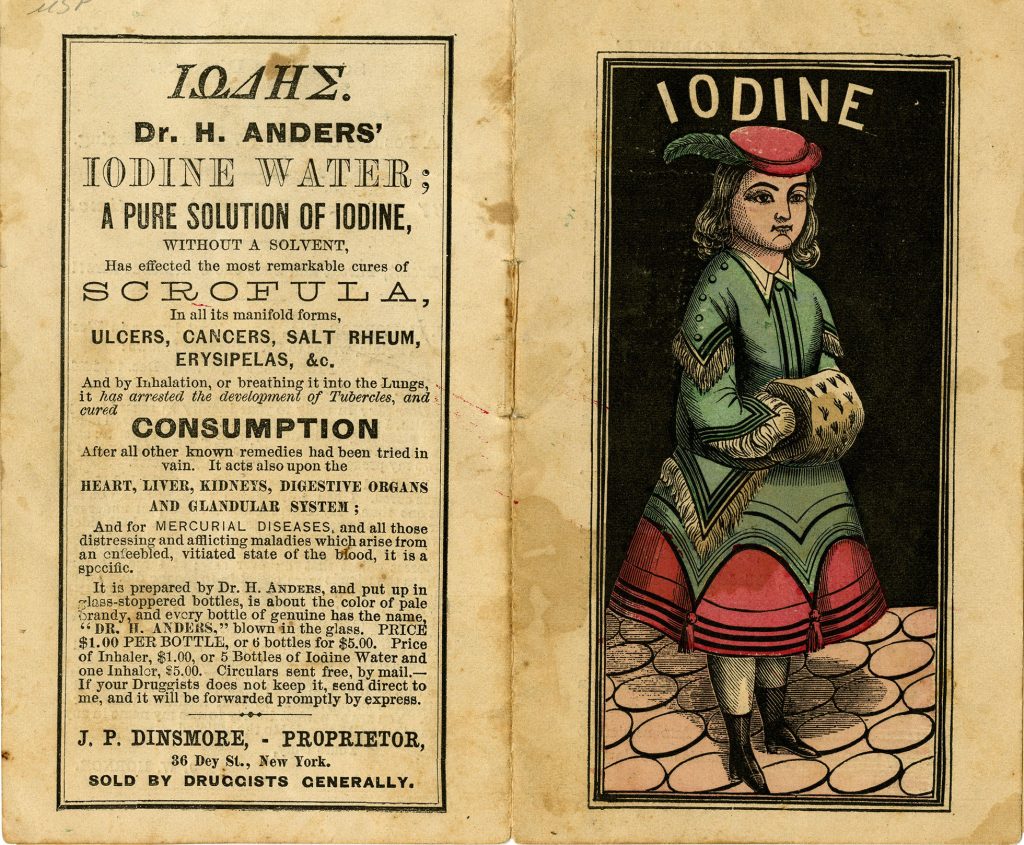
Patent medicines were commonly used in the 1800s and early 1900s across the United States. While they were seldom tested for their effectiveness, they claimed to cure a wide range of medical problems. Advertisements for these products are in the collections of many archives and historical libraries, including the Medical Heritage Center Archival Collections. Patent medicine makers were pioneers in the advertising industry who produced promotional materials in numerous formats, including newspaper and magazine clippings, advertising cards, almanacs, catalogs and even toys such as paper dolls. Our curator and dedicated student employees found examples of these varied forms of advertising when they arranged the Paper Dolls and Advertising Collection. Examples from the collection include:

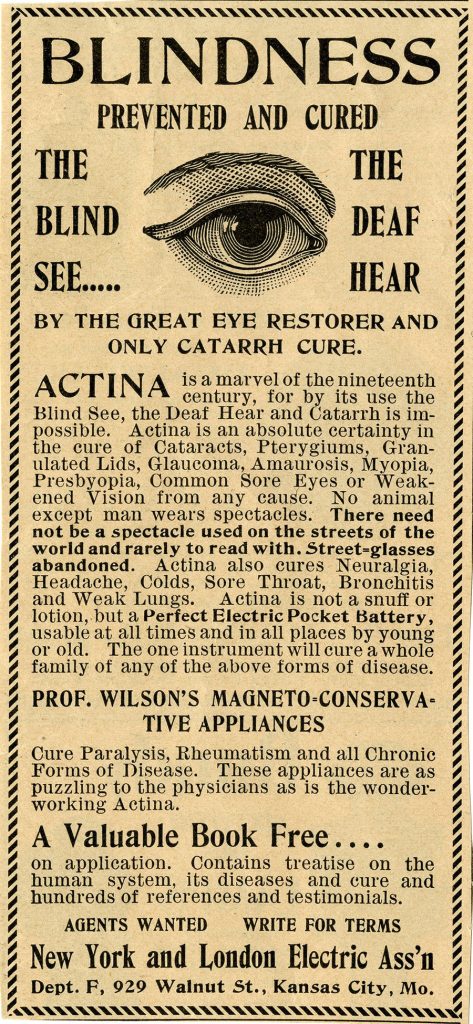
Actina claimed to restore eyesight and hearing loss and cure catarrh. Our curator searched for catarrh online and we believe that this was a term for nasal congestion.

Actina Advertisement, Paper Dolls and Advertising Collection, Medical Heritage Center

Iodine, which is an antiseptic, could remedy ulcers, cancers, salt rheum, erysipelas, tuberculosis and consumption according to Dr. H. Anders.

Iodine Advertisement, Paper Dolls and Advertising Collection, Medical Heritage Center

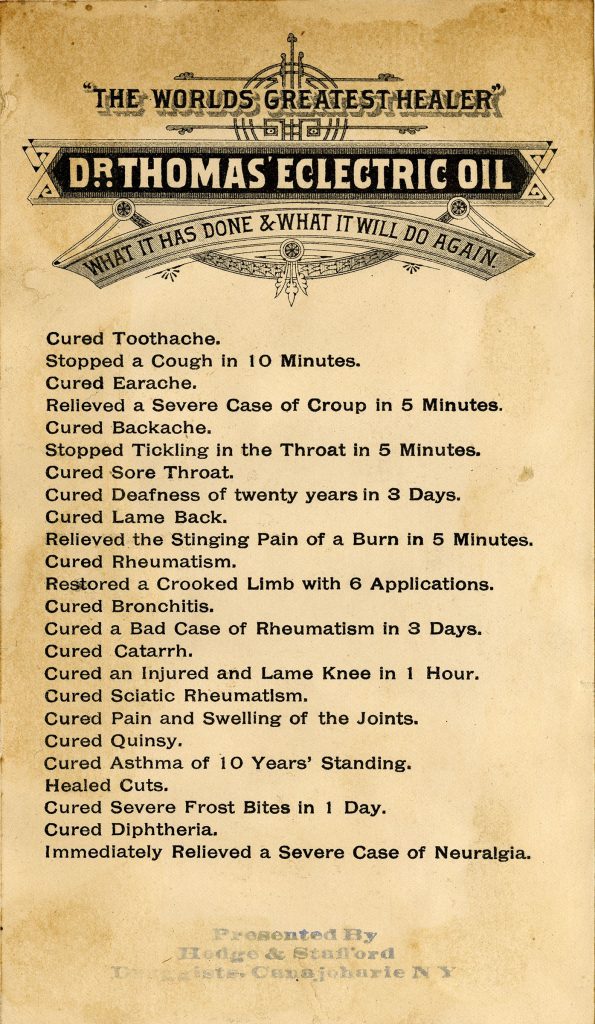
Dr. Thomas Electric Oil was more incredible than iodine as it supposedly healed toothache, earache, coughing, croup, backache, sore throat, deafness, burns, rheumatism, bronchitis, catarrh (nasal congestion), asthma, cuts, frostbite, diptheria and neuralgia.

Dr. Thomas Electric Oil Advertisement, Paper Dolls and Advertising Collection, Medical Heritage Center

Wikipedia has a list of some common patent medicines and their uses . This list and the Medical Heritage Center’s collection do not begin to represent the total number of these remedies that were manufactured and marketed. While it is amusing to see an advertisement claiming just one medicine could remedy ailments as different as asthma and frostbite, we should remember the number of these cure-alls that were made and their popularity are evidence of a lack of access to medical care, limitations on medical knowledge and no regulations that we sometimes take for granted in the present. The prevalence of patent medicines was dangerous as they could be addictive and remedies with alcoholic and narcotic ingredients were even recommended for young children.

The use of patent medicines declined after 1906 when President Theodore Roosevelt passed the Pure Food and Drug Act which brought the first regulations intended to protect people in the United States from medicines with fantastic claims and contaminated food. In 1930 the government employees doing this work became known as the Food and Drug Administration. However, this law and the FDA had limits on what they could regulate and little authority to take problematic products off the market. President Franklin Roosevelt signed the Federal Food, Drug, and Cosmetic Act in 1938 to increase consumer protections.

To read more about patent medicines and see more examples of advertisements, here are online resources for medical history collections. The Food and Drug Administration also has online exhibits about the history of the organization.

If you have questions about Medical Heritage Center collections or would like to view collections, please email the Center at mhcmail@osumc.edu for reference services or to schedule an appointment.

William H. Havener, MD

William H. Havener, MD (1923-1991) was the first full-time ophthalmologist at The Ohio State University College of Medicine (1959-1961) and chairman of the Department of Ophthalmology. After being appointed chairman in 1959 at age 35, Dr. Havener established an innovative teaching program for residents. Dr. Havener became interested in repairing retinal detachments, and developed a technique using a donor fascia lata for scleral buckling. He was dedicated to residents and student teaching and set up a number of formal instruction programs for both the medical school and residency. Dr. Havener was a distinguished teacher and internationally known author.

The Medical Heritage Center has an archival collection about Dr. Havener and the finding aid for it can be viewed at https://hsl.osu.edu/mhc/pdf/william-h-havener-md-collection.

The MHC is on Twitter!

The Medical Heritage Center is now on Twitter! Follow us (@osumhc) for all the latest news and interesting historical facts. For the remainder of 2013, one tweet a week will be posted. In 2014 in support of the four health sciences colleges celebrating centennials, a daily Monday-Friday tweet will feature Medicine (origins trace back to 1834, but started under the umbrella of The Ohio State University in 1914) on Mondays, Nursing on Tuesdays, Dentistry (origins trace back to 1890, but like medicine started in 1914 under the umbrella of OSU) on Wednesdays, Optometry on Thursdays, and the MHC on Fridays.

Alpha Kappa Kappa Pi Chapter

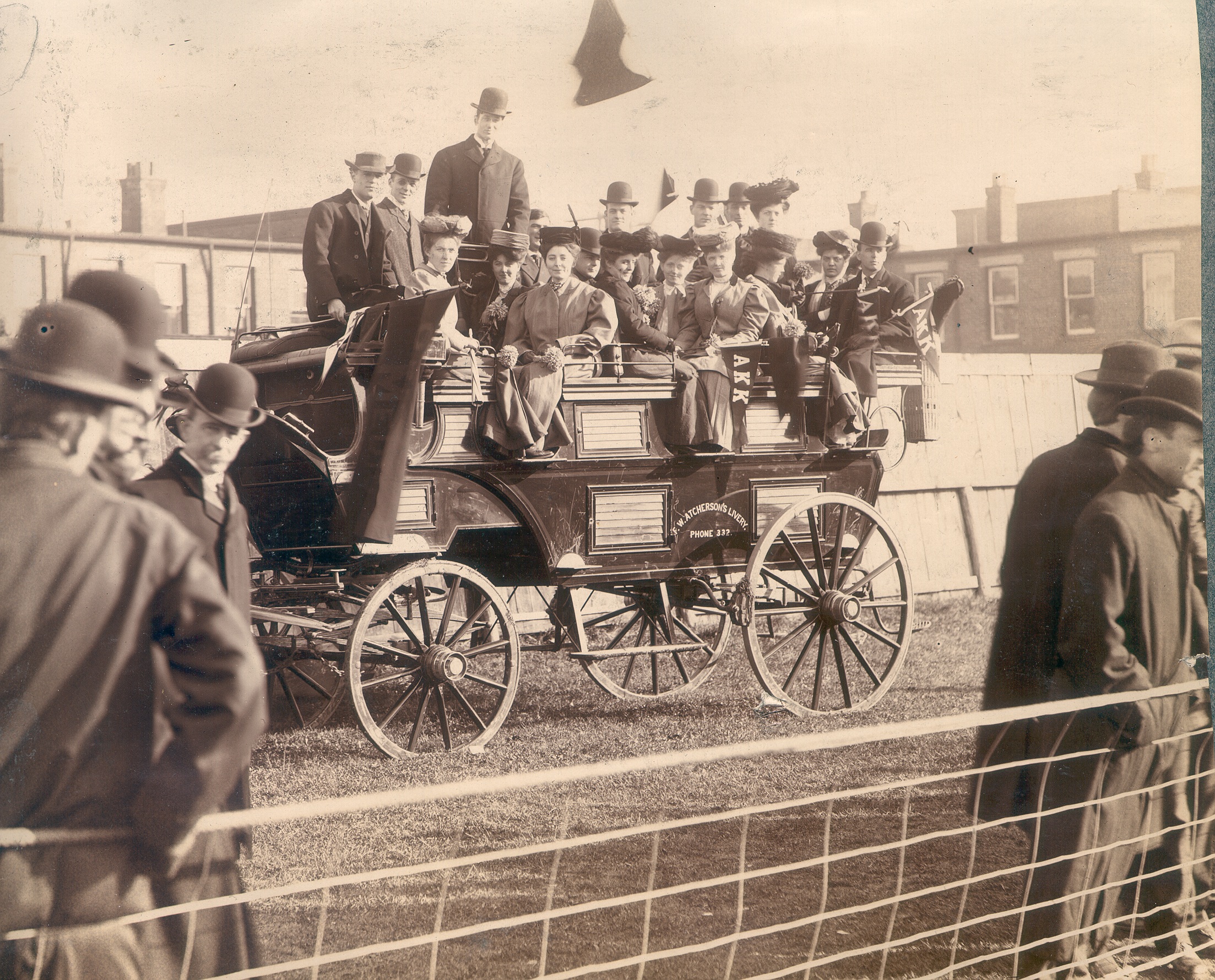
AKK on Parade, c. 1906

AKK on Parade, c. 1906

Alpha Kappa Kappa Pi Chapter at the Ohio Medical University was chartered by the National Medical Fraternity on October 2, 1902.

In 1906 Phi Sigma Psi, a local fraternity at Starling Medical College (1848-1907), petitioned for a charter and was approved. Before the charter was granted, the AKK Council was advised that Starling Medical College and Ohio Medical University (1892-1907) were merging to form Starling-Ohio Medical College (1907-1914) which meant that the men of Phi Sigma Psi could join forces with AKK without the necessity of issuing a new charter. They had 113 members.

The first Chapter house was at 688 North High Street which housed 12 men for the year. After this, they lived at various addresses: 68 Buttles Avenue, 797 Dennison Avenue, and 216 Marshall Avenue. In 1923, the Pi Chapter Company was formed to purchase a house at 199 W. Tenth Avenue. This was later enlarged by purchasing the house to the west and joining them together with an addition. The final Chapter house was erected at 466 King Avenue in 1966. The AKK Pi Chapter ceased operations in 1974.

Columbus Medical College Class of 1877

Columbus Medical College graduates, class of 1877

Columbus Medical College graduates, class of 1877

Columbus Medical College, 1876-1892

In 1875 a sharp dispute arose about making Dr. James Fairchild Baldwin professor of physiology in the Starling Medical College. Dr. Baldwin seemed to some of the faculty well-suited for the job, but Dr. Starling Loving and the administration thought otherwise. Dr. Howard Jones of Circleville was chosen. As a result of this defeat, Drs. John W. Hamilton, D. N. Kinsman, H. C. Pearce and Davis Halderman resigned and organized the Columbus Medical College. During the first seven years the college was conducted in the Sessions Block of High Street. In 1882 Dr. W. B. Hawkes gave four lots on Columbus’ west side and $10,000 toward a hospital to serve the Columbus Medical College. In 1886 the Hawkes Hospital of Mt. Carmel was erected.

About 500 students graduated from this college. In 1892, carrying with it its hospital facilities, Columbus Medical College was merged into Starling Medical College, but some of the faculty could not go along with the merger and joined Dr. J. F. Baldwin and others in the organization of the Ohio Medical University.

Second Blessing Digital Exhibit

The Second Blessing: Columbus Medicine and Health The Early Years is a book written by former Medical Heritage Center scholars Charles F. Wooley and Barbara A. Van Brimmer. Copies of the book are available for purchase by contacting the MHC.

The digital exhibit of the book showcases each chapter and can be viewed by visiting our website: http://hsl.osu.edu/mhc/second-blessing-columbus-medicine-and-health-early-years

Nelson Donnellan Medical License

Nelson Donnellan photograph 1828

Nelson Donnellan medical license certificate 1828 (click to link to the PDF)

Nelson Donnellan’s medical license granted by the State of Ohio on April 10, 1828 is the oldest in our collection.


MHC Quick Info Session Wednesday

Location: First floor collaborative space, Prior Hall

Join us for the Quick Information Session on Wednesday, December 12 from noon-1:00pm in the first floor collaborative space behind the Desk:

“Treasures from the Medical Heritage Center”

Curators will be showcasing hidden treasures from the MHC collections. If you are curious about the services and artifacts that the Medical Heritage Center houses on the fifth floor of Prior Hall, this is a great opportunity to learn more!

Featured treasures will include

–          Swamp root cure

–          Dental cabinet (shown through images, not in person)

–          Jimmy Buffet eyewear

–          Bound human skull

–          Wax moulage and book

–          Suppository pill press

–          Newton’s Opticks (1704)

–          Nightingale’s Notes on Nursing (1860)

–          OSUWMC Service Board poster

–          Dr. Pavey Collection booklet

Centennials and Timeline of Medical Education in Central Ohio

2014 marks 100 years of health sciences education on the Columbus campus of The Ohio State University. This education includes colleges of nursing, optometry, dentistry, and medicine.

The College of Medicine legacy really began in 1834, however. Below is a Timeline of Medical Education in Central Ohio.

Willoughby University of Lake Erie, 1834-1846

 1834: Dr. George W. Card and Dr. John M. Henderson found Willoughby University of Lake Erie in honor of their friend Dr. Westel Willoughby. Drs. Card and Henderson believed Willoughby’s name would give prestige to the university and would aid in securing teachers and students.

Willoughby University operates in Willoughby, Ohio until 1846. Willoughby Medical University of Lake Erie had approximately 618 graduates.


Willoughby Medical College of Columbus, 1847

 1846: Willoughby University moves to Columbus, Ohio and the name changes to Willoughby Medical College of Columbus.

The session of 1847-48 opened in Columbus under the name of the Willoughby Medical College of Columbus located in a building on the northwest corner of Gay and High Streets. The building is not adequate, but before the session was completed Mr. Lyne Starling, an attorney in Columbus and well connected with the older established families, offered to give money to erect a proper building. An entirely new charter was secured for the medical school, which, out of gratitude to the donor, was called Starling Medical College (SMC). Shortly after it has organized all of the trustees of the Willoughby Medical College of Columbus resigned in January 1848 and the class of 1848 was graduated under the charter of Starling Medical College. Willoughby Medical College of Columbus continued less than one complete session and had no graduates.


Starling Medical College, 1847-1907

 1847: Starling Medical College (SMC) replaces Willoughby Medical College as the majority of the trustees, faculty, and students connected with Willoughby Medical College moved to SMC. Starling Medical College is located in St. Francis Hospital in downtown Columbus. It operates until 1907.

In the year 1848 the college was rechartered under the name of Starling Medical College in honor of Mr. Lyne Starling, who donated a building site and $35,000 for a new building: about two-thirds of the building assigned to St. Francis Hospital. During the sixty years of its career under this name the college graduated 2,600 students.

 Columbus Medical College, 1876-1892

 1876: Columbus Medical College is established.

In 1875 a sharp dispute arose about making Dr. James Fairchild Baldwin professor of physiology in the Starling Medical College. Dr. Baldwin seemed to some of the faculty well-suited for the job, but Dr. Starling Loving and the administration thought otherwise. Dr. Howard Jones of Circleville was chosen. As a result of this defeat, Drs. John W. Hamilton, D. N. Kinsman, H. C. Pearce and Davis Halderman resigned and organized the Columbus Medical College. During the first seven years the college was conducted in the Sessions Block of High Street. In 1882 Dr. W. B. Hawkes gave four lots on Columbus’ west side and $10,000 toward a hospital to serve the Columbus Medical College. In 1886 the Hawkes Hospital of Mt. Carmel was erected.

About 500 students graduated from this college. In 1892, carrying with it its hospital facilities, Columbus Medical College was merged into Starling Medical College, but some of the faculty could not go along with the merger and joined Dr. J. F. Baldwin and others in the organization of the Ohio Medical University.

 Ohio Medical University, 1892-1907

 1892: Ohio Medical University (OMU) was founded. OMU was located on Park Street across from Goodale Park. It operates until 1907.

Coincident with the mergement of the Starling Medical College and the Columbus Medical College, the Ohio Medical University was organized, and from the first maintained a high place among the educational institutions of the State. It had colleges of medicine, dentistry and pharmacy, with a charter enabling it to establish a department of midwifery and a school for the training of nurses. From its inception the University adopted the recitation plan of instruction with modifications to suit the subject, and gave clinical work and laboratory exercises prominent places in its courses. Besides erecting large and spacious buildings for the several departments the university donated the ground upon which the Protestant Hospital Association erected a substantial hospital building; the hospital and university cooperating in promoting the welfare of each other. The university sent forth about 1,200 graduates.


Starling-Ohio Medical College, 1907-1914

 1907: Starling Medical College and Ohio Medical University merge and become Starling-Ohio Medical College (SOMC). SOMC operates until 1914.

During the winter of 1906 and 1907 the trustees of the Starling Medical College and of the Ohio Medical University, recognizing the great advantages that would accrue to the cause of education and to the entire medical profession by union and co-operation, transferred the property and equities of these two corporations to a Board of their own selection with power to incorporate a new college. This action was taken March 13, 1907, the name agreed upon, Starling-Ohio Medical College, being a happy combination of the names of the only medical colleges in central Ohio at the time of the union. The new corporation included a Medical College, a Dental College and a Pharmacy College, designated as Departments. There were 303 graduates while SOMC was in operation.


 The Ohio State University College of Medicine, 1914-Present

 1914: The Ohio State University College of Medicine begins.

Recognizing the great advantage that might accrue to the cause of medical education in Ohio and to the entire medical profession and citizenship through the establishment of a College of Medicine by the Ohio State University, the Trustees of the Starling-Ohio Medical College gave to the State of Ohio all its properties, both real and personal, for this purpose. The College of Medicine, therefore, began its career with an honorable history, with an alumni body of more than three thousand, and an established reputation and position. The buildings on the Ohio State University campus that comprised the medical school in 1914 were Hamilton Hall, Kinsman Hall and Starling-Loving University Hospital.

The College of Medicine, through its predecessors, ranks as the second oldest medical college in the state and incorporates all the best medical college interests in central Ohio. The College stands upon a foundation of six medical schools with a continuity of college life spanning 178 years.

Older posts