

Reflections on the Country Doctor: A Slice of History with a Personal Connection
By Phil Sparling
As kids growing up in the 1950s, my brother, sister and I looked forward to Sunday and holiday visits to our paternal grandparents’ home in London, a small town 25 miles west of our house in Columbus. My father was a surgeon and his father was a country doctor.
The London home at 60 N Main Street was special because it was like a castle: huge and old, three stories with a turret, balconies, long hallways, and secret stairways, most of which were off-limits. Then there were the doting aunts, my grandmother’s oatmeal cookies, the parakeets in the parlor, London cousins, and a side ally to explore.
Even as a boy, I knew Grandpa Doc was revered. I remember him as an old man quietly dozing in his comfortable chair in the family room. It was a big chair to accommodate his large frame; it was his chair, no one sat there but him. My parents and aunts continually cautioned us to not disturb him, as he needed his rest.
After four decades as a general practitioner (GP), he no longer tended patients as age and simple wear and tear from a demanding calling had taken its toll. He died in 1959 at age 76 when I was 10. My father died suddenly a few years later when I was a teenager. After my father’s death, visits and connections to London diminished and life moved on in different directions.
Now, in retirement, and after more than half a century living in the Southeast, I visited my dad’s boyhood home and discovered the house had been beautifully restored to its original grandeur. This led me to delve into its history and uncover a surprisingly long history of medical care dispensed from 60 N Main.
It all began with Henry James Sharp, born in 1845 in Gallipolis (Gallia County). Like his father, he became a physician. After attending Ohio Wesleyan, he enrolled in Starling Medical College in Columbus, graduating in 1871. It’s important to note that Starling’s three-year program was well regarded and one of the forerunners of the Ohio State University College of Medicine.
At the time, physician training was not standardized; it varied widely within and across states. The MD credential could be obtained through short courses or apprenticeships; most of which were designed for maximum profit, not educational soundness. At county fairs, paper-milled doctors still peddled patent medicines. Many were talented charlatans capable of wowing audiences with enthralling oratory. Sustained advocacy by the American Medical Association from 1900 to 1920 established the template for medical education as we know it today.
Following graduation, the new Dr. Sharp moved to London and started his practice as a GP. The following year, he married Katharine Dooris from Zanesville. She became a force in her own right as an author, botanist and suffragist. They raised their five children in London and became prominent and respected leaders in the community. They never left London.
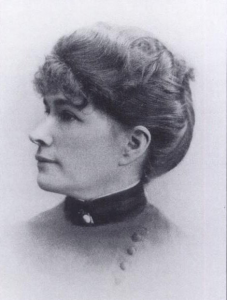
Katharine Sharp
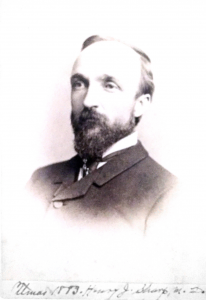
Henry Sharp
Dr. Sharp was a doctor on horseback, practicing from 1871 till his death in 1916 at age 70. House calls were routine. In the course of a day, he might deliver a baby at one farm, set a broken leg at another and return home to find an office full of patients. In the middle of the night, he was often roused from his bed to treat an emergency. GPs faced epidemics and cancers with inadequate knowledge and resources but with dedication to provide the best care possible for patients, all of whom were neighbors.
By the early 1890s, he was prosperous and decided to build a grand home for his family and to better accommodate patients. In this era, doctors saw patients in their homes, so adequate space for a waiting room, exam room and office was a constant challenge. He remained at 60 N Main, which he initially purchased in 1875, as it was a central location, one block from the center of London at the intersection High and Main.
Directly across the street were the recently completed (1892), classically-designed Madison County Courthouse (added to National Register of Historic Places in 1973) and a modern brick jail and sheriff’s residence. In fine fashion, Dr. and Mrs. Sharp had renowned Columbus architects Yost & Packard design a Queen Anne’s style residence. The new house was completed in 1894.
Katharinre Dooris-Sharp wrote a poem about a modern feature of their new home. A few verses are presented below (from The Doctor’s Speaking Tube and Other Poems, Boston: Gorham Press, 1904).
The Doctor’s Speaking Tube
He had traversed the county from end to end,
And even beyond did his trips extend;
There was not a by-road and hardly a gate
Which he had not entered, early or late;
There was not a tree nor flower that grew,
Nor silent land-mark, but what he knew.
‘Twas a tedious method of gathering pelf;
And the long years made the doctor, himself,
Through the county, a sort of land-mark, too,
As over the smooth roads his fleet horse flew:
For no one knew horse-flesh better than he,
And faster than his was a rarity.
Well, the doctor concluded to build a house
With a speaking-tube attachment, to rouse
From his peaceful slumbers, that, nevermore,
Would he need to descend to his front hall-door,
When half awake and en deshabille
And muttering such words as a doctor will.
So he built a mansion in modern style,
Where, the very first night, came Micky O’Rile
In search of a doctor. He pounded the door,
As many and oft-times he’d pounded of yore.
Then: “What do you want?” came a voice at his back.
Mick turned around quickly: ‘twas midnight and black.
No form could he see, but ‘mid splashes of rain,
“Say, what do you want?” came the murmur again.
“Bedad, thin,” says Micky, “that same is a ghost!
“Its a foine thing for sperrits a poor man to roast!
“Its me lave I’ll be takin’ in a bit of sthrake!”
And the doctor lay, chuckling, a good while awake.
Sometimes in the lonely midnight hour
A soft voice tried on the tube its power:
“O Doctor, we need you so very much!”
In the gentle tone was a magic, such,
For a second bidding there was no need,
And away he went at his greatest speed.

60 N. Main, circa 1900
A son Wilfrid Dooris Sharp, born 1880, followed his father into medicine. Doctoring ran in families, then as now. After graduating from Starling Medical College in 1904 and completing a one-year internship, he returned home and joined his father’s practice at 60 N Main. After a few years, he left for additional medical training and then moved to Cleveland where he practiced for 37 years until his death in 1946.
In 1919, three years after her husband’s death, K. Dooris-Sharp sold “the doctor’s house” to a newer doctor in London, Harry Perkins Sparling. He too was a doctor’s son, born in 1883 in Marietta where he went to Marietta College and then Starling-Ohio Medical College, graduating in 1910. He married Stella Murphy the same year and they moved to London a year later after his internship at Mount Carmel Hospital.
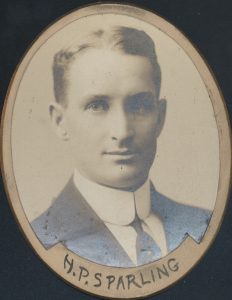
Harry Sparling
By the time he bought the Sharp’s house, Dr. Sparling had established roots in the community as a GP. He and Stella had four children between 1911 and 1916. The large home at 60 N Main was a good fit for a growing family and his expanding practice. For patients, it was still the doctor’s house, only the doctor had changed. As with Dr. and Mrs. Sharp, Dr. and Mrs. Sparling would become part of the fabric of London and live out their lives there.

Sparling children, circa 1920
As you have gathered, Dr. Sparling was Grandpa Doc. I recall stories about midnight house calls and the transition from buggy to automobile. A remnant is the stone stoop on the road in front of the house to step up onto to enter the buggy. And aunts told tales about patients paying the doctor’s bill in kind with eggs, chickens or a part of a butchered hog.
Due to declining health, Grandpa Doc stopped practicing about 1950. He was among the last generation of GPs as medical specialties grew rapidly from mid-century forward. His son (my father) William R. Sparling was an example of the shift to specialization: a 1939 graduate of Ohio State’s College of Medicine, he joined the Army Medical Corp in 1940, then following the war completed a residency in general surgery. He remained in Columbus with a surgical practice at Mount Carmel Hospital.
My grandfather died in 1959 and my grandmother passed in 1972. The house was kept in the Sparling family until 1988. In 2000, another doctor bought it and restored it to its early glory. Of course, today it is a residence only. The original patient waiting area is a spacious entry foyer and the exam room is a cozy den.
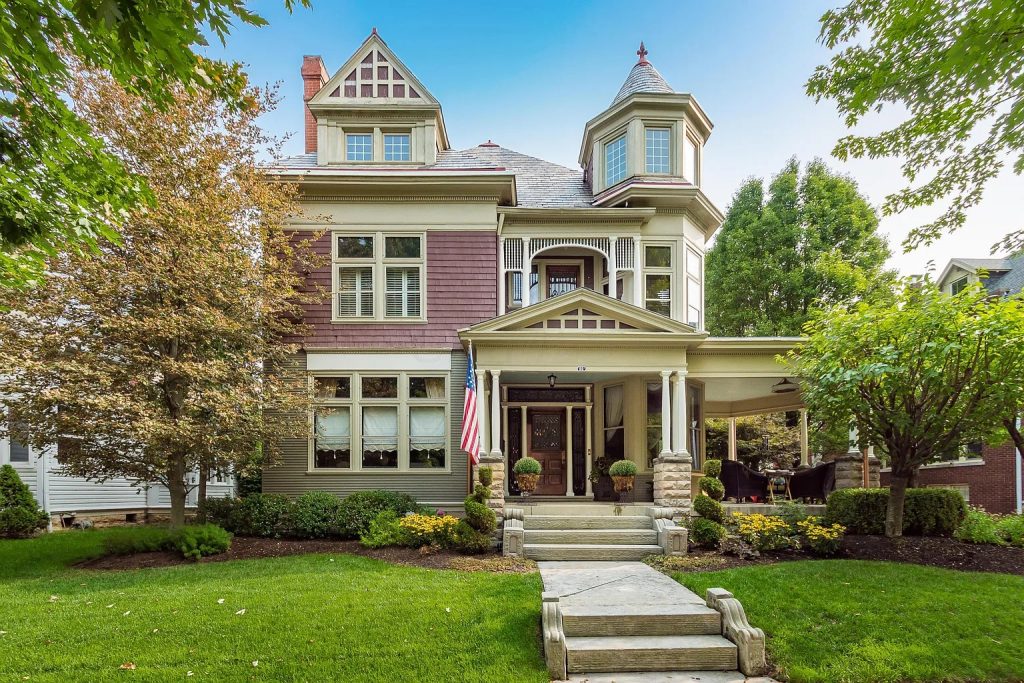
60 N. Main, 2020
From the horse-and-buggy doctor a century and a half ago to today’s primary care physician, the special connection between doctor and patient remains the crux of medicine. But the days of the general practitioner with his black bag are gone, as are visits to the doctor’s house.
As a side note, traveling back into the past was eye-opening. I reconnected with the life and times of previous generations. Be your own wayfinder where family lore, written records and memories of home are guideposts.
I gratefully acknowledge the assistance of Ohio State University Medical Center archivist Kristin Rodgers, officials at the Madison County Recorder’s Office, and current owners of 60 N. Main, Mark and Moira Landes. This essay is dedicated to my brother.
Phil Sparling is a retired professor who lives in the North Georgia foothills.



Recent Comments