Category: College of Dentistry

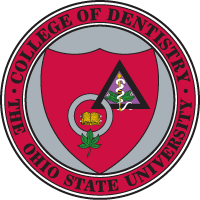
College of Dentistry Seal

The_Ohio_State_University_College_of_Dentistry_seal

The College of Dentistry seal in an “O” with the open book and buckeye leaf with are part of the University seal. The open book signifies education and the buckeye leaf is representative of the Ohio State University. The “O” also represents the Greek letter Omicron which the first letter of the word Odont, meaning tooth.

The triangle, representing the Greek letter Delta, together with the cautery and the branches with the leaves and berries represent the dental profession. The leaves represent the 32 teeth in the permanent dentition and the berries represent the 20 teeth in the primary dentition.

The overlapping of the triangle and the circle represent the joining of dentistry and education.

First Campus Statue

In 1915, the International Dental Federation asked and was granted permission to erect the first campus statue of Dr. Willoughby D. Miller (1853 – 1907). Dr. Miller discovered how and why teeth decay.

The OSU Board of Trustees fixed the temporary location of the statue southwest of the Thompson Library building – it was moved to its present home beside Postle Hall when the building was complete.

The bronze statue is the work of Frederick C. Hibbard, a sculptor from Chicago and costs $5000. It was unveiled December 8, 1915 in the presence of 300 dentists attending the annual meeting of the Ohio Dental Society. Miss Anna Miller of Alexandria, a grandniece of Dr. Miller, performed the act of unveiling.

On the base of the statue is the following inscription: Erected to the Memory of Willoughby Dayton Miller, 1853-1907, Dental scientist and education, Benefactor of his profession, Friend of humanity, a native of Ohio, a citizen of the world, by the dentists of the United States, December 8, 1915.

Gies Report

In 1926 as part of a series of studies on professional education in the United States funded by the Carnegie Foundation for the Advancement of Teaching, Dr. William Gies published a landmark report, Dental Education in the United States and Canada, that established the importance of dentistry as a healing science and an essential component of higher education in the health professions. The report took five years to research and write and included lengthy descriptions and evaluations of the existing dental schools, each of which Dr. Gies visited.

http://www.adea.org/ADEAGiesFoundation/William-J-Gies-and-Gies-Report.aspx

Carl O. Boucher Prosthodontic Conference

The Carl O. Boucher Prosthodontic Conference was established in 1966 to provide continuing education in the art, science and practice of Prosthodontics. It is dedicated as a living tribute to Dr. Carl O. Boucher, who devoted himself to the advancement of Prosthodontics and the teaching of all who desire to advance their knowledge in this discipline of dentistry.

The Medical Heritage Center has an archival collection of brochures from the annual meeting. The finding aid for the collection can be viewed at https://hsl.osu.edu/mhc/pdf/carl-o-boucher-prosthodontic-conference-brochure-collection

Gillette Hayden

Gillette Hayden

Gillette Hayden

Gillette Hayden (1880-1929) was the great-granddaughter of Horace Hayden, one of the founders of the first dental college in Baltimore, and she gained fame for her achievements in periodontics.

Dr. Hayden was valedictorian from East High School in Columbus, Ohio.  She went on to become the third woman to graduate from the dental department of Ohio Medical University in 1902.  After taking some post-graduate work at Northwestern Dental School, she began a general practice of dentistry in Columbus in 1903.  In 1905 she traveled to Europe to introduce methods and treatment of periodontal diseases developed by the late Dr. D.D. Smith of Philadelphia.  In 1908 she returned to Columbus, devoting her practice exclusively to periodontia.

In co-operation with Dr. Grace Rogers Spalding of Detroit, Michigan, Dr. Hayden helped form the American Academy of Periodontology in 1914.  Dr. Hayden was president of the group in 1916, was later elected fellow, and served almost continuously on the executive council until her passing.  She also served as president of the Federation of American Women Dentists in 1923 and was elected secretary of the periodontia section of the International Dental Congress in 1925.  In addition to being a member of the National Dental Association, she was also a member of the Ohio State and Columbus Dental Societies, the Northern Ohio Dental Association and the Central Ohio Dental Association.

Dr. Hayden also worked in the equal rights movement and helped found the Columbus branch of the National Altrusa Club.  In 1925 she was elected president of the National Association.  She was a vibrant member of the community and was actively involved in many more groups and organizations.

The Medical Heritage Center has an archival collection of Dr. Hayden’s and the finding aid for it can be viewed at https://hsl.osu.edu/mhc/pdf/gillette-hayden-collection.

Origins of the OSU College of Dentistry

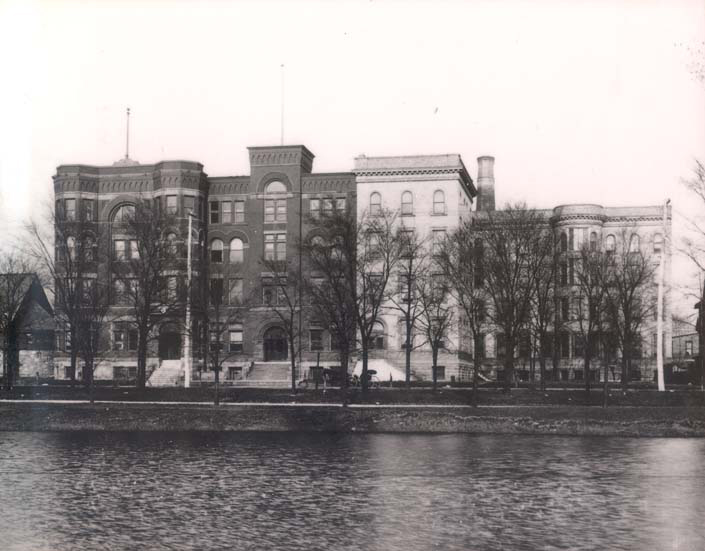
Ohio Medical University

Ohio Medical University

Ohio in 1868 became one of three states to be among the first to pass a dental practice act.  The Ohio State Dental Society, founded in 1866, had in its purpose the idea of advancing the profession by ridding it of incompetent dentists and charlatans.  The Ohio law made it illegal for anyone to practice dentistry for compensation in the state unless that person had receive a diploma from a dental college or had been issued a certificate of qualification by the state dental society or a local society that was an auxiliary of the state organization.

The act provided for the appointment of a state dental board by the state dental society, to oversee the regulation of the profession.  The newly appointed board decided to examine only those who were not graduates of dental schools and were new to practice.  Dentists already in practice were waived from the examination until 1873. As time passed, the examination became more rigorous.  The examination process for certification became dreaded by many who desired a career in dentistry.  Attending a dental school and being certified for practice by simply graduating looked more inviting than a preceptorship of two or three years and an examination.

Another event around 1868 was the establishment of a dental school within Harvard University that marked the first successful placement of dental education within a university.  From that date on the majority of dental schools founded were university affiliated.

The Ohio State University College of Dentistry originated as the dental department of the Ohio Medical University, a freestanding, private institution which was organized and chartered in Columbus in 1890 (the first class session began in 1892).

A new dental law was enacted in May 1892 that provided a five-member board, appointed by the Governor rather than by the state dental society and further required all licensed dentists in the state to re-register.

During the winter of 1906-1907 the trustees of the Starling Medical College and of the Ohio Medical University, recognizing the great advantages that would accrue to the cause of education and to the entire medical profession by union and co-operation, transferred the property and equities of these two corporations to a Board of their own selection with power to incorporate a new college. This action was taken March 13, 1907, the name agreed upon, Starling-Ohio Medical College (SOMC), being a happy combination of the names of the only medical colleges in central Ohio at the time of the union. The new corporation included a Medical College, a Dental College and a Pharmacy College, designated as Departments.

There was a vision of greater things for both SOMC and The Ohio State University when Dr. William Oxley Thompson, president of OSU, was elected president of the SOMC.  Property difficulties were ultimately overcome, and the Legislature authorized, in a bill introduced by Senator E. G. Lloyd, the creation in the Ohio State University not only of a College of Dentistry, but also of a College of Medicine. At the May, 1913, meeting of the Trustees of the Ohio State University, President Thompson presented a proposal from the trustees of SOMC to transfer the real and personal property of that institution to them, provided they would maintain colleges of medicine and dentistry, accept the students in medicine, dentistry, and pharmacy with the rank and standing as certified by the proper officers of SOMC and take the necessary steps to protect the professional rights of the alumni, receiving and preserving the necessary records and papers.  A supplementary proposition was later received, offering to turn over, in addition to the properties, case on hand, after payment of all bills— a balance estimated at $12,000.

These propositions were accepted in January, 1914, by the trustees, who adopted resolutions establishing the College of Medicine and the College of Dentistry.  The property, which was transferred in March, consisted of two lots and a college and hospital building on Park Street, subject to a lease by the Protestant Hospital Association, and three lots on State Street, on which the Starling Medical College/St. Francis Hospital building was located, besides all chattel and personal property.

In April 1914, Dr. Harry M. Semans was elected dean, and a faculty of 24, one-half of whom were salaried, was appointed.  William M. Mutchmore was elected registrar.