Category: Artifacts (page 2 of 2)

Convertible Monaural Stethoscope

Convertible Monaural Stethoscope

Wood, Circa 1860

Artifact Collection, Medical Heritage Center

The stethoscope is an acoustic medical device for auscultation, or listening to the internal sounds of the body. It is used to listen to lung and heart sounds as well as to listen to intestines and blood flow in arteries and veins.

Initially heart sounds were auscultated by placing the ear directly on the chest of the patient. For the sake of convenience and propriety, in 1816 Dr. Rene Theophile Hyacinthe Laennec rolled up several sheets of paper and placed one end over the patient’s heart and the other end over his ear. Laennec was a skilled wood turner and later replaced the rolled paper with a wooden tube. For his invention of the stethoscope, Laennec is considered the father of chest medicine.

In the early 1850’s there was a rush of designs for a new stethoscope that used both ears. In 1851, Arthur Leared invented a binaural stethoscope, and in 1852 George Cammann perfected the design of it for commercial production.

Stethoscopes are often considered as a symbol of the doctor’s profession, as doctors are often seen or depicted with a stethoscope hanging around their neck.

Skin Grafting Instrument

Dr. Gilman Kirk
Skin Grafting Instrument
88mm mortar shell

This skin grafting instrument was made by Dr. Gilman Kirk during World War II from an 88mm mortar shell. The instruments supplied by the military did not work as well as Dr. Kirk would have liked, so he and a military engineer made this skin grafting instrument out of material that was available: an 88mm shell. This is an example of the ingenuity needed in battlefield medicine.

Bloodletting Instruments

Scarificator

Bloodletting was the withdrawal of often considerable quantities of blood from a patient in the belief that it cured or prevented a great many illnesses and diseases. It was a popular medical practice from antiquity up to the late 19th century. The practice has been abandoned for all except a few very specific conditions.

The scarificator is a spring loaded instrument that has a series of blades that snap out to cut the skin to allow for bloodletting. The bleeding bowl, as the name implies, is a bowl used to collect blood. The Medical Heritage Center’s bleeding bowl has lines etched into the inside that correspond to different prescriptions.

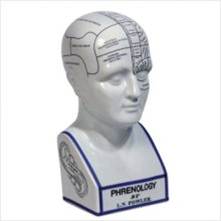
Phrenology Head

L. N. Fowler Phrenology Head (replica)

Porcelain

Artifact Collection, Medical Heritage Center

Phrenology studies the structure of the skull to determine a person’s character. Phrenology’s first heyday was in the 1820s – 1840s. Visiting a phrenologist at that time is akin to seeking the advice of a psychic, clairvoyant or astrologer today as a phrenologist was someone who claimed to have access to special knowledge about people.

A new movement was re-introduced to Britain in the 1860s and 1870s by the American brothers Lorenzo Niles Fowler (1811-1896) and Orson Squire Fowler (1809-1887) who were leading phrenologists of their time. Orson, together with associates Samuel Wells and Nelson Sizer, ran the phrenological business and publishing house Fowlers & Wells in New York City. Meanwhile, Lorenzo spent much of his life in England where he initiated the famous phrenological publishing house, L.N. Fowler & Co., and gained considerable fame with his phrenology head, which is now considered the most famous type of phrenology head.

Although phrenology has been discredited, it did advance the correct notion that different parts of the brain are responsible for different mental functions.

Cupping

Cupping refers to an ancient Chinese practice in which a cup is applied to the skin and the pressure in the cup is reduced, so that the skin and superficial muscle layer is drawn into and held in the cup. The cups are placed at various positions along the meridian lines that are also used in acupuncture.

The earliest recorded use of cupping was in the book, A Handbook of Prescriptions for Emergencies, by Ge Hong (281–341 A.D.).

Originally, practitioners would use hollowed-out animal horns for cups. Today, most acupuncturists use cups made of thick glass or plastic, although bamboo, iron and pottery cups are still used in other countries. Glass cups are the preferred method of delivery, because they do not break as easily as pottery or deteriorate like bamboo, and they allow the acupuncturist to see the skin and evaluate the effects of treatment.

There are three forms of cupping: dry, air and wet. Traditional or dry cupping is using a flame to heat the cup and then applying it to the skin. Air cupping is when the cup is applied to the skin, a suction pump is attached to the rounded end of the cup and the pump is then used to create the vacuum. In wet cupping, the skin is punctured before treatment. When the cup is applied and the skin is drawn up, a small amount of blood may flow from the puncture site, which is believed to help remove harmful substances and toxins from the body.

Generally, the cup is left in place for 5–15 minutes. The skin becomes reddened due to the congestion of blood flow. While cupping is considered relatively safe, it can cause some swelling and bruising on the skin. These bruises are usually painless and disappear within a few days of treatment.

Today, cupping is still used for respiratory disease, as well as digestive and gynecological disorders, headaches and dizziness, and lymphatic blockages. The common cold can be tackled with cupping, as can insomnia and soft tissue injuries.

Nursing Caps

No one has ever discovered the true origin of the cap. It has been suggested that the cap was influenced by the stiff white caps worn by the women trained as nurses at the Institute of Protestant Deaconesses, which was founded by Pastor Theodore Fliedner at Kaiserwerth in Germany in 1836. Florence Nightingale once took a course in training there.

But every lady of Nightingale’s day wore a cap indoors. A great many pictures of Queen Victoria portray her with her cap of plain white stiffened muslin with ruching framing her face.

At the turn of the century, many women had very long hair which the nurse’s cap was intended to hold to maintain the hygienic environment necessary for patient care. Early long caps covered the whole head. These caps were replaced by small or short caps which covered only the knot of hair at the top of the head.

Cap design identified its wearer’s alma mater. A black band sewn on the cap signified senior level or graduate status at many schools, and sometimes identified the head nurse on a clinical unit. Its origin is unknown, but some people believe the black band is a sign of mourning for Nightingale.

In the 1980s with the near universal adoption of scrubs and the claim that the cap was a potential carrier of bacteria and other disease-causing pathogens that could be transmitted from patient to patient, the practice of wearing caps was abandoned in most health care institutions. However, caps can still be found in many developing nations, as well as some countries where women continue to make up the overwhelming majority of nurses.

Newer posts