University of Wisconsin
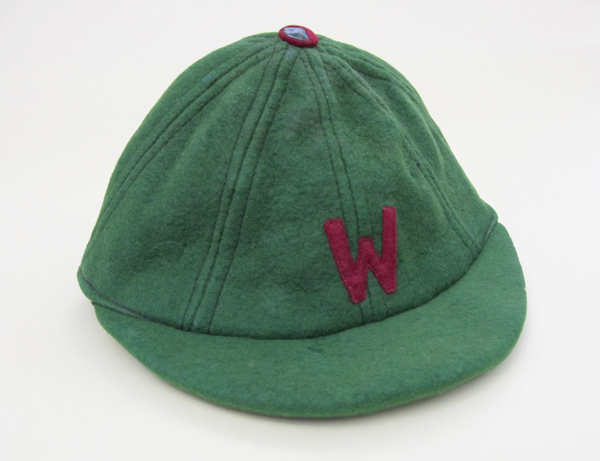
As early as 1901, the freshman men at the University of Wisconsin voted to wear dark green caps, but the tradition did not become firmly established until several years later. In 1907 the sophomore class proposed that freshmen1 be required to wear a green cap with a pink button on top. Caps evidently were available in 1908, but it was not until the next year that the Freshman Rules Committee and Student Conference made wearing the caps mandatory. The caps were dark green, “green caps for green men,” with a cardinal W on the front and a cardinal button on top. In 1909 four stores in Madison sold the caps at a cost of $ .50. Freshmen were to wear the caps from October (school started in late September) to Thanksgiving (later changed to November 1) and from Easter to commencement (mid-June). They were allowed to wear other hats during the winter. The Daily Cardinal, the student paper, mentioned that such caps had become popular in eastern colleges and had recently been introduced at Illinois and Chicago. Freshmen were supposed to touch the red button on top of the cap whenever they addressed an upper classman. Failure to do so could result in charges before the Student Court and penalties ranging from singing University songs at noon on Bascom Hill to being dunked in Lake Mendota.
An article in the student paper in 1907 said that the proposed caps were not for “humiliating the first year men but to make it possible to identify them for the purpose of assisting them in every possible way.” But the caps quickly became a part of what was essentially ritualized hazing of freshmen by sophomores.
Since early in the university’s history, the freshmen and sophomore men had fought one another in various ways. Starting in 1895 they battled in early fall along the shore of the lake behind the Red Gym and the boathouse in what was known as Class Rush or Lake Rush. The Alumni Magazine from November 1901 said that at least 2,000 spectators enjoyed the two-hour contest that year. There were often printed posters from each class advising the other to beware and such rousing cries as “Hit ‘em with bricks, hit ‘em with bricks. U. W. 1906.” But by 1909 the fighting had become too intense, too many people were getting hurt, and it was too difficult to tell which side won, so rush was moved to what is now library mall. Fifteen burlap bags were lined up and whichever class came away with the larger number of bags was declared the winner. After the battle the students often marched up State Street and around the Capitol, usually not on their best behavior. The contest was policed by upper classmen wielding wooden clubs, but by the early 1920s the event was resulting in many injuries and run-ins with the Madison police.
In the spring, the two classes often battled again during Cap Day, held close to commencement, which culminated in Cap Night with a bonfire on what is now library mall in front of the Wisconsin Historical Society building (then home to the libraries of the Historical Society and the University). Freshmen threw their caps into the fire to signal the end of their freshman year, and that is the main reason that few caps survive.
The university administration and student government tried many times to end at least the worst hazing on campus, but their efforts rarely had much effect. Wearing of the caps did almost disappear during World War I when many male students were serving in the war, but in 1919 the students made an effort to revive the custom. Many freshmen refused to wear the caps, and nearly 100 students were thrown into the lake that year. The Student Court responded by outlawing the caps, class rush and cap night. Many students protested and at a referendum held in 1922 the students voted to reinstate all three. But the traditions were nearing their end and in the spring of 1923 the Student Court ruled that freshmen could not be required to wear any specific article of clothing. Some students did still wear the caps at least into the late 1920s, but they quickly fell from favor. Class rush also ended in the late 1920s, closing a colorful if somewhat turbulent era in student life at Wisconsin.
-David Null
1Only freshman men were required to wear the caps. Women during that time usually comprised around one-third of the student body.