
Tag Archives: Theresa Delgadillo

Temporary Labor, Temporary Lives

June 10, 2013

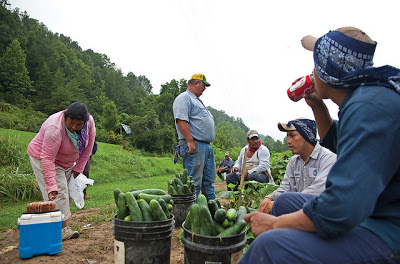
Photo by Laura Elizabeth Pohl. Flickr/Creative Commons License.

Photo by Laura Elizabeth Pohl. Flickr/Creative Commons License.

By Theresa Delgadillo

“In my mind, slavery has not yet disappeared. And in this case, we the Mexican agricultural workers are the slaves. I want to say to all of the employers that we are not machines. And I want them to consider, for just a moment, that the money they have is thanks to the work of all the Mexican agricultural workers who come to Canada to work.”

– Mexican agricultural contract worker in El Contrato (2003)

Advocates of U.S. immigration reform have long cited the importance of immigrant labor in making our daily meals possible. Immigrant labor drives all aspects of agricultural production in the U.S. — picking, packing and delivering to our local markets the vegetables and fruits we eat as well as slaughtering and processing the poultry and meats we consume. Yet, what we overlook when we focus on how much agricultural labor rests on immigrant shoulders is the wealth, income and economies the workers also produce. In Min Sook Lee’s 2003 film El Contrato, viewers hear how small family farms grew into major industries through the use of Mexican agricultural contract workers. But viewers also hear the male workers, who are at the center of this film, speak about the pain of their ordinary family and social life disrupted, their isolation and their powerlessness life as contract workers to improve the conditions of their labor. The film also shows us their efforts to support each other.

Since visas for temporary contract labor, skilled labor, and the temporary status of millions is on the table in the current immigration debate in the U.S., those interested in immigration reform might be interested in viewing Lee’s film to consider how guest worker programs affect all those involved, but also to learn about the historic and economic contributions of immigrant workers. For me, El Contrato drives a home a point that many would prefer to forget: immigrants are people, embedded in social as well as economic networks. El Contrato shows us men who are not able to both live and work among their families and social networks, but instead must forego life for work. Their labor, nonetheless, contributes to two economies: Canadian and Mexican. Though El Contrato addresses a Canadian/Mexican context, viewers might consider that the men’s voices in this film and their expressions of desire for a fuller family are sentiments shared by immigrants in the U.S. Today, we again revisit the debate between prioritizing family and social relationships in U.S. immigration law over that of worker supply and between inclusion of new immigrants via citizenship or forms of legal second-class status.

Filmmaker Min Sook Lee is at work on another film, Migrant Dreams, that focuses on women contract workers in Canada. The trailer promises even more intimate glimpses into the lives of contract workers, yet because these aspects of life are absent from El Contrato I wonder about the sources of this gendered difference — were these aspects of men’s lives not available to the woman filmmaker or a sign of the difference in men’s and women’s immigrant experience? Something to consider when Migrant Dreams is completed and published. In the meantime, view El Contrato in full online at the Canadian Film Board’s website.


Theresa Delgadillo is a Co-Editor/Moderator of Mujeres Talk and an Assistant Professor of Comparative Studies at The Ohio State University.

Learning from Mexican and Native Women

August 20, 2012

Photo Credit: Pepe Rivera. Taken June 26, 2011. From Flickr.

Photo Credit: Pepe Rivera. Taken June 26, 2011. From Flickr.

By Theresa Delgadillo

Yesterday, as I continued my work on translating an oral history interview from Spanish into English, I was struck by something that this particular participant in the project said – as I often am in this work. I’ve had the honor of interviewing some very wise and determined Latinas in the project that I began in 2008 to collect the oral histories of Latina leaders in Milwaukee, Wisconsin. These are some very interesting women! Fortunately, I am near the end of the editing and looking forward to sending it off the publisher soon. To get back to my point: my interviewee, commenting on the social customs of Mexico and the U.S., says at one point, “There it is the same as here, exactly the same as here. The only difference is that there is still a fiction that in Mexico it’s different.” She was talking about the acceptability of divorce, but it resonated with me on other levels, such as the changes in daily life, work and environment, partially because there was some interesting news from Mexico recently in the The New York Times about a group of indigenous women in Cherán, Michoacoán, who mobilized against armed illegal loggers and are now defending their town from violence and their forest from deforestation. To readers of Latina/o literatures, or literature about migration, the name Cherán might be familiar, since it was one of the sites of migration to the U.S. portrayed in Ruben Martinez’s Crossing Over: A Mexican Family on the Migrant Trail(2001). The August 2, 2012 article by Karla Zabludovsky titled “Reclaiming the Forests and the Right to Feel Safe,” describes the events in Cherán and the women’s actions as “extraordinary” as it details their effectiveness. Motivated in part by the loss of the beautiful forest that was once their patrimony, a loss that must be visible to them on a daily basis, the women see themselves acting not only for themselves but for future generations. When I read it, I wondered, and not for the first time, if Luis Urrea’s novelInto the Beautiful North (2009) hadn’t come to life – because this is not the first instance in recent years of Mexican women taking the lead to end violence and environmental destruction. Meanwhile, New York State is set to join the ranks of states allowing fracking. In an August 19, 2012 CBS News Report, “New York State to Allow Fracking,” Jeff Glor’s article notes that the process of fracking releases dangerous contaminants that have high potential to endanger air and water supplies, yet quotes local farmers who need the money. The women of Cherán, Michoacán, also need money to live and they are supported in part, according to the article, by remittances from residents who have migrated to the U.S., yet it seems they are living in the aftermath of a disastrous environmental decision and working to make it right. Like the people of Cherán, Michoacán, Mexico, we face some very difficult decisions in these energy-gobbling times, and we might consider what we can productively learn through a comparative perspective that doesn’t consign indigenous women to a lost past, but instead examines the experience of both residents and migrants from particular regions about what doesn’t work – because as my interviewee says: “There it is the same as here, exactly the same as here. The only difference is that there is still a fiction that in Mexico it’s different.”

Theresa Delgadillo is on the faculty at Ohio State University.

  1. María Antonietta Berriozábal  August 20, 2012 at 4:27 PM

    Dear Theresa:

    I find your work fascinating. I am a lover of oral history. Next month my book, María, Daughter of Immigrants, will be published. The first chapters include the stories that my parents told me as a child. With just their stories – no genealogical searches for me – I was able to share the story of my great grand mother and grandparents going back one hundred years. That is rather astounding. To think that these women can share a story, you chronicle them and one hundred years from now someone will be sharing them.

    Another reason for my interest in your work is that in 1995 I attended the Fourth World Conference on Women in China as a member of the US delegation. During the conference I met with women from Central America and some from Peru. Some could not even speak Spanish. They spoke their native dialects, but they had leaders who had learned Spanish and they were our interpreters. One of the reasons they had gone to the Beigjing conference, through great sacrifice, was to tell their stories of how their ancestral lands were being taken by businesses. It is the same story that continues to this day of multi-national corporations raping the environment in other countries so they can provide goods and food for the developed countries like the US and others. But the women were fighting; they were organizing and using their voices. I found it interesting that the leaders of the movements, at least of the ones I met, were mujeres. They wore their colorful clothing almost as the shield of warriors.

    In any event, I appreciate what you are doing very much.

    Sincerely,

    María Antonietta Berriozábal
    San Antonio, Texas

  2. Theresa (Mujeres Talk Co-Moderator)  August 20, 2012 at 6:14 PM

    Dear María Antonietta,

    I am looking forward to reading the preview of your book that appeared in Frontiers, and to your new book. Please send us an announcement for it as soon as it appears. My project was motivated, too, by the desire to record and share the life stories of Latinas whose experiences don’t appear elsewhere.

    Research in the U.S. has shown that indigenous migrants to the U.S. from Latin America often face difficulties precisely because of the language assumptions that you noted in your experience. Despite language differences, we are all struggling with the same difficult questions about how we use our natural resources.

    Thank you so much for your comments and encouragement, and thank you for sharing your work.

    Take care, Theresa

  3. Lourdes Alberto  August 28, 2012 at 8:31 PM

    In reading this post I am reminded that indigenous people think of themselves as planetary citizens–they fight for their people, their cultures, their history, but also all of our well-being and that of future generations.
    As an indigenous person myself (Oaxaqueña), I struggle with my own part in the depletion of the Earth’s natural resources.
    You know, three seasons ago I started growing a garden with the goal of eventually meeting all of my family’s summertime food needs. It was so fulfilling, so liberating, so unexpected. I know now that my challenge is to remember and live the knowledge my grandparents left me about the land, about plants and about the importance of well-being. As you mentioned, there are tens of thousands of indigenous people from Latin America in CA. Growing up we had an informal plant co-op/exchange. Someone would manage to bring over a plant, flower, hierba, from Oaxaca and we would literally share cuttings–yerba santa, varieties of avocado, ruda. It was amazing! A kind of urban indigenous transnational environmentalism!

  4. Theresa (Mujeres Talk Co-Moderator)  September 3, 2012 at 5:25 AM

    Dear Lourdes,

    It’s good to hear from those that grow gardens for sustainability, and I appreciate the work you’ve put into this important task for three seasons, which, as you say, is a combination of memory work, and living a connection to others and growing food. Thank you for your beautiful note!

    Take care, Theresa

Latino/a in Spain?

July 10, 2012

By Theresa Delgadillo

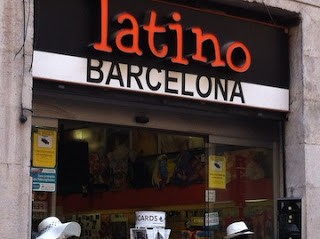
Storefront, July 2012. Photo Credit: Theresa Delgadillo

Storefront, July 2012. Photo Credit: Theresa Delgadillo

In Barcelona, Spain, while speaking with friends over lunch at a communal picnic table – switching from Spanish to English and back again – I heard the woman in the family sitting next to us say, in a whispered voice, “son Latinos.” She was referring to us, of course, answering what seemed to be a confused query from her partner about who or what we were. The term “Latino” has most definitely taken hold here to describe Latin American immigrants and their children, and it seems that just as in the U.S. it reflects a growing demographic that is welcomed by many and feared by some. 

Both Madrid and Barcelona have significant Latino/a populations and neighborhoods which have begun to appear in contemporary Spanish visual culture. The recent, very popular telenovela in the U.S. La Reina del Sur seems to acknowledge the issue of Mexican migration to Spain in the story of its protagonist Teresa, who flees drug violence in Mexico only to become an international drug smuggler herself in Spain. Latinos/as in Spain come from many different Latin American countries and some do have ties to U.S. Latinos/as, making the Latino/a connection global. As my colleague Dr. Miroslava Chávez-Garcia notes, the globalization of Latinos/as has its down side: Latinos/as and gangs are often linked in the popular discourse of both the U.S. and Spain. However, Spanish scholars Dr. and Prof. Carme Panchón Iglesias and Prof. Isaac Ravetllat Ballesté of the University of Barcelona suggest that Barcelona and Catalonia’s unique history and experience as a bilingual, bicultural people suggests that it may be well-equipped to create from these demographic and cultural shifts a society where difference is valued, where culture and language is shared rather than imposed, a society where inclusion and integration rather than assimilation predominates. If Catalonia is a particularly apt place for enacting that vision, let’s hope it spreads far beyond the borders of this region.

For many years, I have employed the pan-ethnic label “Latino” or “Latina” to refer to citizens of the U.S. who are Mexican American, Puerto Rican or of Latin American background. The term also generally refers to permanent residents of the U.S. from Latin American backgrounds, though individuals in this latter group often retain their identities as Latin Americans and prefer to be known as Latin Americans rather than Latinos/as, making it important to distinguish between Latin American and Latinos/as. My understanding has been the same as that of Marcelo Suarez-Orozco and Mariela Paez, who suggest in Latinos Remaking America that Latinos are “made in the U.S.A.” However, “Latino/a” is no longer only a U.S. identity, as this recent experience revealed to me.

What research or leisure travel are you doing this summer? What is the Latino/a experience you have or are encountering in your travels? How are Latin@s seen and understood where you are?

Theresa Delgadillo is on the faculty of Ohio State University and is a Co-Moderator of Mujeres Talk.

Considering Transformations at the SSGA Conference

May 28, 2012

"Grapes of Light." October 6, 2007. Photo by Maria Yu. From Flickr.

“Grapes of Light.” October 6, 2007. Photo by Maria Yu. From Flickr.

By Theresa Delgadillo

Back home from another stimulating gathering of the Society for the Study of Gloria Anzaldúa, a conference held every 18 months at the University of Texas at San Antonio, hosted and sponsored by the Women’s Studies Institute. Kudos to Professor Norma Cantú, Chairperson of the SSGA, for putting together a great program, and to Professor Sonia Saldívar-Hull, Director of the Women’s Studies Institute, and Carolyn Motley and other WSI staff, for the program, funding and logistical support to SSGA.

The theme of the 2012 conference was “Transformations,” and so many of the presentations and lectures and papers shared at this conference so thoughtfully and productively addressed this idea and practice in both Gloria Anzaldúa’s ouvre and from the perspective of other fields and bodies of knowledge in relation to Anzaldúan thought. Dr. Nancy “Rusty” Barceló, President of Northern New Mexico University, and Dr. Norma Alarcón delivered plenary speeches that challenged us to do the transformative work, in our actions in higher education as well as in our consciousness and self-growing, that so occupied Anzaldúa. I was not able to make the trip to Anzaldúa’s burial site, where Dr. Aida Hurtado also delivered a talk. The Noche de Cultura was a beautiful and energizing evening of song and dance with original compositions performed by Nancy “Rusty” Barceló, traditional and original mariachi songs from Carmencristina, folk music from Brenda Romero, fandango from Martha González and Quetzal who also joined the finale performance of Fandango Tejas. Fandango is fun! Since my explorations of Anzaldúa’s work have centered on how she queers the religious imaginary, I was particularly interested in the panels on indigenous worldviews, spirituality and religiosity in all its forms, though I could only, lamentably, attend a couple, but that’s a good reason to look for these papers in published form in either the published conference proceedings / Mundo Zurdo volumes or the MALCS journal Chicana/Latina Studies, or to research on a trip to the Gloria Anzaldúa Archives at UT-Austin.

From readings of and about Anzaldúa’s work, from conversations with those who worked with her, from hearing and witnessing her in action — in my case, in the early 1990s at a campus-wide lecture/presentation she gave at the University of Wisconsin-Milwaukee (where I was a returning undergraduate student many years ago) — we know that transformation was at the center of her project, that it was a life-long project, that she hoped to win others to engaging in this life-long project, and that in every level of academia or sphere of community or professional/career/work life in which she found herself, she lived that project, consciously and daily.

Theresa Delgadillo is on the faculty at Ohio State University and a Moderator/Editor ofMujeres Talk Blog. Her book Spiritual Mestizaje: Religion, Gender, Race and Nation in Contemporary Chicana Narrative (2011) addresses Anzaldúa’s theory and method of spiritual mestizaje.