Stigmatized Markets: Los Angeles Street Vending Kids Working and Restoring a Dignified Self

By Emir Estrada

https://www.youtube.com/watch?v=UgbGSYmLgmQ

The video in the link above depicts the public humiliation of a child street vendor in Tabasco, Mexico. Three officials stand tall next to him as he inconsolably and powerlessly follows through on their command to dump on the street the merchandise he carried on a small straw basket. Once he empties the basket, the officials turn away and leave him on the floor to collect his merchandize. This incident took place in Mexico, but this also happens in our own backyard, here in the U.S.

When I watched this video, I was working on an academic article based on original research I conducted in 2009 to 2012 with street vending children and their families in Los Angeles, CA.  Street vending is a popular economic strategy for poor, undocumented and Spanish monolingual Latinos in Los Angeles. During my study, I spent two and a half years with various street vending families and conducted 66 interviews with children between the ages of 10-18 and their parents. I also accompanied several families while they sold goods on the streets. Continue reading

Zika and Abortion

The sign says “Stop Criminalizing Women.” The woman belongs to a protest movement in Chile, which, like El Salvador, has draconian laws that criminalize women who terminate their pregnancy. In both countries abortion is illegal under all circumstances, even if necessary to save the life of the woman. In El Salvador the exception that allowed abortion when the mother’s life is in danger was removed in 1998; in Chile it was removed under the military dictatorship in 1989.

The sign says “Stop Criminalizing Women.” The woman belongs to a protest movement in Chile, which, like El Salvador, has draconian laws that criminalize women who terminate their pregnancy. In both countries abortion is illegal under all circumstances, even if necessary to save the life of the woman. In El Salvador the exception that allowed abortion when the mother’s life is in danger was removed in 1998; in Chile it was removed under the military dictatorship in 1989.

by Ann Hibner Koblitz

(This essay was originally published on February 1, 2016 on the author’s blog:  “Sex, Abortion, and Contraception”)

The spread of the Zika virus is causing consternation and alarm in many countries. The symptoms of the mosquito-borne virus are generally quite mild, to the extent that many victims don’t even know that they are ill. Recently, however, it has become clear that, when contracted by women in the first trimester of pregnancy, Zika can cause birth defects such as microcephaly, brain damage, deafness, and paralysis. The World Health Organization has stated that as many as four million people in the Americas could be infected in 2016, and the U.S. Centers for Disease Control are cautioning pregnant women not to travel to certain countries in Latin America and the Caribbean where the virus outbreak is becoming severe.

The Central American country of El Salvador has been particularly hard hit, and the government has taken the unprecedented step of warning women not to become pregnant until 2018. This advice is bizarre. El Salvador is a poor country. Many women face barriers, both practical and cultural, to contraceptive use. Moreover, abortion — even when the fetus is known to be severely deformed — is illegal, and the punishments are severe.

An effective government strategy to combat the epidemic of birth defects would consist of three components: widespread sex education and cheap and easily available contraception; widely available prenatal screening for birth defects (amniocentesis); and safe, legal abortion. Since El Salvador has none of these, women in large numbers will inevitably get pregnant, and some will deliver babies with severe abnormalities.

Note that the government’s admonitions are not directed at men, as if they didn’t realize that men share responsibility for pregnancy. Rather, the clear implication is that women and women alone will be blamed for the expected public health catastrophe. A 25 January 2016 article in The New York Times about the Zika threat in El Salvador aptly describes the Salvadoran government’s pregnancy warning as “the equivalent of a Hail Mary pass that, to many here, only illustrates their government’s desperation.”

In this article the word “abortion” is conspicuous by its absence. This is a peculiar oversight by The New York Times, since the illegality of all abortion in El Salvador is one of the principal obstacles to an effective response to the public health crisis.

Also omitted from the coverage in The New York Times is any discussion of U.S. culpability for the deplorable situation in that country. During the years 1979-1992 the U.S. gave billions of dollars in financial and military aid to the right-wing government that committed large-scale atrocities during a civil war in which an estimated 80 thousand people died. After the war the huge quantity of weapons and the large number of demobilized and unemployed former soldiers set the stage for an epidemic of violent crime. In addition, in the mid-1990s the U.S. deported several thousand Salvadoran pandilleros (gang members, mainly from Southern California), who brought their criminal gangs back with them to El Salvador. Current estimates of the number of gang members in El Salvador (a country having 1/50 the population of the U.S.) range from 30 to 60 thousand. At present El Salvador has the highest homicide rate in the Americas.

The pandilleros are not the only U.S. export to cause havoc in El Salvador. Over the past two decades religious fundamentalist groups based in or funded from the U.S. have given rise to anti-abortion fanaticism on a level that was virtually unknown before. In 1994 the Kovalevskaia Fund (of which I am director) and the Salvadoran Women Doctors’ Association convened an international conference in San Salvador to discuss the medical consequences of illegally induced abortion. El Salvador’s Vice-Minister of Health attended, and topics included the use of herbal abortifacients and menstrual regulators by the indigenous peoples of El Salvador, the actions of RU-486, the efficiency of vacuum aspiration as an abortion technique, the work of South American abortion clinics and their education programs for midwives and obstetricians, and so on. There was a sprinkling of anti-abortion people among the 300 doctors and medical students in attendance, but discussions were wide-ranging and respectful. Yes, that is not a misprint. The abortion opponents in El Salvador listened to the discussions of these topics with interest and respect.

Now, however, such an event would be virtually impossible to organize because religious fundamentalists have become much more visible, violent, and well-funded than they were in the mid-1990s. Medical personnel are prevented from performing abortions even in cases of ectopic pregnancy or other life-threatening conditions. In such circumstances it is not surprising that the Salvadoran government fails to mention abortion in connection with the Zika crisis. That The New York Times fails to mention abortion in its own coverage is harder to explain.

Postscript (added 4 February 2016) Although the article on the response in El Salvador to the Zika virus did not mention abortion at all, a 3 February editorial in The New York Times did: “In Latin America, where many nations outlaw abortion, some governments have advised that pregnancies be delayed, which can create only greater anxiety for women who have sadly limited control over such decisions…. Immediate responses, like increasing access to birth control and abortion, face stiff legal and cultural resistance in the affected region.” The New York Times also carried an article “Surge of Zika Virus Has Brazilians Re-examining Strict Abortion Laws”.

Second postscript (added 8 February 2016) Today’s The New York Times has an excellent op-ed on the situation in Brazil by Debora Diniz, a professor of law at the University of Brasilia.

Ann Hibner Koblitz, Professor of Women and Gender Studies, has taught at ASU since 1998. Her first book was the biography of a Russian woman mathematician, feminist and writer. Her second book examined the lives of the first group of Russian women to receive their doctorates in the sciences and medicine. Her most recent book, Sex and Herbs and Birth Control: Women and Fertility Regulation through the Ages (Kovalevskaia Fund, 2014) received the 2015 Transdisciplinary Humanities Book Award from the Institute for Humanties Research at ASU. She also directs a small non-profit foundation for women in science in Asia, Africa and Latin America, and her blog, “Sex, Abortion, and Contraception,” can be found at http://ahkoblitz.wordpress.com.

Artists in the Americas Confront the Fracturing Effects of Violence

audience on stage with actors

Audience on stage set with actors. Pequeños Territorios en Recconstrucción by Teatro Línea de Sombra. Jan 2016. Photo by T Delgadillo. CC BY-NC-NC 2.0

by Theresa Delgadillo

Strong Women?

Narratives of supposedly “strong” women who almost unwillingly enter into drug trafficking proliferate in the world of telenovelas, such as Reina del Sur, Señora Acero, and La Viuda Negra. Indeed, Telemundo advertises its television programs with the tagline: “nuestras protagonistas no se la pasan llorando” (translation: “our protagonists aren’t crybabies”). While not writing directly about these particular telenovelas, or the roles of women in them, Nicaraguan writer Sergio Ramírez observes that a shift in telenovela narratives has occurred: the celebrated subject of these narratives is no longer the poor servant who marries the wealthy son of the household or discovers that she has been secretly wealthy all along, but instead the poor person who rises to wealth by any means necessary, drug trafficking included.[1] In contrast to these mass media representations, in two recent performances and one exhibit in Mexico City, artists engage the issues of drug violence, state violence, and gendered violence in ways that might inspire further dialogue, action, and community, and they do this by devising varied strategies for inviting the audience in to participate in a consideration of these issues.

Displaced Women Organize

Pequeños Territorios en Reconstrucción is an interactive performance that employs drama, documentary, collage, art-making to consider the effort by the Liga de Mujeres Desplazadas to create not only new homes, but new societies. The play asks: under what circumstances would building a house, or, together with your peers, building a neighborhood, attract the ire, hostility, and violence of others? When and why is the act of creating a “home” for oneself an affront to others? When we say we want to do good, for whom is that good? “Pequeños Territorios en Reconstrucción” is a “fábula documental” or fictional documentary drama created by the company LAB/Teatro Línea de Sombra in Mexico City, and recently performed at Teatro Benito Juárez in that city, tells the story of the Liga de Mujeres Desplazadas (The League of Women Displaced) in Colombia, and the neighborhood they constructed with their own hands to give life to themselves and their families. The title of the play might be translated to English as “Small Regions in Reconstruction,” and what the work addresses is the act of reconstructing the world one small neighborhood at a time by telling the story of a group of women – the Liga — displaced from their original homes by the combined violence of the Colombian conflict and drug trafficking, yet not resigned to marginality or the acceptance of violence.

Instead, the women joined together in the space where they found themselves, and organized to support each other, naming themselves the Liga de Mujeres Desplazadas, and eventually erecting an entire neighborhood of 98 homes with cement blocks they learned to construct themselves. Their neighborhood abuts a new housing development in the area that is a kind of suburban enclave, and yet the women’s neighborhood offers a version of “improvement” and defines “good” in ways that contrast with those advertised and offered by the model of suburban living. As we learn in this performance, this difference creates tension but also inspires other women and working people to initiate their own construction efforts.

Interactive and Collective Work in Performance

Pequeños Territorios en Reconstrucción tells a collective story in a collective way, re-enacting the physicality of making and placing concrete blocks to construct a home; shifting among varied voices; working to make the collective of women present visually on stage while also acknowledging the important role of human rights lawyer and activist Patricia Guerrero in advising the Liga de Mujeres Desplazadas. Many of the women in the Liga and the “City of Women” are Afro-Colombian, and on their webpage they describe themselves as a multiracial and multiethnic community, though the performance does not explicitly address the questions of race and ethnicity as these intersect with gender in the experience of the displaced women. The violence that the women flee from and then encounter again when they have the audacity to build their own homes is juxtaposed in this performance with the violence of the drug wars and a luxurious home and zoo built by Pablo Escobar.

small concrete blocks on stage made into houses

Creating block houses. Performance of Pequeños Territorios en Recconstrucciòn by Teatro Linea de Sombra. January 2016. Photo by T Delgadillo. CC BY-NC-ND 2.0

The playwrights, actors, and director first heard about La Liga in 2010 from an article in El Proceso about heroic women that included the Mothers of the Plaza de Mayo in Argentina and women fighting against feminicide in Juárez, Mexico. They traveled to Colombia from Mexico to meet the women of the Liga, and visited them twice more in the following years to learn about the neighborhood they were constructing and to participate in arts workshops in the newly founded “City of Women.” Out of those repeated visits, a relationship developed, one that felt to the creators of Pequeños Territorios en Reconstrucción as something they could learn from, living as they do, too, in a country beset by violence. Yet the performance resists easy comparisons between Colombia and Mexico, and this collaboratively produced and enacted interactive performance asks audiences to attend to the specific contexts of each place. Auad Atala, Alicia Laguna, Eduardo Bernal, Jorge A. Vargas, and Noé Morales collaborate to tell the story of the “City of Women,” and the threats of violence and attacks that the women experienced for their initiative. They are joined in this performance, as they are in each run of the work, by two children from the “City of Women,” who also participate in telling the story of their home, of their mothers, of their neighbors, and of their peers – with great pride and delight! The story unfolds in various modes: the actors and children speaking as they construct models of the “City of Women” on stage intermixed with documentary footage as well as real and imagined text projected on a large screen at the back of the stage. As the story unfolds, the model-sized “City of Women” is slowly constructed on stage by the actors and children, and then populated with images of the actual women who built this neighborhood, concrete block by concrete block, with their own hands. The performance ends with an invitation to the audience to visit the “City of Women” that has been reconstructed on the stage, view the pictures and layout firsthand and discuss the project with the actors and children. The audience responded with much warmth and interest to this last section of the performance, engaging in dialogue both with the creators of this performance and with other audience members.

Remembering and Enacting Feminist Action

The “City of Women” in Turbaco, Colombia, is not new; it came into being fifteen years ago, and yet this performance conveys the significance of feminist action that it represents and positions the audience to consider its relevance in contemporary contexts. In this way, it both remembers and enacts, because the conditions that gave rise to the Liga and City are conditions that women face across the Américas. This interactive performance takes a distinctly different approach to the history of feminist action against violence in the Américas than that recently taken by the Argentine government in two important actions. In January of 2016, La Jornada reported that the Argentine Minister of Health stripped the name of one of the founders of the Mothers of the Plazo de Mayo, Laura Bonaparte, from the title of public hospital. Bonaparte’s name had been added to the hospital’s name upon her death in 2013 and in homage to her work on behalf of the disappeared and tortured. In addition, María Coronel, and other employees of the Escuelita de Famaillá in Tucumán — which was the first clandestine center of detention run by the last dictatorship, and which had been transformed into a memorial space dedicated to human rights issues – were dismissed. Coronel is quoted in La Jornada saying [my translation]: “Memorial sites are not just official jobs; they are the result of years of struggle and we will continue to maintain them no matter what, they are not going to disappear us.”[2]

Intimacy and Violence

Another contemporary performance that employs and combines the techniques of documentary and those of drama is Hugo Salcedo’s Música de Balas. Salcedo’s work won the 2011 National Prize in Dramaturgy and was reprised recently by four talented young actors – three men and one woman — at Casazul in Mexico City. The cast includes Christel Klitbo, Christhian Alvarado, Quetzalli Cortés, and Raúl Rodríguez. Música de Balas, or The Music of Bullets, took place in a small black box theater, the Sala Experimental Ludwik Margules, an intimate setting, with audience members sitting on three sides of performance space. The actors make use of the small performance space to great effect, and sometimes move among the audience, and include them as “extras” in some dramatic scenes. A series of first person accounts about the experience of narco violence in Mexico fold, and through these narratives we begin to take stock of the trauma induced by this violence and the danger of it becoming an everyday state of being. These dramatic accounts are sometimes supplemented by and sometimes alternated with documentary footage or photographs of violent events and acts in the country over the past decade. In Música de Balas the victims of violence lament their loss, manifest their trauma, critique government action and inaction, question the perpetrators of violence and those of us who witness it as it ultimately conveys how we are all victims.

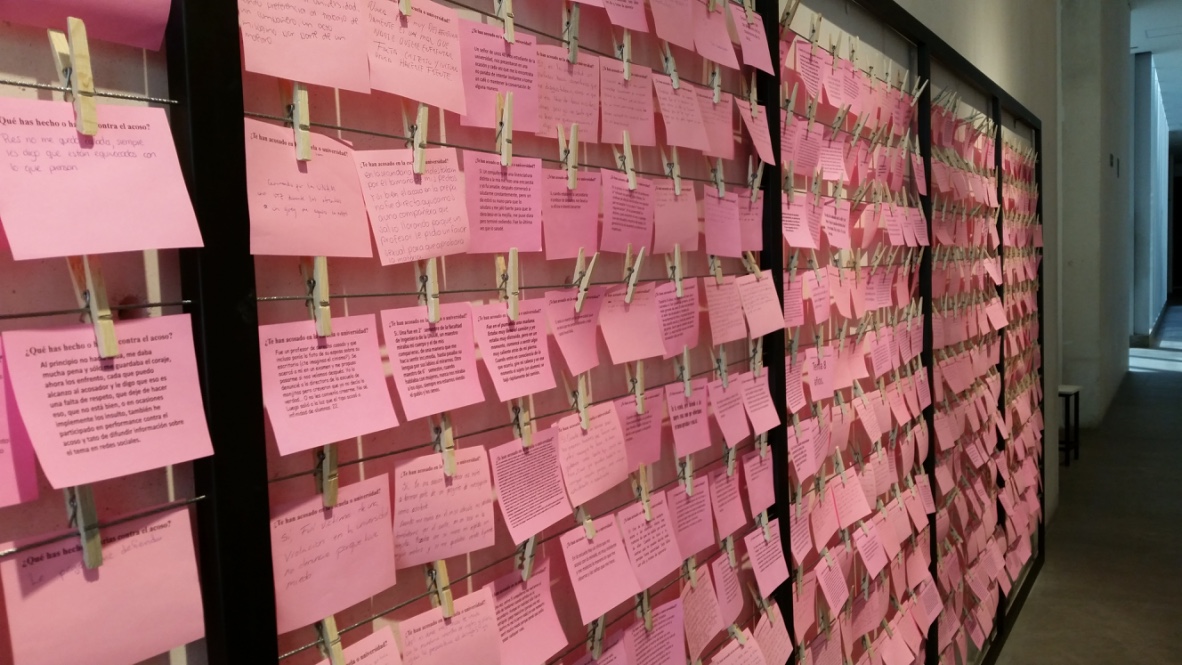
pink cards clothespinned to wire line

El Tendedero by Mónica Meyer. March 2016 at MUAC. Photo by T Delgadillo. CC BY-NC-ND 2.0

The retrospective exhibit of Mexican feminist artist Monica Mayer’s work, Si tiene dudas…pregunte, or “If you have questions…ask” — now on display at the MUAC or Museo Universitario de Arte Contemporáneo, and running until July 31, 2016 — also explores the intimacy of violence in several projects, including an interactive piece titled El Tendedero or “The Clothesline,” an updated version of a 1978 installation pictured in the exhibit that questioned women about their experience of Mexico City. El Tendedero questions viewers about the experience of sexual harassment and violence. The piece asks a series of questions about when and where viewers experienced sexual harassment or violence, how they acted in response, how this changed their behavior, and what they’ve done to prevent such violence in the future. The questions and answers, written on pink cards, are attached with clothespins to wire lines, forming a wall of hanging pink cards, all seemingly the same and yet unique and distinct voices. The title of the piece explicitly challenges the sexist discourses that cast sexual violence and harassment as “private” and “intimate” dirty laundry that should not be aired (often to protect the “reputation” of perpetrators), discourses that remain prevalent throughout the world. A panel discussion linked to the exhibit, “Vocabularios contra el acoso,” offers a valuable discussion of the human rights of women in local and global contexts that begins from a consideration of this particular art project.

thumb_20160211_150644_1024

Closeup of El Tendedero by Mónica Mayer. MUAC. March 2016. Photo by T Delgadillo. CC BY-NC-ND 2.0

In these distinct and innovative ways, Mexican artists are engaging the fictional and the documentary to invite audiences to join them in exploring a series of questions relevant not only in Latin America but throughout the  Americas. Pequeños Territorios en Reconstrucción aims to have as much of an impact on theater audiences as the women of the Liga had on those around them by critically representing the ways that their collective creative and progressive energies destabilized acceptance of violence. Música de Balas represents the terror experienced by ordinary men and women subjected to extreme forms of violence as well as uncertainty in ways that combats de-sensitization and reminds audiences of the enduring impacts of trauma. El Tendedero allows us to hear the voices of women combatting sexual harassment and abuse as it opens a path for audiences to enact their own resistance to this violence.

[1] Sergio Ramírez. “La superproducción más cara de la historia.” La Jornada. 20 enero 2016.

[2] Stella Calloni. “Retiran nombre de fundadora de Madres de Plaza de Mayo a un hospital en Argentina.” La Jornada. 20 enero 2016.

Theresa Delgadillo is a member of the Editorial Group for the Mujeres Talk website. She is an Associate Professor of Comparative Studies at The Ohio State University and the author of Latina Lives in Milwaukee (Illinois, 2015) and Spiritual Mestizaje: Religion, Gender, Race, and Nation in Contemporary Chicana Narrative (Duke, 2011).

Eugenicist Views Take Center Stage in Election Season

photo of eugenics poster that warns viewers to check for supposedly defective hereditary seed

“Eugenics” by Gennie Stafford. Photo of poster in Jewish Museum. From Flickr. CC BY-NC-ND 2.0

by Laura Briggs

Many have been writing in recent days about when Donald Trump started sounding like a fascist. Business Insider Australia even dug up a quote from Ivana Trump in an old Vanity Fair article that claimed that Donald kept Hitler’s speeches by his bed, a statement he didn’t deny. Political science scholar Matthew McWilliams found that the single most important characteristic that predicted Trump support was authoritarianism. Yet an influential Vox article by Dylan Matthews back in December denied that Trump’s politics were on the fascist spectrum, and seemed to halt the momentum of those who had begun raising the question after Trump argued for banning Muslims at the border (initially including U.S. citizens). But Matthews’ doubtful claims that Trump doesn’t advocate violence or overthrowing the Constitution, and his apparent ignorance of the fact that Hitler was elected notwithstanding, the answer for some of us was: we heard Trump as a fascist from the day he announced. He couched his anti-Mexican racism in eugenic terms that day, back in June. He (in)famously began his speech by saying:

“When Mexico sends its people, they’re not sending their best. They’re sending people that have lots of problems, and they’re bringing those problems to us. They’re bringing drugs. They’re bringing crime. They’re rapists.”

Much has been said about this except the most obvious: it implies that most Mexican immigrants are men and that most of those men are rapists. Where does this notion of the “Mexican rapist” come from? Especially since it’s profoundly wrong. Rape is an overwhelmingly male crime, but he offers no proof for the outrageous claim that Mexican men are rapists and overlooks the fact that the majority of migrants from Mexico to the United States are women. Or at least have been since the 1990s. While some say that gender balance has shifted since 2008 (when net migration began to approach zero, with as many Mexicans leaving as arriving), if you add women together with children, men are still a minority of Mexican migrants.

Trump is, no doubt, aware that there are Mexican migrant women in the US—after all, they do a disproportionate amount of the cleaning in the resorts and office buildings that Trump has built his fortune on (and he recently even threw out a woman from one of his rallies, asking “Are you from Mexico?”).

But demographic accuracy wasn’t really what he was after. Trump strummed an old string in US American politics by seeming to defend a violated, victimized (white) womanhood from a racialized other, recalling the old lynching narrative (also resuscitated recently by Maine Governor LePage, complaining about “drug dealers” who go to his state and impregnate “white women”). But by changing the demon of the story from an African-American to a (foreign) Mexican rapist, he shifted it in a direction that would be familiar to fascists everywhere—a eugenic one. It was about the need to protect an imagined (white) volk and their homeland not just from foreigners, but from the wrong kind of reproduction. White women being impregnated by Mexicans. As Mary Romero and others who have been tracking groups like Mothers Against Illegal Aliens have noticed, this image of the Mexican rapist might be a new note in national politics, but it is deeply familiar one from extremist, white nativist groups in Arizona and elsewhere. As he talked about the need to shore up borders, build walls, and “make America great again,” Trump was also invoking the foreign threat to white womanhood, white reproduction, and white children in a way that many of us recognized from the frontiers of eugenic racism in places like Arizona. The Washington Post and Senators may only know about David Duke and the KKK, but Latina feminism has been tracking an account of white reproduction and the Mexican threat.

This wasn’t immediately obvious in the national conversation, though, because virtually everyone who responded to Trump last June was willing to agree with him that Mexican migrants are (all) men. The American Immigration Council (AIC) quickly released a report that responded to Trump in detail, finding that only 1.6 percent of immigrant males 18 to 39 years old were incarcerated, compared to 3.3 percent of native-born males. It added, “The 2010 Census data reveals that incarceration rates among the young, less-educated Mexican, Salvadoran, and Guatemalan men who make up the bulk of the unauthorized population are significantly lower than the incarceration rate among native-born young men without a high-school diploma. In 2010, less-educated native-born men age 18-39 had an incarceration rate of 10.7 percent—more than triple the 2.8 percent rate among foreign-born Mexican men, and five times greater than the 1.7 percent rate among foreign-born Salvadoran and Guatemalan men.” The AIC data, in turn, were duly broadcast by the media, including the Washington Post fact checker (which gave Trump “four Pinocchios” for lying.) These figures reveal the falsity of Trump’s statements, but they also point to the problem of criminalization and incarceration of young people that the Black Lives Matter movement has again brought to the fore in our national consciousness.

While Trump merely implied that Mexican immigrants were all men, the AIC report was explicit. It looked at male crime data, and the Post and other media outlets accepted this without comment. All agreed to take it for granted that all Mexican (or Central American) immigrants are men.

While there is a white supremacist wing of the Republican Party that has been demonizing Mexicans for a long time—think of Pat Buchanan’s 2000 presidential run on an anti-Mexican platform—the “Mexican rapist” was from a white nativist playbook, to the right of Buchanan’s. Trump’s Hitler-isms remade the Jewish racial-religious threat to the homeland into two, the Mexican racial threat and the Muslim religious threat.

The significance of Trump’s invocation of white nativist eugenics was invisible last summer because feminism is only occasionally important to the national political debate. When he calls women “dogs” or “cows,” or complains about Megan “blood coming out of her whatever” Kelly, commentators can get a whiff of his misogyny. But the unspoken “white women” at the back of his “Mexican rapists” comment (or the complete invisibility of Mexican and Central American women to anybody) aren’t seen or heard by the media. But not only Latina feminists, but feminist scholars of Hitler, Franco, and some Latin American conservatisms have noted the importance of this foreign/national reproduction story to fascism consistently. Scholars like Leila Rupp, Gisela Bok, and Mary Nash have written about the political significance of Aryan or Spanish women having many babies, the banning of contraception and abortion, and the centrality of eugenics as a reproductive politics to fascist visions of the future and its population. (It’s telling in this regard that Trump is alone among the current leaders in the Republican field in carving out a rape exception for banning abortion.) Trump’s specifically reproductive racism, an account of the relationship of gender and race that tells a story of the appropriate white female reproduction of the nation, is a way of thinking that resonates deeply with feminist accounts of fascism and womanhood. But this hasn’t emerged in the national discussion about Trump’s candidacy because most begin from the same assumption he did: Mexicans are men.

We might say that Trump, who’s never been accused of the usual “dog whistle” subterfuges of national Republican candidates when it comes to his racist pronouncements, blew a dog whistle of his own about what we might call the race-and-gender politics of the “Mexican rapist” comment. While it’s difficult to get a handle on Trump’s politics because of a pervasive sense that he doesn’t believe what he’s saying—after all, when did Trump care about immigration or criminalizing abortion before he was running for President—it doesn’t matter whether his positions represent his deeply held beliefs or not. He is running on becoming popular—populist—with deep political cunning. He is deliberately building a new strain of American fascism in a way we haven’t seen since the 1930s and Huey Long and Father Coughlin and their Jewish threat.

While many have argued that Trump is allowing a full-throated and proud white racism to crawl out from under the rock where it has been relegated (allowing only a more genteel, less explicit racism on the national stage), I would go further and say he is building it. The 20% of South Carolina Trump supporters who have told pollsters that it was a mistake to end slavery, the Nevada supporters who rattled off a fantasy of the mass-murder of Muslims to Nation reporter Sasha Abramsky—these, I suspect, are new developments. These are flames fanned by things like Trump’s repetition of the old imperialist canard of Pershing in the Philippines at the turn of the century dipping bullets in pigs’ blood and shooting Muslim insurgents there.

The Republican Party is now in full freak-out mode that it is on the verge of selecting a nominee who plays games about whether he will denounce David Duke and the Ku Klux Klan—denouncing him one day, claiming he doesn’t know who he is the next. While the G.O.P. has certainly been racist in recent years—think of its obstructionism toward Obama, the “birther” craziness, the recent attempt to cast a shadow of illegitimacy over his nomination of a replacement for Supreme Court Justice Antonin Scalia, the denunciation of Syrian and Mexican immigrants—the party has always maintained a thin veneer of deniability that allows a handful of people of color and a lot of white folks to maintain their party membership without shame. It seems genuinely to be news that Trump’s position is unapologetically racist, and arguably fascist.

It’s just possible that if they had listened to his announcement speech with feminist ears—had heard the “Mexican rapist” canard as the eugenic claim it was—Trump’s fascism would have been obvious a long time ago.

Laura J. Briggs is Professor and Chair of Women, Gender, Sexuality Studies at UMass Amherst. A widely recognized historian of reproductive politics, Briggs has published three books: Somebody’s Children: The Politics of Transracial and Transnational Adoption, (Duke University Press, 2012); Reproducing Empire: Race, Sex, Science and U.S. Imperialism in Puerto Rico (University of California Press, 2002); and International Adoption: Global Inequalities and the Circulation of Children (NYU Press, 2009, o-author with Diana Marre). Briggs has also published  numerous articles on empire/transnational history of the U.S. in Latin America; reproductive politics and race and sexuality; adoption; and immigration/migration. Recent articles ahve been published in International Feminist Journal of Politics; Feminist Studies; Frontiers; Scholar and the Feminist Online; American Quarterly; American Indian Quarterly; Scripta Nova (Barcelona). In 2012 she created the academic blog site Somebody’s Children: A Blog about Adoption, ART, and Reproductive Politics, where she offers incisive commentary informed by her extensive research.  Professor Briggs has a long history of activism both within institutions and in the community, especially on issues of immigration, and is a collective member of the Tepoztlán Institute for Transnational History.