Category Archives: Latina/o Studies

Latina/o Futures, Literatures, and Necessary Tensions

April 15, 2013

"2009-12-04 JJAY -27" by Aloucha from Flickr.

“2009-12-04 JJAY -27” by Aloucha from Flickr.

by Susan C. Méndez

Recently, I attended John Jay College of Criminal Justice’s 1st Biennial Latina/o Literary Theory & Criticism Conference entitled, “Haciendo Caminos: Mapping the Futures of U.S. Latina/o Literatures.” The conference organizers Richard Perez and Belinda Linn Rincón did a phenomenal job of arranging provocative keynote addresses by Ramón Saldívar, José Esteban Muñoz, Mary Pat Brady, and Silvio Torres-Saillant. They also assembled two days of panels on Latina/o literatures. For a conference-goer such as myself, who always has a hard time finding the one-to perhaps-three panels that actually pertain to what she researches and/or teaches at every literature conference she attends, this event was a veritable cornucopia of literary insights. As a former co-chair conference organizer for MELUS 2010, I could especially appreciate all the hard work and dedication that it took, on the parts of Perez and Rincón and their support staff, to pull off such an endeavor.

Now to turn to the ideas presented at the conference; first, let me state a disclaimer that these summaries derive from my personal and admittedly incomplete notes as a single conference participant. Please forgive any unintentional inaccuracies. Ramón Saldívar set the tone of the conference with his key note address which examined the role of speculative realism in the future of Latina/o literatures. He offered a framework for understanding how the past and the future are more intimately connected than we may think. Saldívar asserted that for Latinas/os, our relationship to the future should be to realize the history not made. Speculative realist texts can act as a set of alternative thought experiments in order to create a new imaginary for the Latina/o community.

The next day, José Esteban Muñoz and Mary Pat Brady delivered powerful meditations linking politics and art. In their presentations, there was an uneasiness stated about hyphenated identities and other identity labels such as “Hispanic” and “Latina/o”; subsequently, Muñoz suggested returning to the label “Brown.” According to my notes, Muñoz explains that in “Brownness,” there is no ranking of “Brown” individuals or conditions; there is just the grounded experience of being “Brown” based on a shared sense of harm and yet flourishing as well. I particularly liked this idea about identity because it seemed to fit so well with feminist organizations like MALCS, where we have always stressed an non-hierarchical, heterogeneous inclusion of all women who share in the grounded experience of being from or connected to the Latina/o or Latin American community or world regions, and this experience is often rooted in a history of political and social oppression but is also marked by cultural flourishing and expression as women. Aesthetic practices and places can serve in the rehearsal of this identity, allowing Latinas/os to be who we want to be in the world. For Brady and Muñoz, this led to a consideration of recent reflections on “failure” by Halberstam and others, as well as recent discussions of “negative aesthetics in art” for understanding queer Latina/o literature and performance.

Lastly, there was the closing keynote address and conversation where Silvio Torres-Saillant posed the following questions to authors Helena María Viramontes and Ernesto Quiñonez: How does one study Latina/o literature without relying on literalization? Do critics do enough to emphasize the art of literature? How do we get students to do the artistic work? These questions caused quite a stir for the panelists and the audience. Several scholars contested the implied sentiment that current scholar-teachers are not getting their students to appreciate Latina/o literature as art. The writers, including author Angie Cruz from the audience, expressed interest in the feminist and other readings of their work by literary scholars. Sadly, I missed how the chaotic stir of discussion at this last session concluded; I had my own stirring chaos to contend with in visiting my dad and brother that last night in New York before I had to return home early the next day.

Putting the rich ideas of this conference aside for a moment, this last session emphasized the types of heated yet productive discussions that happened throughout the conference. These moments seemed to happen for two reasons: generational and gender gaps. In one roundtable conversation, a senior Latina/o literature scholar took offense with the assertion that critical studies of Latina/o literature did not flourish until the late 1980s, a perspective that overlooks earlier critical work. In another instance, following a reading of Pedro Monge’s “Lagrimas del alma” (a short play about the aftermath of the flight of Pedro Pan for one Cuban-American family), another debate occurred over what language the play should be performed in: English, Spanish, or a mix of both. Many audience members expressed the view that use of both languages seemed to be realistic and audience-friendly. However, one participant, an older gentleman, favored a seemingly purist view of language: a play by a Cuban man about Cuban history should be in Spanish. At still another panel, a scholar took issue with the frequent teaching of Junot Díaz’s The Brief Wondrous Life of Oscar Wao (2007) as a feminist text. The rich discussion on all sides of this issue among the audience included more than one participant explaining how Oscar Wao is about much more than Yunior trying to score “pussy.” It escaped these audience members’ attention that by using words such as “pussy” in their discussion, they were not doing much to advance their assertion of feminism in this text. In this way, my feminist training, which is reinforced daily through my work with MALCS, reminds me of the importance of not only what I am talking about but also of how I am talking about the subject-matter at hand. “Pussy” only invokes a colonial and patriarchal legacy of violence that reduces targeted women and their communities to be mere objects and not the true subjects that they are. “Pussy” does little to flesh out a study of feminist agency, collaboration, and societal transformation in almost any work.

The take-away from all these passionate discussions is the need to keep having these important conversations about the history of Latina/o Literary Studies, language, and gender. We need to have these arguments, to be reminded of the importance of this history and these concepts, amongst our own community members engaged in Latina/o Literary and cultural production. Asking these questions of each other in our continued work and study should be a first and foremost concern for everyone involved. We need to keep each other honest and knowledgeable about our work always and most significantly before we present our work in more general venues and conferences. In this way, the new ideas, arguments, and theories presented at conferences such as this one are not the only benefit to be had; these other meaningful discussions maintain the field in a healthy state of self-awareness. Hence, conferences devoted to any facet of Latina/o Studies are crucial, should be strongly supported, and the organizers of such events deserve to be recognized for their substantial service to the professional community.

Susan C. Méndez is an Assistant Professor in the Department of English & Theatre and the Department of Latin American & Women’s Studies at the University of Scranton. She teaches courses on Multi-Ethnic American Literature and Women’s Studies. Primarily, she conducts research on novels written by Latino/a authors. Méndez is a 2011-2013 At Large Representative of MALCS.
Challenging the Latina/o Achievement Gaps—Let’s Begin By Making School Relevant to Their Community, Their Culture and Their Lives

March 18, 2013

By Grace C. Huerta, Ph.D.

A 2013 study recently published by the National Assessment of Educational Progress, shows that reading scores among Latina/o middle-level students remain below the average of their white peers in such states as California, Florida, Illinois, New York, Texas and Washington. In fact, over the course of 30 years, Latina/o students in junior and senior high schools continue to see declines in academic achievement, standardized test scores, graduation rates and college attendance (Gándara, 2010).

What is this data really telling us? What is happening in our communities and public schools that keep this fast-growing minority group from closing the achievement gap and moving forward to college?

Undergraduate students from The Evergreen State College, sought to answer these questions as they conducted community-based interdisciplinary research in the town of Salish, Washington (a pseudonym) during the fall and winter of 2012-13. Our undergraduates, many of whom are bilingual, first generation minority students themselves, discovered that such questions are difficult to answer without understanding the larger context of a community.

Small Town, Big Changes
By visiting Salish’s city center, historical museum, industries, schools, tribal lands, churches, and health authority, undergraduates explored the history, culture, labor, and education in a Pacific Northwest town who has undergone demographic change—change that mirrors the ongoing struggles encountered by immigrants across America.

Salish’s economy was based on logging, shellfish harvesting and salmon fishing. These industries are now in decline due to international outsourcing, company restructuring, and the enforcement of tribal fishing treaties. Struggling against poverty, today Salish’s largest employers include the local casino and a subsidiary wood product company. Other seasonal industries have emerged, such as salal harvesting (floral greens), wreathe-making, oyster harvesting and tree planting, all of which draw a Mexican and Guatemalan labor force. These immigrants now have children attending the Salish public schools.

Learning A Community—Undergraduates at Work
Evergreen College students were eager to learn about Salish, a community they bypass on the way to weekends in Seattle or to the capital, Olympia. Given Salish’s invisibility, faculty identified this as an important site for a field-based study.

Using qualitative research methods, undergraduates analyzed historical documents, conducted observations, interviewed and videotaped immigrant advocates, educators, and Latina/o families and students. Evergreen students also tutored English language learners (ELLs), cooked meals for the homeless, supported a clothing bank, assisted in an adult literacy program and mentored alternative high school students.

The majority of our college students chose to mentor Latino/a and ELLs in four K-12 public schools. They volunteered at one dual language elementary school, a middle school, a junior high school and a comprehensive high school whose students included Mexican, Euro-Americans, Guatemalan and Native American students.

Undergraduates tutored elementary students who received content area instruction in Spanish and English. They worked with a faculty of elementary bilingual teachers who utilized student-centered and culturally relevant pedagogy. During their weekly school visits, Evergreen students observed a rich cross-cultural learning environment where languages, family traditions, histories and the arts held equal value along-side math, science, and state standards. By implementing a dual language program, these K-5 students were engaged by a curriculum and pedagogy that resonated with their lives (Brown-Jeffy & Cooper, 2011).

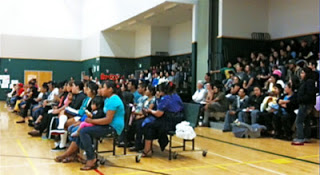
Our undergraduates also met elementary bilingual school staff who were concerned with issues central to the immigrant community. For example, school advocates, educators and immigration lawyers from Seattle organized a community workshop regarding “The Dream Act” and immigration policy in the run-up to the 2012 presidential election. Respectful of the families and their children’s needs, the workshop was presented and translated into three languages, Spanish, English and a Mayan dialect, Mam. At least 100 family and community members were in attendance at the elementary school. The undergraduates later recognized the importance of these collective educational efforts to support the concerns of the larger community.

Scratched Surfaces—Struggles at the Secondary Level
In contrast, our observations at the secondary school differed significantly from those at the elementary level. Gaining entrée into the predominately English-only, Salish High School was particularly challenging. Teachers explained they were too busy to accommodate our weekly visits. For those undergraduates who were able to observe ELL classrooms, they noted a predominant use of worksheets, homework assignments from other classes, with little culturally relevant content available to them. The teens often chatted amongst themselves, which later called into question the rigor of instruction they received. As our undergraduates collected data, it became apparent there were a number of variables that impacted ELL academic achievement in grades 8-12.

Figure 1.“The Dream Act” Community Information Meeting at Salish Elementary.

Figure 1.“The Dream Act” Community Information Meeting at Salish Elementary.

The college students noted how the popular media depicts minority students being saved by “supermen or women” who romantically buck the system in private or charter schools. And yet, our students reported in their interviews with faculty that they felt demoralized by the pressures they faced, such as the emphasis on standardized testing and the lack of resources. It was clear that the secondary ELL teachers had few opportunities for professional development and collaboration. Faculty isolation resulted in collateral damage where the teachers internalized these pressures, adopted low expectations, and essentialized ELLs as illiterate and incapable of any deep cognitive understanding. It was apparent to the Evergreen students that such cultural deficit thinking did little to help empower the high school students.

Our undergraduates also observed some educators who resisted external support, such as the tutoring or mentoring, fearing this would take time away from standardized test preparation. The introduction of culturally relevant pedagogy or dual language activities was rejected at the secondary level. Ironically, these were the same practices that proved to be successful at Salish’s dual language elementary school.

While secondary teachers emphasized content area instruction, our undergrads noted that the curriculum did not motivate ELLs. A common philosophical stance taken by educational administrators emphasized colorblindness. They were not interested in program models that affirmed diversity, such as through dual language classes, or the creation of supervised spaces for youth to develop a sense of belonging (Gándara, 2010; Slavin & Cheung, 2005).

Such initiatives were perceived to agitate students rather than empower them to critically think for themselves. When Evergreen students asked to take part in organizing a Latina/o cultural club, educators initially questioned why was there a need for such an organization? An administrator asked, “We don’t want to segregate students. Why couldn’t we have one big group that can get along?” At yet, it was at this time that our undergraduates dug in their heels, and became even more committed to attending after school mentoring sessions.

Over the course of a month, we saw the high school Latina/o Culture Club (a term generated and agreed upon by the youth) meetings increase from three students to five students, to 11 students, and to 15 students. Interestingly, some of the students who attended the club planning meetings were Euro-American youth who hold long-term cross-cultural friendships with their Latina/o peers. It was these same students who met while attending Salish’s dual language elementary school many years ago. A sense of school attachment and sense of belonging established through the extracurricular club seemed to lift student engagement. In fact, the teens were amazed to learn that our undergraduates attended a collage that was only 15-20 minutes away.

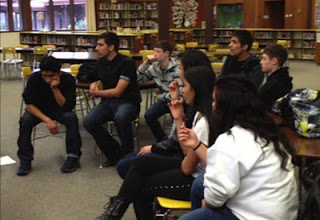
Figure 2. High school Latina/o Culture Club members enjoy some dulce while recollecting their days in a dual language elementary school.

Figure 2. High school Latina/o Culture Club members enjoy some dulce while recollecting their days in a dual language elementary school.

Meanwhile, without school funding, the club struggled to identify an adviser. As a result, the official status of the club remains uncertain. However, one science teacher visited a club meeting. She was visibly surprised to see sophomores, juniors, and seniors working side by side with college students, as they created art projects about their cultural backgrounds. One teen described how the club, with new friendships with the college students, shared laughter, conversation, and music and brought, “Relief from the stress of the day.”

Not a Panacea, But a Start
While our Evergreen students will continue to take part in the Latina/o club, as well as tutor in the dual language elementary school throughout the 2013 academic year, these initiatives alone are not a panacea for closing the achievement gap. But what we can say is there is a yearning, a need for connection to one another, to family, to culture. It is this lack of connection between communities and the institutional structures and practices of schooling which cause students to disengage from a system that often marginalizes them. The nurturing, affirming cultural practices evident in elementary settings are mostly absent from such as Salish High, whose families barely fit into the town’s history, culture, and fragmented economy.

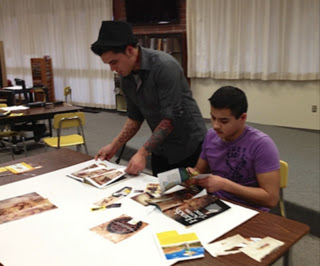
Figure 3. Salish High School student works on his culture poster board with an undergraduate mentor from The Evergreen State College.

Figure 3. Salish High School student works on his culture poster board with an undergraduate mentor from The Evergreen State College.

It can be said through our initial fieldwork in the Salish schools that standardized tests scores just scratch the surface when addressing the educational inequities Latina/o students face. Similar outcomes are evident among secondary Latino/a students and ELLs nationwide as they experience inequitable access to core and advanced placement curriculum (Huerta, 2009). These students remain essentially parked in low-level classes, where a scripted and irrelevant curriculum are taught by a teacher workforce with low morale, with no opportunity for ongoing professional development and collaboration (Fry, 2004). Traditional high school program models, leaves little hope for disrupting the patterns of low academic achievement, graduation rates and college attendance among Latina/o students.

That said, our research does show how we can make some strides. When our undergraduates talked to Latina/o teenagers, they found that the youth wanted dual language instruction in their schools beyond the elementary level. The teens wanted a club to study culture and to learn about college. They were interested in the politics of “The Dream Act” and the possibilities for new immigration policies.

But space must be made within the community and schools for such engagement to take place. While the Salish community has taken steps in this direction, a systemic K-12 effort to disrupt what is not working in the public schools must be confronted. Collaboration with local advocates and mentors remains an approach that offers support to schools uncertain how to meet the needs of diverse communities such as Salish.

References

Brown-Jeffy, S. and Cooper, J. (2011). “Toward A Conceptual Framework of Culturally Relevant Pedagogy: An Overview of The Conceptual and Theoretical Literature.” Teacher Education Quarterly, Winter, 65-84.

Fry, R. (2004). Latino Youth Finishing College: The Role of Selective Pathways. Washington, DC: Pew Hispanic Center. Available: http://pewhispanic.org/reports/report.php?ReportID=30

Gándara P. (2010). “The Latino Education Crisis.” Educational Leadership, 67, (5), 24-30.

Huerta, G. (2009). Educational Foundations: Diverse Histories, Diverse Perspectives. Kentucky: Wadsworth.

National Assessment of Educational Progress. (2013). Mega-States: An Analysis of Student Performance in the Five Most Heavily Populated States in the Nation.Washington D.C.: National Center for Educational Statistics, U.S. Dept. of Education.

Slavin, R. and Cheung, A. (2005). “A Synthesis of Research on Language of Reading Instruction for English Language Learners.” Review of Educational Research, 75, 247–284.

Dr. Grace Huerta is a faculty member at The Evergreen State College in Olympia, WA. Previously, she was an Associate Professor at Utah State University. She earned her Ph.D. in Educational Leadership and Policy Studies from Arizona State University and completed her undergraduate work at the University of Southern California. Her areas of research include multicultural education, qualitative research methodology and secondary ESL/bilingual education. She is the author of the book Educational Foundations; Diverse Histories, Diverse Perspectives.

Comment(s):

Caty Escobar    April 6, 2013 at 6:54 PM

Great post! This really made me reflect on my own experiences in school and how I saw my community collaborate. I grew up in Maryland and in my elementary school there was a large Latino population. My mother felt very involved in my school life because there were interpreters available on-site, at PTA meetings, and during parent-teacher conferences. At times, the school would put together programs that targeted Latino families so that teachers could better understand their students’ family life and culture. I too had many resources available in elementary school that eventually vanished when I entered middle school and high school. My perspective on this poor transition is that because educators believe that a child’s early school years are the most important for development, more support should be provided during these years. Also, because there are less educators and counselors of an ethnic background in schools students’ opinions and voices are not heard. I believe change should occur within the educational system first to encourage multicultural discipline, bilingual education, and cultural services to students and parents. Your research shows that change is difficult when teachers are reluctant to cooperate and when resources are low. What these undergraduate students have done thus far is phenomenal and proof that mentoring is also needed in schools.

Learning from Mexican and Native Women

August 20, 2012

Photo Credit: Pepe Rivera. Taken June 26, 2011. From Flickr.

Photo Credit: Pepe Rivera. Taken June 26, 2011. From Flickr.

By Theresa Delgadillo

Yesterday, as I continued my work on translating an oral history interview from Spanish into English, I was struck by something that this particular participant in the project said – as I often am in this work. I’ve had the honor of interviewing some very wise and determined Latinas in the project that I began in 2008 to collect the oral histories of Latina leaders in Milwaukee, Wisconsin. These are some very interesting women! Fortunately, I am near the end of the editing and looking forward to sending it off the publisher soon. To get back to my point: my interviewee, commenting on the social customs of Mexico and the U.S., says at one point, “There it is the same as here, exactly the same as here. The only difference is that there is still a fiction that in Mexico it’s different.” She was talking about the acceptability of divorce, but it resonated with me on other levels, such as the changes in daily life, work and environment, partially because there was some interesting news from Mexico recently in the The New York Times about a group of indigenous women in Cherán, Michoacoán, who mobilized against armed illegal loggers and are now defending their town from violence and their forest from deforestation. To readers of Latina/o literatures, or literature about migration, the name Cherán might be familiar, since it was one of the sites of migration to the U.S. portrayed in Ruben Martinez’s Crossing Over: A Mexican Family on the Migrant Trail(2001). The August 2, 2012 article by Karla Zabludovsky titled “Reclaiming the Forests and the Right to Feel Safe,” describes the events in Cherán and the women’s actions as “extraordinary” as it details their effectiveness. Motivated in part by the loss of the beautiful forest that was once their patrimony, a loss that must be visible to them on a daily basis, the women see themselves acting not only for themselves but for future generations. When I read it, I wondered, and not for the first time, if Luis Urrea’s novelInto the Beautiful North (2009) hadn’t come to life – because this is not the first instance in recent years of Mexican women taking the lead to end violence and environmental destruction. Meanwhile, New York State is set to join the ranks of states allowing fracking. In an August 19, 2012 CBS News Report, “New York State to Allow Fracking,” Jeff Glor’s article notes that the process of fracking releases dangerous contaminants that have high potential to endanger air and water supplies, yet quotes local farmers who need the money. The women of Cherán, Michoacán, also need money to live and they are supported in part, according to the article, by remittances from residents who have migrated to the U.S., yet it seems they are living in the aftermath of a disastrous environmental decision and working to make it right. Like the people of Cherán, Michoacán, Mexico, we face some very difficult decisions in these energy-gobbling times, and we might consider what we can productively learn through a comparative perspective that doesn’t consign indigenous women to a lost past, but instead examines the experience of both residents and migrants from particular regions about what doesn’t work – because as my interviewee says: “There it is the same as here, exactly the same as here. The only difference is that there is still a fiction that in Mexico it’s different.”

Theresa Delgadillo is on the faculty at Ohio State University.

  1. María Antonietta Berriozábal  August 20, 2012 at 4:27 PM

    Dear Theresa:

    I find your work fascinating. I am a lover of oral history. Next month my book, María, Daughter of Immigrants, will be published. The first chapters include the stories that my parents told me as a child. With just their stories – no genealogical searches for me – I was able to share the story of my great grand mother and grandparents going back one hundred years. That is rather astounding. To think that these women can share a story, you chronicle them and one hundred years from now someone will be sharing them.

    Another reason for my interest in your work is that in 1995 I attended the Fourth World Conference on Women in China as a member of the US delegation. During the conference I met with women from Central America and some from Peru. Some could not even speak Spanish. They spoke their native dialects, but they had leaders who had learned Spanish and they were our interpreters. One of the reasons they had gone to the Beigjing conference, through great sacrifice, was to tell their stories of how their ancestral lands were being taken by businesses. It is the same story that continues to this day of multi-national corporations raping the environment in other countries so they can provide goods and food for the developed countries like the US and others. But the women were fighting; they were organizing and using their voices. I found it interesting that the leaders of the movements, at least of the ones I met, were mujeres. They wore their colorful clothing almost as the shield of warriors.

    In any event, I appreciate what you are doing very much.

    Sincerely,

    María Antonietta Berriozábal
    San Antonio, Texas

  2. Theresa (Mujeres Talk Co-Moderator)  August 20, 2012 at 6:14 PM

    Dear María Antonietta,

    I am looking forward to reading the preview of your book that appeared in Frontiers, and to your new book. Please send us an announcement for it as soon as it appears. My project was motivated, too, by the desire to record and share the life stories of Latinas whose experiences don’t appear elsewhere.

    Research in the U.S. has shown that indigenous migrants to the U.S. from Latin America often face difficulties precisely because of the language assumptions that you noted in your experience. Despite language differences, we are all struggling with the same difficult questions about how we use our natural resources.

    Thank you so much for your comments and encouragement, and thank you for sharing your work.

    Take care, Theresa

  3. Lourdes Alberto  August 28, 2012 at 8:31 PM

    In reading this post I am reminded that indigenous people think of themselves as planetary citizens–they fight for their people, their cultures, their history, but also all of our well-being and that of future generations.
    As an indigenous person myself (Oaxaqueña), I struggle with my own part in the depletion of the Earth’s natural resources.
    You know, three seasons ago I started growing a garden with the goal of eventually meeting all of my family’s summertime food needs. It was so fulfilling, so liberating, so unexpected. I know now that my challenge is to remember and live the knowledge my grandparents left me about the land, about plants and about the importance of well-being. As you mentioned, there are tens of thousands of indigenous people from Latin America in CA. Growing up we had an informal plant co-op/exchange. Someone would manage to bring over a plant, flower, hierba, from Oaxaca and we would literally share cuttings–yerba santa, varieties of avocado, ruda. It was amazing! A kind of urban indigenous transnational environmentalism!

  4. Theresa (Mujeres Talk Co-Moderator)  September 3, 2012 at 5:25 AM

    Dear Lourdes,

    It’s good to hear from those that grow gardens for sustainability, and I appreciate the work you’ve put into this important task for three seasons, which, as you say, is a combination of memory work, and living a connection to others and growing food. Thank you for your beautiful note!

    Take care, Theresa

Latino/a in Spain?

July 10, 2012

By Theresa Delgadillo

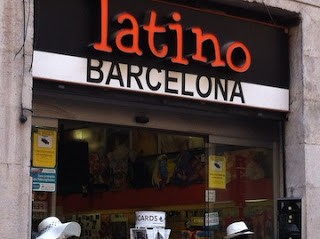
Storefront, July 2012. Photo Credit: Theresa Delgadillo

Storefront, July 2012. Photo Credit: Theresa Delgadillo

In Barcelona, Spain, while speaking with friends over lunch at a communal picnic table – switching from Spanish to English and back again – I heard the woman in the family sitting next to us say, in a whispered voice, “son Latinos.” She was referring to us, of course, answering what seemed to be a confused query from her partner about who or what we were. The term “Latino” has most definitely taken hold here to describe Latin American immigrants and their children, and it seems that just as in the U.S. it reflects a growing demographic that is welcomed by many and feared by some. 

Both Madrid and Barcelona have significant Latino/a populations and neighborhoods which have begun to appear in contemporary Spanish visual culture. The recent, very popular telenovela in the U.S. La Reina del Sur seems to acknowledge the issue of Mexican migration to Spain in the story of its protagonist Teresa, who flees drug violence in Mexico only to become an international drug smuggler herself in Spain. Latinos/as in Spain come from many different Latin American countries and some do have ties to U.S. Latinos/as, making the Latino/a connection global. As my colleague Dr. Miroslava Chávez-Garcia notes, the globalization of Latinos/as has its down side: Latinos/as and gangs are often linked in the popular discourse of both the U.S. and Spain. However, Spanish scholars Dr. and Prof. Carme Panchón Iglesias and Prof. Isaac Ravetllat Ballesté of the University of Barcelona suggest that Barcelona and Catalonia’s unique history and experience as a bilingual, bicultural people suggests that it may be well-equipped to create from these demographic and cultural shifts a society where difference is valued, where culture and language is shared rather than imposed, a society where inclusion and integration rather than assimilation predominates. If Catalonia is a particularly apt place for enacting that vision, let’s hope it spreads far beyond the borders of this region.

For many years, I have employed the pan-ethnic label “Latino” or “Latina” to refer to citizens of the U.S. who are Mexican American, Puerto Rican or of Latin American background. The term also generally refers to permanent residents of the U.S. from Latin American backgrounds, though individuals in this latter group often retain their identities as Latin Americans and prefer to be known as Latin Americans rather than Latinos/as, making it important to distinguish between Latin American and Latinos/as. My understanding has been the same as that of Marcelo Suarez-Orozco and Mariela Paez, who suggest in Latinos Remaking America that Latinos are “made in the U.S.A.” However, “Latino/a” is no longer only a U.S. identity, as this recent experience revealed to me.

What research or leisure travel are you doing this summer? What is the Latino/a experience you have or are encountering in your travels? How are Latin@s seen and understood where you are?

Theresa Delgadillo is on the faculty of Ohio State University and is a Co-Moderator of Mujeres Talk.