
Category Archives: Health and Wellness

Understanding Diabetes to Help Yourself, Your Family Members, Your Friends . . .

October 22, 2012

Amelia María de la Luz Montes

Amelia María de la Luz Montes

By Amelia María de la Luz Montes
(ameliamontes.com)

Diabetes is different from other diseases. Once you have it, you have it for life. There is no remission. Your pancreas will remain either completely non-working (type 1) or forever debilitated (type II). With diabetes, if you want to live a long life with a balanced glucose level, it is primarily up to you to completely change your eating and exercise habits (even with medication). Unlike cancer which most often concerns medical doctors locating and excising a tumor, followed by chemotherapy and/or other medications, the burden of controlling blood sugars rests upon the individual, not in excising the pancreas or getting a new one. An individual with diabetes could be taking medication like metformin, a well-known drug that has been on the market a long time and has had a good record in assisting the body to control sugar or glucose levels, but that is not enough. Notice that I wrote “assisting” because, again, the burden falls upon the individual. You can take all the drugs you want, but without a diet you create yourself that fits your chemical makeup, and without a good exercise regimen—complications from diabetes will appear (retinopathy, nephropathy, neuropathy).

And that is why doctors become so very frustrated with patients.  “I tell them until I’m blue in the face,” a doctor once told me.  “I tell them that it’s up to them.  They have to control their glucose levels.  A pill is not the answer.  Most people are not willing to make any changes until it’s too late—until they can’t walk, they go blind, they go on dialysis.”

I’ve thought about what this doctor and others have similarly said. And in reading so much about this disease, I’ve also understood another aspect to the patient’s inabilities to change.

First:  It’s very hard to come home after a diagnosis and be told to completely change your diet. To what? How does one know? Insurance companies often will not include “Diabetes Education” for patients until they are actually diagnosed with the disease. For those who are diagnosed as “Pre-Diabetic” (meaning that there is evidence of high glucose levels but not quite high enough for the diabetes diagnosis), there is no education. This should be the exact time when much of the education should take place. Or, if it is apparent that the disease is a genetic factor in an individual’s family history, that individual should have the opportunity to enroll in diabetes education even if she/he may never manifest the disease—at least they are more equipped to understand themselves and help other family members or friends who have it.

Second:  Michael Montoya’s book, Making the Mexican Diabetic (2011) is a must-read for all of us because he points out how Chicano and Chicana/Latina and Latino communities can so easily become areas with high rates of diabetes. For familias with a tight income, it’s hard to think about buying expensive organic food and taking the time to cook it when McDonalds offers a sausage burrito for $1.00 and when you are tired from working two jobs—who wants to cook?  And if you’re tired from work, the last thing you want to think about is exercise. Or if the doctor tells you to at least walk your neighborhood for a half hour every day, you may live in a neighborhood where that would not be a safe thing to do. I agree with Dr. Montoya that as long as we have the fast food companies setting up shop everywhere, as long as towns and cities do not offer safe public areas (parks!) with activities to join (swimming, running clubs, yoga, kick ball, sports for youngsters and adults), it’s going to be very difficult to lower the rate of diabetes in our population.

Third:  A key component to understanding your body is to test your blood and if you are on a very tight budget, this can be difficult. The glucose test monitor is often available for “free” (once you’re diagnosed). But the problem here concerns the test strips, which are expensive. Just yesterday, I bought (with my prescription) my supply of test strips. There are 100 in two vials. With insurance: $62. Without insurance: $124.

If you do not have diabetes (but you know it runs in your family and you’d like to start monitoring your blood so you will prevent the disease) or if you have been told you have “Pre-Diabetes”—you will have to shell out the $124. Something needs to happen so that the cost of test strips can be more affordable making it possible for people to purchase. I’m not sure what the answer is yet regarding the cost of test strips.

Why testing is so important: Without testing, you have no idea what your body is doing. You could feel just fine and your body may be riding on high levels of glucose and the longer you have such high levels running throughout your bloodstream, the quicker you will damage various organs in the body. It will only take a few months before the damage manifests itself in a variety of ways (neuropathy, retinopathy, nephropathy).

Fourth:  Trying meditation or learning strategies to cope in stressful situations is also key but difficult. Studies show that testing one’s blood regularly and keeping it balanced plus learning coping strategies is important in lowering glucose levels. Why? Keeping a normal blood pressure level prevents inflammation and inflammation will then also cause high glucose levels in your body which then also damages organs. And that is another aspect to this disease:  it’s not only about the food you eat, it’s also about how much stress there is in your life. Something as small as a simple cold cause glucose levels to rise. Illness, trauma, stress, major disappointments in life: all cause glucose levels to rise.

The U.S. can boast about all of us being hard-working people who produce more in a year than neighboring countries around the world. And we do. However, a study showed that even though we produce more, we also make more mistakes (because we are overworked) and therefore spend millions having to correct those mistakes. We also spend millions on emergency hospital visits and doctor’s visits.  The first year of my diagnosis, I ended up in the emergency room three times and even with insurance, my out-of-pocket expenditure to medical issues were quite high.

What to do? Some tips:

1. There are foods that do not have such a high residual pesticide load and are very affordable (non-organic).  These are:

a.     broccoli
b.     cabbage
c.     asparagus
d.     cauliflower
e.     avocado
f.      brussel sprouts
g.     garlic
h.     bananas
i.      zucchini

2. A QUICK RECIPE:  I have found “mashed cauliflower” a most delicious substitute for mashed potatoes. Potatoes are not good for all individuals with diabetes. The high starch content will affect most people (and that includes rice as well—brown or white). Directions:

a.  cut up the cauliflower
b.  steam
c.  mash it up (either in a food processor or with a potato masher)
d.  add spices if you wish

Mashed cauliflower is easily frozen so you can make a lot of it, freeze it, and then you don’t have to keep taking the time to cook it each time you want some.

3. During that first year of diagnosis, what really helped me was figuring out how many carbohydrates are in foods. There is a little book which I call the “carb helper.” It’s title is: The Calorie King: Calorie, Fat, and Carbohydrate Counter 2012. It is revised every year or so and it’s vital for those of us with diabetes. You’ll be surprised what foods are high in carbohydrates (glucose) and what foods are not.   Those who are unfamiliar with diabetes may think that it’s just about staying away from desserts or sugary drinks. Onion and carrots have a lot of sugar, but I did not know this until I began studying carbohydrate counts. One carrot is like a spoonful of sugar. Who knew? And onions: why do onions carmelize?  Because they have a high glucose level. Since finding this out, I now cook with shallots instead of onions and it’s just as delicious.

4.  For exercise:  If you cannot afford a gym or cannot exercise outside, walk around your house (inside) for twenty minutes to a half hour, or climb stairs (if stairs are at your work, take time to walk up and down during half your lunch hour) if there are stairs at or near home or at work.  Purchase a new/used bike if you can afford it.

Discoveries:

The most important aspect I have discovered in researching this disease is understanding how each individual (chemically) is so vastly different. Two people with diabetes may react very differently when they eat, say, a banana.  I know someone with Type II Diabetes who enjoys eating a banana every day and their glucose levels do not spike. I cannot eat a banana—not even a bite because then my glucose levels spike. The one thing to understand about diabetes is that the journey to balance glucose levels demands a journey into keenly understanding your body. Our bodies are like fingerprints. Our chemical and genetic makeup is so fascinatingly individual. And it takes commitment to want to do this.  But it can be done!

Amelia María de la Luz Montes, Ph.D. is an Associate Professor of English and Ethnic Studies at the University of Nebraska, where she also serves as Chair of the Institute for Ethnic Studies. She frequently blogs about diabetes and health issues.

Comment(s):

  1. Dawn Valadez  October 22, 2012 at 2:36 PM

    Thanks so much for posting this! Latinas, especially Mexican American women, have such high rates of diabetes – it is like an epidemic in our community. However, with your guidelines all is not lost. I disagree that it is with you forever though – with a healthy diet and lots of exercise people are able to get off of medicine and live a healthy diabetes-free life. You still have to be vigilant, but shouldn’t we all be anyways? I get concerned when I hear it’s “with you forever” because for some of us with food issues that feels like “why bother” when in fact we can do a lot to stop it in it’s tracks! and even if we need meds we can live healthy lives. My mom has had diabetes for 30 years, she’s in her 80’s and is still walking y qué fregosa! She lives with me and we work together to have a healthy diet and walk daily.

    I agree about the financial and convenience issues but some ways we can help each other is to grow our own food and share it! Or go to the farmer’s market together and buy in bulk, most farmer’s markets take food stamps now which is very helpful for people receiving those benefits. Starting a walking group helps too.

    Anyways, thanks for the post and here’s some more helpful info:
    http://www.diabetesselfmanagement.com/Blog/David-Spero/can-type-2-diabetes-be-reversed/

    Dawn Valadez

  2. Amelia ML Montes October 24, 2012 at 8:43 AM
    Dear Dawn,
    Thank you so much for your “reply.” I am so happy to read that your mom is in her 80s and has been self-managing the disease with a healthy diet and walking. This is key to keeping one’s glucose numbers low so that complications do not occur.And thanks for addressing the topic about “reversing Diabetes.” It’s important to discuss this further. When one is diagnosed with Diabetes (Type II), it means that one’s pancreas is debilitated. It is not able to emit enough cells that can collect glucose from the bloodstream. Some of the cells are malformed. With Type I– the pancreas is not working at all and the individual must be on daily insulin. But with Type I, diet and exercise is still key. With Type II– I think the miscommunication here is about being able to self-manage instead of a life of pills and insulin and becoming progressively worse.So I want to be clear here: what I mean by having if “forever” is that those with Diabetes Type II will always have a debilitated pancreas– always. It’s about what you do with your debilitated pancreas that is the key. If you do nothing, you will obviously get progressively worse. Pills and insulin help but again– with only pills and insulin, you will also get progressively worse.Self-managing your pancreas with diet and exercise (as David Spero points out) can have such great effects that a person may not need insulin, meformin, and other Diabetes medication.I am like Bob and Terri who are on very low carbohydrate diets and exercise daily. They were quoted in the article as feeling healthier than they’ve ever felt before and that their A1C levels are below normal which is GREAT because that will definitely prevent complications.But what will always “forever” be the issue is the pancreas not being able to do the work necessary without the individual helping the pancreas with diet and exercise.

    Here’s why diet and exercise is so key:
    First: a low carbohydrate diet keeps the amount of glucose in the blood stream minimal so that the pancreas’ low production of cells will not be overtaxed.
    Second: Exercise is so important because exercise “stimulates” the pancreas to emit more cells than a normal person would need. And since a debilitated pancreas is creating some normal cells and some misshapen cells, having more cells than one needs will definitely take the glucose out of the bloodstream.

    So– low carb diet (making sure you aren’t filling up your bloodstream with glucose) and exercise (stimulating the pancreas to make more cells to take out the glucose) will certainly lower glucose levels and prevent complications.

    One does not die of Diabetes. You die from complications of the disease. And when they say “disease”–they’re talking about the debilitated pancreas.

    So this is why I say “forever”–I’m talking about the pancreas. And this is why I do not agree with anyone who thinks that they can reverse a debilitated pancreas.

    What they CAN PREVENT is getting progressively worse and having complications. So I think it is a matter of semantics. But I worry that people think they can suddenly be Diabetes free. I think the better term is that they are “successfully self-managing the disease” and that is certainly what your mom is doing!

    Hope my further explanation helps.
    And yes–so important to help each other, go to farmer’s markets, have a walking group. I lead a Diabetes Support Book Group at an Independent Bookstore in town and this has been very helpful. I love the idea of a walking group too!

    Sending you and your mom my best wishes, Dawn!

  3. Anonymous  October 22, 2012 at 4:04 PM
    I am a Registered Dietitan in Tx. I have seen many patients w/ DM & understand your experience. It is a great article. My one disagreement is w/ Promoting organic foods to be healthy. Yes, they are a “better” choice if possible, but for so many it’s just not an option. Just adds stress to an already stressful situation.
    Recommend Fresh or Frozen, as avail.
    Thank you for sharing your experience.
  4. Amelia ML Montes October 24, 2012 at 8:08 AM
    Saludos Dawn,
    Thanks so much for your response to my blog. It is indeed an epidemic in our community and I am hoping with more education, we can help each other. I agree with you that with a healthy diet and daily (and I mean daily!) exercise, people can self-manage the disease. And this is what I mean by having diabetes for the rest of your life: the pancreas will never be a normal pancreas if you have this disease. Being off medication only means that you are self-managing the pancreas/the disease. And this is where it can get dangerous if people think that once they are off insulin or medicine, that they no longer have diabetes. The pancreas has not changed. It is still debilitated. I think the better term is that the individual is able to “self-manage” the disease with diet and exercise.As for reversing Diabetes: Once the pancreas is debilitated, it cannot be “reversed.” I think the word choice is the problem here and in Spero’s article he explains it better. He is talking about doctors who tell patients that they will only get progressively worse. And, like Spero, I disagree with that kind of doom and gloom projection. You will only get progressively worse if you do not do anything about it– but it’s up to you. And that is the key to self-managing: it’s all up to you.
    Like Bob (who was quoted in the article), I am on a very low-carb diet and do daily exercise (as my endocrinologist advised) and my A1C level is now lower than what is considered normal. And like Terri (who was also quoted in the article) I also am “far healthier” and feel it is easy now to maintain my glucose numbers. But in the beginning, I knew, when I was diagnosed, that this was going to be a life-long process. It’s important to face the truth. Now I no longer am afraid about this truth. After you get used to self-managing via diet and exercise, it does get easier– but in the beginning it demands a lot of changes in your life.I am so very glad that your mom is doing well and in her 80s. Bravo on the walking– that is key!And yes– growing our own food, farmer’s markets, helping each other– so very important!I’m so glad you wrote in!
    Thank you Dawn. Mil gracias!
    Sending you and your mom healthy energias!
 

Decolonize Your Diet!

September 10, 2012

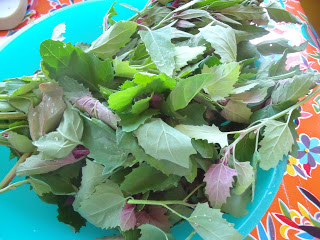
Quelites Harvest

Quelites Harvest

By Luz Calvo and Catriona R. Esquibel

We have a passion for Mexican food. We have a passion for gardens, for healthy food, for food justice, and for people of color reclaiming our histories. All of this has led us to our current project, Decolonize Your Diet. This is a project to reclaim the heritage foods of greater Mexico and Central America as a way improving the physical, emotional, and spiritual health of US Latinos/as.

SOME BACKGROUND

In the US, a person’s health is almost pre-determined by their socio-economic status. For the most part, upper and middle class people, who have access to health care, higher education, healthy foods, and safe spaces to exercise, have significantly better health than poor folks who lack health insurance, education, access to grocery stores, and who live in poor and often dangerous neighborhoods. Public health scholars evaluate the health of demographic groups by looking at mortality, infant mortality, obesity, heart disease, high blood pressure, diabetes, and cancer rates. Poor people have worse health on all these measures. This is not surprising: Social inequality affects people’s health and lifespan.

However, there is one notable exception to the equation of poverty = poor health—public health scholars have found that recent immigrants from Mexico have very low rates of mortality, infant mortality, and illness compared to other groups. Public health scholars have dubbed this phenomenon “The Latino/a Paradox.”(1) Recent Latino/a immigrants, mainly from Mexico and Central America, have better health than Latinos and Latinas who were born in the US. The health of recent immigrants rivals the health of the [w]healthiest Americans! This fact is somewhat astounding given that Latino/a immigrants face so many challenges: in general, Latino/a immigrants arrive to this country with very few economic resources. They don’t have access to preventative health care and are often afraid to seek care when they are sick. They work in difficult and dangerous jobs and they are under extremely high levels of social, spiritual, and economic stress. One would expect their health to suffer under these circumstances.

Public health scholars have not been able to explain Latino/a immigrants’ health; but there is significant evidence supporting the health benefits of traditional diets of Mexico and Central America. We believe that these food traditions protect Latino/a immigrants from disease, including diabetes, heart disease, obesity, and some cancers. Unfortunately, the health of immigrants declines over time. The longer immigrants stay in the US and the more they assimilate into US culture, the worse their health becomes. By the second generation, Latinos/as face the same issues as other poor folks in the US, with skyrocketing rates of diabetes, obesity, and heart disease. Cancer rates also start to increase.

DECOLONIZE YOUR DIET

We feel it is imperative that Chicano/a Studies engage food justice in research and teaching. We call to our comrades, colleagues, and students to look at their personal food choices as political acts. Resist cultural imperialism by reclaiming ancestral foods. Honor our ancestors and their wisdom by learning how to cook beans, make corn tortillas, and grow food.  Above all, share your knowledge!

The following chart outlines some of the differences between what we think is a Colonized Standard American Diet (¡Qué SAD!) and a decolonized approach:

WESTERN DIET
DECOLONIZED DIET
Advertising and Fads
Ancestral Knowledge/Oral Tradition
Hybrid Seeds and GMO
Heritage Seeds and Seed Saving
White Supremacy
Respect for Mexican and Indigenous Knowledge and Traditions
White sugar, White flour, White rice
Brown is Beautiful: Honey, Whole Wheat, Brown Rice
Assimilation, Submission, Capitulation
Resistance, Resilience
No connection to the land. Reliance on Chain Grocery Stores.
Community Gardens, Guerilla Gardening, Urban Farming,
Boredom
Creativity
Conspicuous consumption
Simple, accessible food
Disavowal, Thoughtlessness
Intentions, Blessings and Ceremony
Processed Foods
Real, whole food
Anti-union/anti-immigrant
Fair labor practices, Worker cooperatives
Pesticides and Monoculture
Permaculture and Biodiversity
Pharmaceutical industry
La Comida es Medicina, Herbal remedies
Wasteful
Resourceful

As part of our project, we are collecting and sharing knowledge and recipes. We are inspired by Native food activists like Winona LaDuke (2,3,4), Devon Abbott Mihesuah (5) and the Tohono O’odham Nation (6). We’re very excited by the significant health benefits to be gained from eating cooked dried beans (7,8,9), nopales (10,11), chia (10), quelites (12), and verdolagas (13, 14, 15).

JOIN US AND LEARN MORE!

We invite you to join us in the reclamation of Mexican heritage foods: join “Luz’s Decolonial Cooking Club” on Facebook or follow our blog at decolonizeyourdiet.blogspot.com

CITATIONS
  1. Viruell-Fuentes, Edna A. 2007. Beyond acculturation: immigration, discrimination, and health research among Mexicans in the United States. Social science & medicine (1982) 65 (7): 1524–35.
  2. LaDuke, Winona. 1999. All Our Relations: Native Struggles for Land and Life. Cambridge, MA; Minneapolis, MN: South End Press; Honor the Earth.
  3. LaDuke, Winona. 2005. Recovering the Sacred: The Power of Naming and Claiming. Cambridge, MA: South End Press.
  4. LaDuke, Winona, and Sarah Alexander. n.d. Food is Medicine: Recovering Traditional Foods to Heal the People. Honor the Earth/White Earth Land Recovery Project.
  5. Mihesuah, Devon Abbot. 2005. Recovering Our Ancestor’s Gardens: Indigenous Recipes and Guide to Diet and Fitness. University of Nebraska Press.
  6. Tohono O’odham Community Action with Mary Pagnelli Votto and Frances Manuel. 2010. From I’Itoi’s Garden: Tohono O’Odham Food Traditions.Blurb.com.
  7. Reynoso, Camacho, R. 2007. El consumo de frijol común (Phaseolus vulgaris L.) y su efecto sobre el cáncer de colon en ratas Sprague-Dawley. Agricultura técnica en México 33 (1): 43–52.
  8. Guevara, Lara, F. 2006. Phenolics, Flavonoids and Other Nutraceuticals in Mexican Wild Common Beans {(Phaseolus} Vulgaris).
  9. Serrano, José, and Isabel Goñi. 2004. [Role of black bean Phaseolus vulgaris on the nutritional status of Guatemalan population]. Archivos latinoamericanos de nutrición 54 (1): 36–44.
  10. Guevara-Cruz, Martha et al. 2012. A dietary pattern including nopal, chia seed, soy protein, and oat reduces serum triglycerides and glucose intolerance in patients with metabolic syndrome. The Journal of nutrition 142 (1): 64–69.
  11. Gutierrez, Miguel Angel. 1998. Medicinal Use of the Latin Food Staple Nopales: The Prickly Pear Cactus. Nutrition Bytes 4
  12. Barakat, Lamiaa A A, and Rasha Hamed Mahmoud. 2011. The antiatherogenic, renal protective and immunomodulatory effects of purslane, pumpkin and flax seeds on hypercholesterolemic rats. North American journal of medical sciences3 (9): 411–17.
  13. Huang, Yun, and Lei Dong. 2011. Protective effect of purslane in a rat model of ulcerative colitis. Zhongguo Zhong yao za zhi = Zhongguo zhongyao zazhi = China journal of Chinese materia medica 36 (19): 2727–30.
  14. Huang, Zhiliang, et al. 2009. Total phenolics and antioxidant capacity of indigenous vegetables in the southeast United States: Alabama Collaboration for Cardiovascular Equality Project. International journal of food sciences and nutrition 60 (2): 100–08.
  15. Shobeiri, S F, et al. 2009. Portulaca oleracea L. in the treatment of patients with abnormal uterine bleeding: a pilot clinical trial. Phytotherapy research: {PTR} 23 (10): 1411–14.

Luz Calvo is an associate professor of Ethnic Studies at Cal State East Bay.  After their breast cancer diagnosis in 2006, Calvo became interested in food justice activism.

Catriona R. Esquibel is an associate professor of Race and Resistance Studies at San Francisco State University. Esquibel started writing about ancestral foods after she and Calvo ate verdolagas at her father’s morada on Good Friday in Holman, New Mexico.

Comment(s):

  1. Elena Gutierrez  September 11, 2012 at 5:46 PM

    Verdolagas grow in the sidewalk cracks here in Chicago and I have more than once excavated and cooked them with friends. We get a few stares but they are so yummy and worth it! Thanks too for these references- not I can show my mom the “proof” that nopales really will help her diabetes. Excited to hear about your further works in this area.

  2. Theresa (Mujeres Talk Co-Moderator)  September 12, 2012 at 12:33 PM

    When my dad became diabetic i started looking into healthier traditional foods and yes, nopales are, indeed, good for diabetes! Luz and Catriona, thank you for sharing some of this exciting new work, and your emphasis not on the pricey and expensive and hard to find ingredients but on the readily available and traditional prepared in healthy ways. I am curious if anyone has done studies on the practices of keeping milpas that are mentioned in fiction that describes early and mid 20th century Chican@ life and health.

  3. Dianna Ching  November 21, 2012 at 5:06 PM

    I want to get rid of my tummy fats but I can’t deprive myself on foods so I never considered diet. But this one sounds so easy so I think I’ll give it a shot. Instead of having a liposculpture right away, why not try this. Thanks a lot!

Living Without a Car

May 10, 2012

By Theresa Delgadillo

I rode home the other day in the pouring rain, on my bicycle. A few drops fell as I left my office, a few more as I packed the bike and headed into traffic. The umbrellas were out, the windows on passing cars were all rolled up. Then the deluge hit. I stopped under the thick, spring-green leafy branches of a beautiful old tree by the law school to keep dry. From the pace of the clouds crossing the sky it would probably be about twenty or thirty minutes before it let up enough to get home fairly dry. The safest thing would have been to stay under the tree for a half hour … but I didn’t. As nearly everyone else – with the exception of other bikers and runners along the way – ducked for cover under awnings and bus shelters or hopped into cars, I headed into traffic and in short order was completely drenched. The other bikers mostly sped by – those with rain gear looked just so comfortable (I hadn’t packed mine that day). The runners seemed mostly okay in the rain, several laughed and waved, recognizing another intrepid spirit. Bystanders exclaimed and pointed as this completely empapada bicycle commuter passed by. I hadn’t expected to have a hard time keeping my eyes open, but I did – the rain was that hard and fierce.

It felt glorious. It was a moving massage. It inspired joy. If I go on, I will wind up romanticizing – or maybe I already have – a ride on a warm, spring, rainy day on which I welcomed a change in my daily routine. For the past eight months, my bicycle has been my primary mode of transportation. I actually sold my car in the fall – my way of making sure I didn’t backslide on this new adventure. That’s when I realized anew something I had, in fact, long known: in the U.S. only poor people and New Yorkers don’t have cars. I’ll tell you about the many ways I’ve re-learned this another time, but for now let me note that people look at me a little funny when they learn about my “transportation status.” Part of the surprise has to be about the gap between what people imagine a university professor makes and the lack of an automobile as a sign of lower income levels, but another part of it is surely about the difficulty most of us have imagining life without a car. A friend reports that in her neighborhood the parents have started a “bike ride with the kids to school in the morning pool” rather than the traditional car-pool. At a recent conference, I heard several people comment on how they’d like to live in a more ecologically sound way, but we just don’t provide the structures to allow it. I’ve found myself advocating for those structures more often and in more places now that I’m on the bike everyday, getting myself where I need to go on my own Chicana-power; getting a little bit of daily exercise; saving money on car payments, car maintenance, insurance and gas; not making the environment any worse. I highly recommend it. There’s great rain gear available for commuters so you don’t have to ride in the rain if you don’t want to … but I’ve re-discovered that it’s just rain.

Theresa Delgadillo is on the faculty at Ohio State University and is the Moderator of Mujeres Talk blog.

Comments:

  1. Ktrion  May 10, 2012 at 7:27 AM

    Love the image of you traveling under your own Chicana power!

  2. Danielle  January 20, 2013 at 8:55 PM

    I never owned a car and perhaps ten years down the road, I will eventually own one.

Thoughts on Limbaugh, Sex for Pleasure and Birth Control

March 26, 2012

By Ella Diaz

"Prevention" by brains the head

“Prevention” by brains the head

The recent radio blast by Rush Limbaugh regarding 3rd year law school student, Sandra Fluke, and her advocacy for female student rights to contraception at Georgetown University was jarring for this MALCS blogger. Sandra Fluke was verbally attacked by Rush Limbaugh and I was shocked by the hatred for a particular type of woman in this country. This particular type of woman is like me and you: she is well-educated, articulate, progressive in her politics, and feminist in her worldview and praxis. This particular type of woman is definitely a symbolic threat in our high-security-times in the U.S., a period in which our law enforcement seeks control and surveillance at all levels of society. While many may write off Limbaugh’s attack of Fluke as belligerent, or out of touch, the fact is that global misogyny and feminicide is exploding and undeniable. Left unchecked for so long, it is now rearing its head more visibly in the affluent and privileged classes. In other words, it is of no concern to Fluke’s detractors if she is white, married, a mother, or culturally conservative as she definitely demonstrated in her interview with journalist Amy Goodman on February 17, 2012, which you can watch at: http://www.democracynow.org/2012/2/17/where_are_the_women_lawmakers_walk

Fluke was barred from testifying in front of a Congressional panel considering contraception coverage by religious institutions. (Let’s bear in mind that religious institutions are completely entitled to their points of view on the topic, but health care providers are not.) In her interview, Goodman asked Fluke to respond to the charge that the government should not be involved in women’s reproductive choices; Fluke replied that the issue was actually about women’s health. She gave an example of a colleague who suffers from polycystic ovarian syndrome and is under-going premature menopause because she doesn’t have access to birth control at Georgetown, proving her point that doctors prescribe birth control for women’s health issues; it is not merely a family planning tool or a way to avoid having babies. Fluke also made sure to qualify herself as a married (a.k.a. monogamous) woman in her interview with Goodman. Verbal attacks and cultural campaigns against professional women who speak publicly about their bodies will only increase in the coming months leading up to the election.

While I applaud Fluke’s smart strategy for countering mainstream presumptions about why women use birth control, I wonder if it only maintains patriarchal standards for women? I mean, I’m not married, I don’t have or desire any kids, and I am sexually active. With nothing to be ashamed of, I would like to confront Limbaugh’s carefully laid out rationale for why women such as me should post our sexual activities on the internet, since we expect the government to pay us to have sex. Oh, yes, folks, I am not putting words in his mouth or even paraphrasing:

Rush Limbaugh“What does it say about the college co-ed Susan Fluke [sic] who goes before a congressional committee and essentially says that she must be paid to have sex? What does that make her? It makes her a slut, right? Makes her a prostitute. She wants to be paid to have sex. She’s having so much sex, she can’t afford the contraception. She wants you and me and the taxpayers to pay her to have sex.”

Limbaugh went onto propose that if the government pays for Fluke to have sex, we as taxpayers should get something; we should be able to watch.

The problem, though, is we have already been watching for years. It’s just been someone else’s good time. Everyday we watch ads and infomercials for various men’s enhancements and desire supplements. From Extenze and Viagra commercials, to Trojan Man ads, men’s desire and virility remains perfectly natural and central to the cultural norm in the twenty-first-century. Recently, a series of K-Y Jelly ads have featured mutual “satisfaction,” but I noticed how the ads frame pleasure through a particular moralist and racial understanding of sex.  From the several commercials I have caught, they are always heterosexual couples who are always in bed and of the same race. This is what acceptable sex looks like. Message received.

Limbaugh also issued two apologies in the following weeks, the first was calculated and smug; the second more sober, given that about fifty sponsors had pulled out. The other day in a conversation about the incident I was told that the whole Sandra Fluke debacle was a distraction—a planned event to get us easy-to-rile-“femi-nazis” upset and off topic. I mean, there are so many other important issues facing the nation—gas prices, employment opportunities flat-lining, and the economic downturn. But while I was told not to get too worked up over nothing, a bill in Arizona nears passage (at the date of this blog) that will allow any employer to opt out of providing contraception coverage. Women who seek reimbursement would have to prove they’re using it for medical reasons, and not birth control. Georgia’s state senate also voted to ban abortion coverage under the state employee’s healthcare plan. The New Hampshire State House passed a similar measure. In Utah, legislation has been passed that would make their state the first to ban public schools from teaching contraception as a way to prevent pregnancy or STDs. The Virginia senate passed a bill requiring an ultrasound via vaginal or topical probe for every patient prior to undergoing an abortion. For more, on this whirlwind of legislation, please see:http://www.democracynow.org/2012/3/19/ina_may_gaskin_on_rising_us

Ella Diaz is a Visiting Faculty member at the San Francisco Art Institute. Her Ph.D. in American Studies is from the College of William and Mary. Diaz is an At Large Representative of MALCS.

Comments:

Mujeres Talk Moderator  June 2, 2012 at 6:24 AM

Ella, your blog essay had 179 pageviews on the day it was posted and I recently heard someone mention at a conference how much they liked it! Thanks for speaking out on Latina reproductive health.